Battery Series Voltage Calculator
Estimate series bank voltage, watt-hour capacity, full and empty charge range, BMS voltage headroom, load current, and compatibility warnings for RV, van, and camp power systems.
Battery series voltage estimate
| Series bank | Example modules | Nominal voltage | Typical full voltage |
|---|---|---|---|
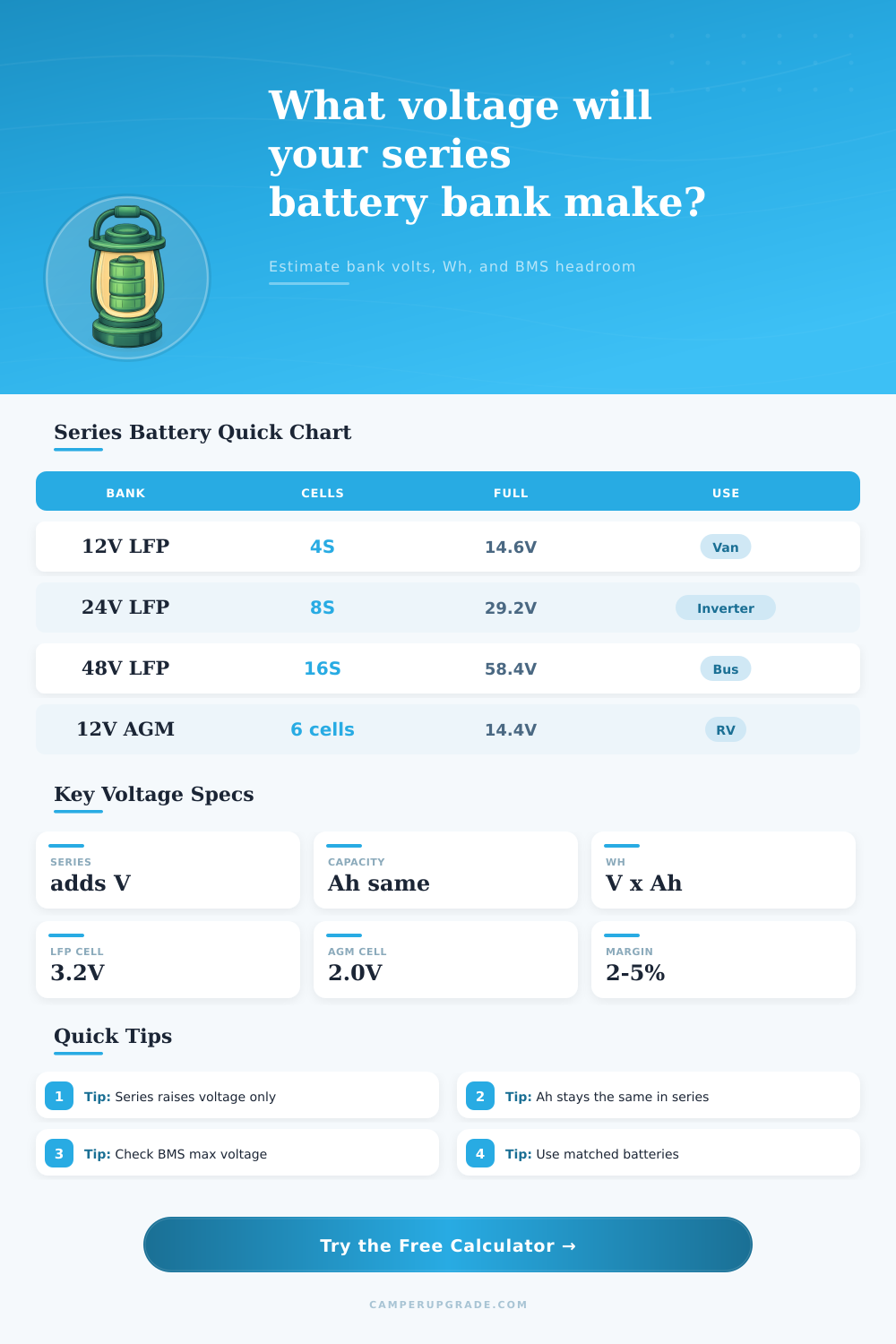
| 1S 12V LiFePO4 battery | One 12.8V 100Ah module | 12.8V | 14.6V from 4 cells at 3.65V |
| 2S 24V LiFePO4 bank | Two 12.8V modules in series | 25.6V | 29.2V from 8 cells at 3.65V |
| 4S 48V LiFePO4 bank | Four 12.8V modules in series | 51.2V | 58.4V from 16 cells at 3.65V |
| 2S 12V golf-cart bank | Two 6V flooded batteries | 12.0V | 14.4V from 6 cells at 2.40V |
| 2S 24V AGM bank | Two 12V AGM batteries | 24.0V | 28.8V from 12 cells at 2.40V |
| 3S 36V lead-acid bank | Three 12V batteries | 36.0V | 43.2V from 18 cells at 2.40V |
| 13S NMC pack | Custom lithium-ion module stack | 48.1V | 54.6V from 13 cells at 4.20V |
| Chemistry | Nominal cell | Full cell | Empty planning cell |
|---|---|---|---|
| LiFePO4 | 3.20V | 3.65V | 2.50V to 2.80V depending on BMS |
| AGM lead acid | 2.00V | 2.35V to 2.45V absorption | 1.75V to 1.85V under load |
| Flooded lead acid | 2.00V | 2.40V to 2.45V absorption | 1.75V to 1.85V planning floor |
| Gel lead acid | 2.00V | 2.30V to 2.38V absorption | 1.80V to 1.90V conservative floor |
| Lithium-ion NMC | 3.60V to 3.70V | 4.20V | 3.00V to 3.20V depending on pack |
| Lithium titanate | 2.30V to 2.40V | 2.70V to 2.80V | 1.80V to 2.00V depending on pack |
| Rule | Formula | Example | Why it matters |
|---|---|---|---|
| Nominal bank voltage | Battery volts x series count | 12.8V x 2 = 25.6V | Sets inverter and DC bus voltage |
| Bank Ah in series | Same as one battery Ah | 2 x 100Ah in series = 100Ah | Series does not add amp-hours |
| Nominal watt-hours | Bank volts x Ah | 25.6V x 100Ah = 2,560Wh | Best simple capacity comparison |
| Full bank voltage | Full cell volts x total cells | 3.65V x 8 = 29.2V | Must fit charger and BMS limits |
| Load current | Watts / bank volts | 800W / 25.6V = 31.3A | Higher voltage lowers current |
| BMS headroom | BMS max - full bank volts | 30.0V - 29.2V = 0.8V | Shows voltage compatibility margin |
| Check | Green range | Caution range | Stop and verify |
|---|---|---|---|
| BMS max voltage vs full bank | BMS max is above full bank plus margin | BMS max only barely clears full bank | Full bank exceeds BMS max |
| Charger profile | Matches chemistry and series voltage | Adjustable charger needs programming | Wrong chemistry profile |
| Series battery matching | Same model, age, Ah, and SOC | Same type with small age difference | Mixed chemistry or capacity |
| Load voltage target | Nominal bank near equipment rating | Within equipment input window | Equipment rating unknown |
| Cell count inference | Nominal voltage matches whole cells | Small rounding difference | Unusual module voltage |
| Load | Typical watts | Current at 12.8V | Current at 25.6V |
|---|---|---|---|
| LED lights and fan | 35W | 2.7A | 1.4A |
| 12V compressor fridge average | 55W | 4.3A | 2.1A |
| CPAP through inverter | 70W | 5.5A before inverter loss | 2.7A before inverter loss |
| Laptop and Starlink | 170W | 13.3A before inverter loss | 6.6A before inverter loss |
| Small microwave running | 1,100W | 85.9A before inverter loss | 43.0A before inverter loss |
| Large inverter burst | 3,000W | 234.4A before inverter loss | 117.2A before inverter loss |
When you decide to create a battery bank for an off-grid property, a van, an RV, or any other vehicle, you must decide whether you will use a twelve-volt system or a higher-voltage system. You can create a higher-voltage system by connecting batteries in series. The voltage you choose between twelve volts and higher voltages will change the amperage of the system, the inverter that will run from the system, and the headroom available to the battery charger and protection systems for the battery bank.
Wiring batteries in series multiplies the voltage of the battery bank, but it does not increase the amp-hour capacity of the battery bank. For instance, if you have two twelve-volt batteries, you can wire them in series by connecting the positive terminal of one battery to the negative terminal of the other battery. With the two twelve-volt batteries wired in series, you will have a twenty-four volt battery bank, but you will have the same amp-hour capacity as that of one twelve-volt battery.
Choose the Right Voltage for Your Battery Bank
Higher voltages allow for lower currents to deliver the same amount of wattage from the battery bank. Using lower currents reduces the amount of copper that is required for wiring, reduces the amount of heat that the system creates, and reduces the voltage drop that occurs in the system. With each device that you plan to connect to the battery bank, you must make sure that each device can accept both the voltage range that the battery bank will create and can handle the voltage of the batteries when they are fully charged.
In addition to the nominal voltage of the batteries that you plan to use in your battery bank, you must also consider the voltage of the real batteries when they are charging or discharging. For example, lithium iron phosphate batteries has a nominal voltage of twelve point eight volts, but they reach a voltage of fourteen point six volts when they are fully charged. If you put two lithium iron phosphate batteries in series, your battery bank will reach a voltage of twenty-nine point two volts when the batteries are fully charged.
The charger that you use with your battery bank must be set to a voltage level that is equal to or higher than the calculated voltage of the battery bank when it is fully charged. This can be calculated with a battery bank voltage calculator. Such a calculator will compare the voltage of the battery bank when it is fully charged to the voltage limit of the battery management system.
By ensuring that the voltage of the battery bank is not higher than the voltage limit of the battery bank, you can avoid damaging the batteries or the battery management system. By using a voltage and amp-hour calculator, you can calculate the total amount of energy in your battery bank in the unit of watt-hours. You can calculate the watt-hours of a battery bank by multiplying the voltage of the battery bank by the amp-hour capacity of that same battery bank.
By increasing the voltage of your battery bank without increasing the amp-hours, you are increasing the total amount of stored energy in the battery bank. Increasing the energy stored in the battery bank is helpful for those with limited space for batteries. Furthermore, it is also helpful when comparing the wattage of your battery bank to the real loads that will be using power from the battery bank.
For instance, an eight-hundred-watt inverter will draw a certain amount of current from a twelve volt battery bank. However, the same inverter will draw half the current from a twenty-five point six volt battery bank. This reduction of current to half the original current will allow you to stay within the continuous charge and discharge current of the battery bank and its battery management system and fuses.
The chemistry of the batteries that you use in your battery bank will also impact the voltage of that battery bank. For instance, lead-acid batteries will have a voltage limit of approximately two point four volts each when they are being charged. In contrast, lithium iron phosphate batteries will have a voltage limit of three point six five volts each when they are being charged.
Furthermore, a battery bank that uses six-volt golf-cart batteries will have a different voltage when fully charged than a battery bank with twelve-volt lithium batteries. In order to calculate the correct voltages for your planned battery bank, you can use a battery bank calculator that allows you to change the chemistry of the batteries that will be used in the battery bank. By allowing you to change the chemistry of the batteries, the calculator will automatically update the voltage of each cell in the battery bank.
By updating these voltages automatically, you can avoid the mistake of thinking that each battery will have the same voltage as another battery in the battery bank that you previously used. In addition to the voltage of the battery bank, you must also provide a safety margin between the voltage of the battery bank when it is fully charged and the voltage limit of the battery management system for the battery bank. A three percent safety margin is commonly used between these two variables.
Without providing a safety margin between the voltage of the battery bank and the voltage limit of the battery management system, voltage issues in the battery bank, such as overheating, could cause the voltage of the battery bank to reach a level that the battery management system will not allow to continue to discharge the batteries. Using a battery bank calculator will provide for you the headroom in the battery managment systems voltage limit so that you can decide for yourself if your settings for the battery charger are realistic. Furthermore, you should also consider the current that the load that will use the power from your battery bank will draw.
Even if you dont plan on sizing the cables for the current draw, you can use the battery bank calculator to calculate the current draw of your load. The calculator will take your calculated voltage of the battery bank and your wattage of the devices that you plan to use to calculate the amps that the devices will draw. You can also calculate the current draw of your devices with your battery bank calculator because a high C-rate for your batteries indicates that high current will be drawn by your batteries, your battery bank, and your fuses.
While your system may allow the batteries to handle the load of the devices that are calculated to run on the battery bank, many systems that work on paper will fail when provided the load that is required of them for more than a few minutes. By calculating each of these numbers before you purchase your batteries, battery bank, battery management system, or any other component of your electrical system, you will have an idea of any incompatibilities between the components that you plan to purchase. A battery bank with a voltage that is close to the voltage of an inverter may work for only a few minutes.
A battery bank that exceeds the voltage limit of the battery management system will not allow the batteries to charge to their full charge, and the system will not function at all when the batteries are at full charge. Each of the inputs and each of the outputs of the battery bank calculator allow you to have a clear picture of the relationship of the battery bank to each component within the battery bank system. This clear picture allows for the group of batteries to become a working power system.