Boil Water Time Altitude Calculator
Estimate water boiling temperature, stove run time, useful heat, and fuel consumed from volume, starting temperature, altitude, burner output, pot efficiency, wind, lid use, and fuel type.
🏔Altitude and Camp Boil Presets
⚙Water, Stove, Pot, Weather, and Fuel Inputs
This calculator estimates heat-up time for liquid water. Disinfection guidance varies by source, water clarity, and altitude, so follow your filter, purifier, or local public-health instructions when water safety matters.
📊Stove, Pot, and Fuel Spec Grid
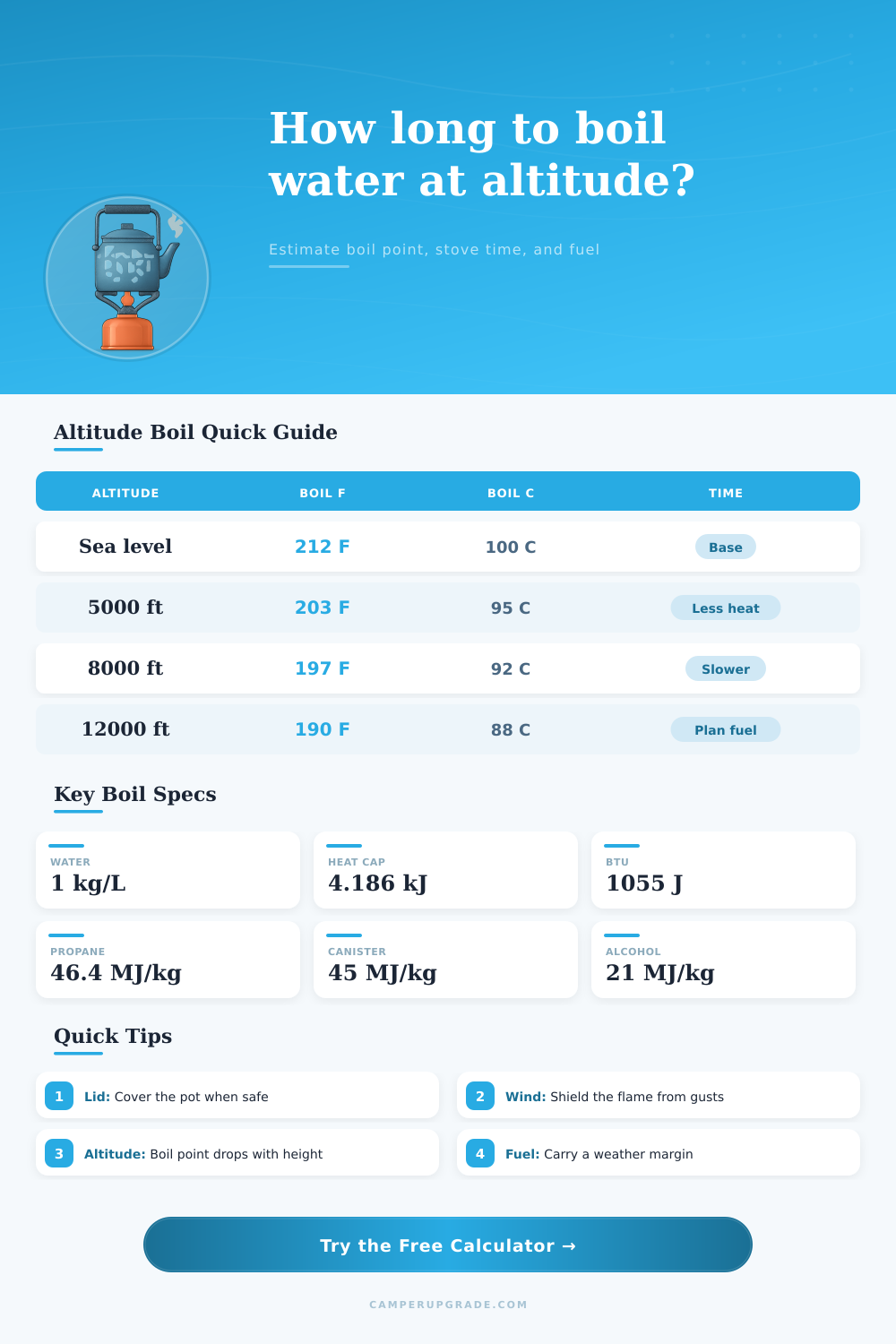
🌡Altitude Boiling Point Table
| Altitude | Approx boiling point | What changes | Planning note |
|---|---|---|---|
| 0 ft / 0 m | 212 F / 100 C | Highest boil temperature | Baseline fuel and time |
| 1000 ft / 305 m | 210 F / 99 C | Small drop | Nearly sea-level behavior |
| 3000 ft / 914 m | 206 F / 97 C | Lower final target | Cold starts still dominate |
| 5000 ft / 1524 m | 203 F / 95 C | Noticeably cooler boil | Common mountain campground |
| 7000 ft / 2134 m | 199 F / 93 C | Food hydrates slower | Protect flame from wind |
| 9000 ft / 2743 m | 195 F / 91 C | Lower cooking heat | Plan longer simmer tasks |
| 11000 ft / 3353 m | 192 F / 89 C | High-country boil | Fuel margin matters |
| 13000 ft / 3962 m | 188 F / 87 C | Very low boil temp | Use efficient pot and lid |
| 15000 ft / 4572 m | 185 F / 85 C | Extreme camp altitude | Expect weather penalties |
⛽Stove and Fuel Reference Tables
| Stove or heat source | Typical output | Practical efficiency | Best use |
|---|---|---|---|
| Small canister stove | 7000-10000 BTU/hr | 35-55% | Solo or two-person pots |
| Heat exchanger canister system | 5000-9000 BTU/hr | 55-72% | Fast water boils in wind |
| Two-burner propane camp stove | 10000-20000 BTU/hr | 35-55% | Large family cookware |
| Alcohol stove | 1000-2500 watts equivalent | 25-45% | Quiet solo boiling |
| RV electric kettle | 1000-1800 watts | 80-90% | Shore power or inverter use |
| Induction hob with pot | 1200-1800 watts | 75-88% | Efficient camper kitchen |
| Fuel type | Energy content used | Calculator output | Notes |
|---|---|---|---|
| Isobutane canister | 45 MJ/kg | grams and ounces | Cold can reduce delivered output |
| Propane | 46.4 MJ/kg | grams and ounces | Strong cold-weather performance |
| White gas | 44 MJ/kg | grams and ounces | Good for long cold trips |
| Alcohol fuel | 21 MJ/kg | grams and ounces | Lower energy density |
| Butane cartridge | 45.7 MJ/kg | grams and ounces | Works best in mild conditions |
| Electric power | 3.6 MJ/kWh | Wh and kWh | Useful for RV battery planning |
💡Boiling Time Tips
Boiling water on a mountain trip is different then boiling water at home due to the change in air pressure that occurs with the climbs. As the air pressure decrease with higher altitudes, the boiling point of the water will also decrease. As a result, the water will not reach as high of temperatures while boiling.
Consequently, the water may be less effectively at performing tasks like cooking food or purifying the water. In order to calculate how much fuel is required to boil the water on a trip, there are several differently inputs that must be made into the calculator. Such inputs include the volume of the water to be boiled, the starting temperature of the water, the altitude of the trip, the details of the stove that youll use, the temperature of the water, whether there will be wind on the trip, and whether the pot will have a lid.
Boiling Water and Fuel on Mountain Trips
Each of these factor will contribute to the calculation of the time, energy, and fuel weight necessary for the trip. Beyond the boiling temperature calculations for the water, another important factor to consider is the length of time that the stove will be lit. At the lower air pressure altitudes common on the mountains, the water will boil at a lower temperature and will reach that boiling state more quick than at sea level.
Because the boiling water will be cooler, however, food that are boiled in that water may require more time to soften than if the same stovetop was used at sea level. An “hold time” feature for the calculator allow for the inclusion of such an extra parameter to the calculations. Furthermore, the length of time that the stove will be lit will impact the fuel calculations for the stove.
The type of fuel that you will use for the stove is another important variable. Each fuel burn differently at different temperatures. For instance, isobutane fuel canisters will work well in cold weather, but will lose pressure in those same condition, resulting in a smaller flame.
Propane burns better in cold temperatures, but is heavier per unit of energy provided. Alcohol stoves are more quiet and have fewer moving part, but the fuel has lower energy density. Each of these fuels can be incorporated into the calculator through the adjustment of the settings for the fuel type.
Wind can also factor into the amount of fuel that the stove will consume. When there is wind, the flame will flicker and some of the heat will escape from the pot. Using a rock or the pack to shield the stove from the wind will reduce the amount of fuel that is burn.
Furthermore, using a wind factor in the fuel calculations will account for the fuel that will be burned due to the wind. Using realistic setting for the wind factor and the efficiency of the stove will provide estimates for fuel consumption that are representative of the actual fuel consumption that will occur on the stove trips. Reference tables list the boiling temperatures of water at various altitudes.
For instance, at altitudes of 7,000 feet, the boiling temperature is approximately 10 degrees less than at sea level. Furthermore, the tables note that the efficiency of open flame stoves tends to be under 55%, meaning that using a lid to the pots will save fuel on the trip. Because the temperature of the water that is boiled will be lower at higher altitudes, more time will be required for the water to reach a boiling point that will kill the majority of the pathogen in the water.
Thus, although the calculator considers the physics of boiling the water, the decision of how long to boil the water is up to the individual on the trip. In order to ensure that there is enough fuel for the trip, calculations should of been made according to the worst case scenarios. For instance, cold water will require more fuel than warm water to reach the boiling temperature.
Furthermore, steady wind will increase the fuel consumption rate of the stove. By running the stove calculation with different scenarios, an individual will have an idea of how much fuel to carry on the trip.