Water Bottle Count Calculator
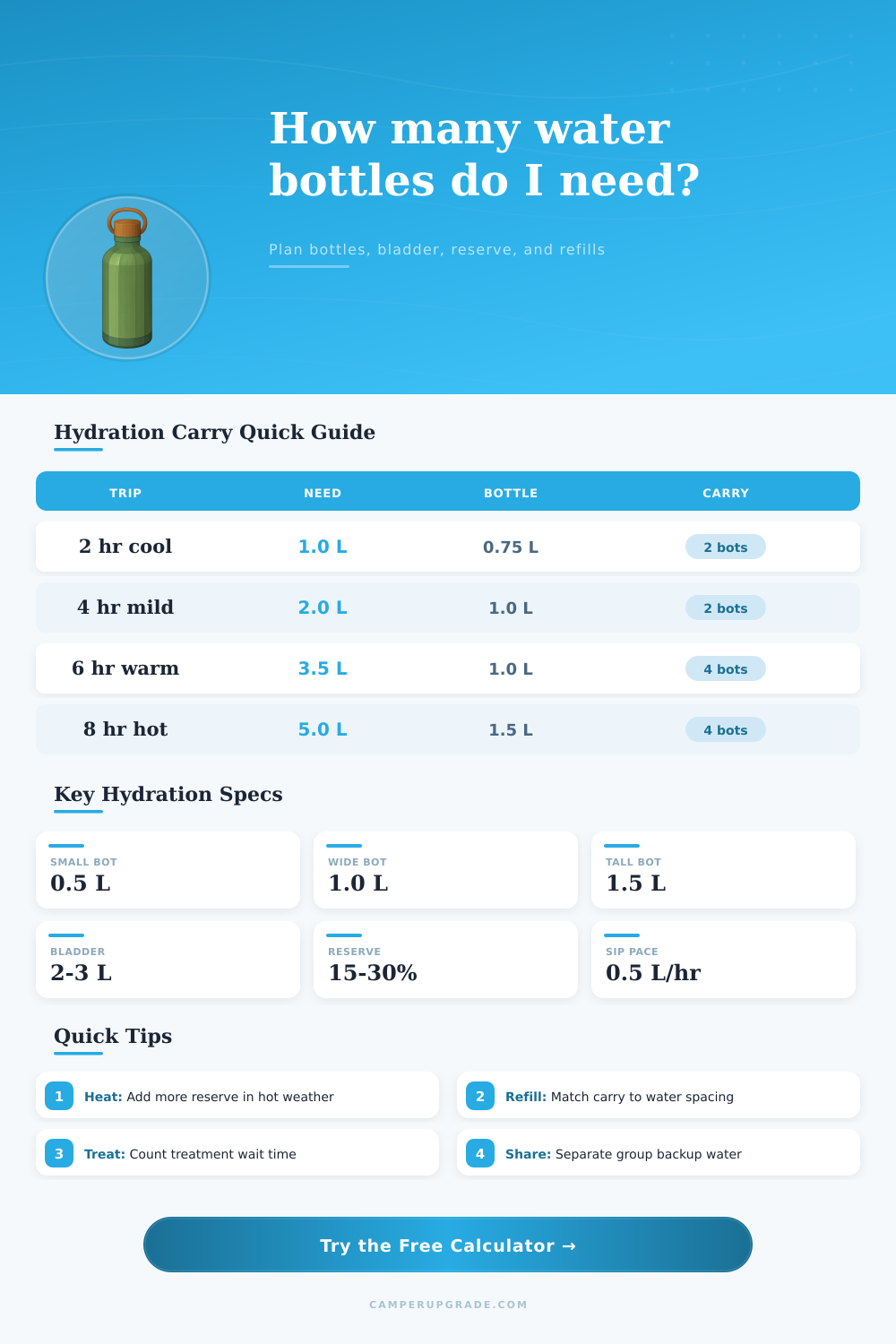
Estimate bottle count, total carried liters, reserve margin, and refill spacing from water need, bottle size, bladder capacity, weather, hike hours, treatment wait time, and shared group water.
🏕Hydration Carry Presets
⚙Water Need, Bottles, Refill, and Reserve Inputs
This calculator estimates carry volume for planning. Adjust for personal sweat rate, altitude, medical needs, route exposure, water source reliability, and current land manager guidance.
💧Hydration Bottle and Bladder Spec Grid
Soft flask
0.5 LEasy front-pocket access for short loops and running vests.
Compact bottle
0.6 LFits small side pockets and kid packs without much bulk.
Trail bottle
0.75 LGood balance for moderate hikes and narrow backpack pockets.
Wide-mouth bottle
1.0 LSimple measuring size for filters, tablets, and daily planning.
Tall bottle
1.5 LFewer containers but heavier when full and harder to pocket.
Collapsible bottle
2.0 LUseful as a refill bag, camp bag, or backup dry-route bottle.
Day bladder
2.0 LHands-free sipping with one bottle kept for mixing or backup.
Large bladder
3.0 LHigh-capacity carry for hot routes with fewer reliable sources.
📊Hydration Reference Tables
| Hike Type | Typical Pace | Reserve | Carry Note |
|---|---|---|---|
| Easy cool walk | 0.3-0.4 L/hr | 10-15% | Small bottle works |
| Moderate day hike | 0.45-0.6 L/hr | 15-25% | Use 1 L bottles |
| Hot exposed trail | 0.7-1.0 L/hr | 25-50% | Add bladder capacity |
| Remote dry route | 0.6-1.0 L/hr | 35-50% | Carry all water |
| Family or pet trip | 0.4-0.8 L/hr | 25-50% | Add group share |
| Bottle Size | 1 L Need | 3 L Need | 5 L Need |
|---|---|---|---|
| 0.5 L | 2 bottles | 6 bottles | 10 bottles |
| 0.75 L | 2 bottles | 4 bottles | 7 bottles |
| 1.0 L | 1 bottle | 3 bottles | 5 bottles |
| 1.5 L | 1 bottle | 2 bottles | 4 bottles |
| 2.0 L | 1 bottle | 2 bottles | 3 bottles |
| Refill Gap | 0.5 L/hr | 0.75 L/hr | Buffer |
|---|---|---|---|
| 1.5 hours | 0.75 L | 1.13 L | 1 bottle |
| 2 hours | 1.00 L | 1.50 L | 1-2 bottles |
| 3 hours | 1.50 L | 2.25 L | 2-3 bottles |
| 4 hours | 2.00 L | 3.00 L | 3-4 bottles |
| No refill | Full trip | Full trip | Add reserve |
| Treatment | Wait | Planning Effect | Carry Tip |
|---|---|---|---|
| Squeeze filter | 0-5 min | Low delay | Drink soon |
| UV pen | 1-5 min | Low delay | Use clear water |
| Chlorine dioxide | 15-30 min | Medium delay | Keep buffer bottle |
| Cold cloudy water | 60-120 min | High delay | Treat early |
| Boiling | Fuel time | Camp use | Not ideal walking |
🧭Quick Planning Specs
When planning a hike, people must determine how much water they should carry. The amount of water that people should carry depend on a variety of factors. The trail that they will take depends on how much water people need.
The time of year that people go on their hike will also impact the amount of water that they should carry. Finally, each person will have a different amount of water that they should carry because some people drinks water very quickly while others take their time drinking their water so that it lasts for the entirety of the hike. People need to determine the amount of water that they will need in order to complete their hike because water is very heavy and people have limited space in their backpack.
How Much Water to Carry on a Hike
Additionally, it can be a problem if they dont have any water left for the dry portion of their hike. In order to calculate the amount of water that they will need for their hike, people can use the water calculator. This water calculator will ask for a variety of different piece of information.
The first of these is the water need, which is the amount of water that you think you will need for your hike. The temperature adjustment will ask people to adjust the amount of water that they will need according to how hot the hike will be. The treatment wait time will ask people how long they will have to wait for their water to be treated so that they can account for that in their total amount of water.
The group share will ask for how much additional water that will be needed for any additional individual who will be on the hike with the calculator user. Within the water calculator, there will be a field for the reserve percentage of the total amount of water that will be needed. People will need this portion of the hike in case they take wrong turns on the trail, if they walk at a slower rate than they typically do when hiking, or if the water sources that are available is smaller than the map indicates for that specific hike.
People might carry too much of this reserve water, which would mean they will be carrying excess weight that they wont be able to use, or they could carry too little so that they will not have enough water for some of these dry portions of their hike. This can be accounted for in the calculator by setting different percentages of reserve water and seeing how that impact the total number of hours that they will take for their hike. Other considerations for how much water that people will carry will be based off the refill spacing for water on their hike.
If the water refill point are every three hours, people can carry less water at the start of the hike since they will be able to refill every three hours. However, if there are gaps between water sources of six hours, people will have to carry more water since there will be longer gaps in which they will have to rely on the water that they are carrying. These scenario can again be compared within the water calculator so that people understand how often they will be needing to refill their water for the hike.
Finally, another consideration will be the size of peoples bladder and the size of the bottle that they use to carry their water. Some people carry bladders that allow them to sip on their water while hiking, however it can be more difficult to refill those bladders. Other bottles have a wide mouth to allow for easier filtering of the water, but may require individuals to stop drinking more often to have enough water.
Most individuals will use both types of product. Here, the water calculator will show how much water that should be carried in bottles if the water bladder capacity is subtracted from the total water requirement for that hike. In the reference tables on the calculator, information is provided regarding a variety of common hiking scenarios.
The tables can provide information on the different hiking variables and how they relate to each other. These tables are not rules that all hiker should follow, but they do provide information on the different variables that were observed during numerous hikes. The water calculator will not account for the way that people might feel on the hike that they are planning.
Factors like the altitude of the hike will impact how much water that people may need to drink. The humidity during the hike will also impact the amount of water that people need to consume. Finally, the amount of food that people eat will also impact the amount of water that they need to consume while hiking.
Thus, while the water calculator provides a good starting point for all hikers for how much water they may need for their hike, adjustments may be required during the hike. The goal is to have enough water to account for any unexpected issue or surprises while hiking but to also carry the minimum amount necessary to keep the weight of the water that they use for hiking to a more reasonable amount.