Hip Belt Size Calculator
Estimate backpack hip belt size, buckle adjustment range, load transfer score, and padding overlap from your hip measurement and pack fit details.
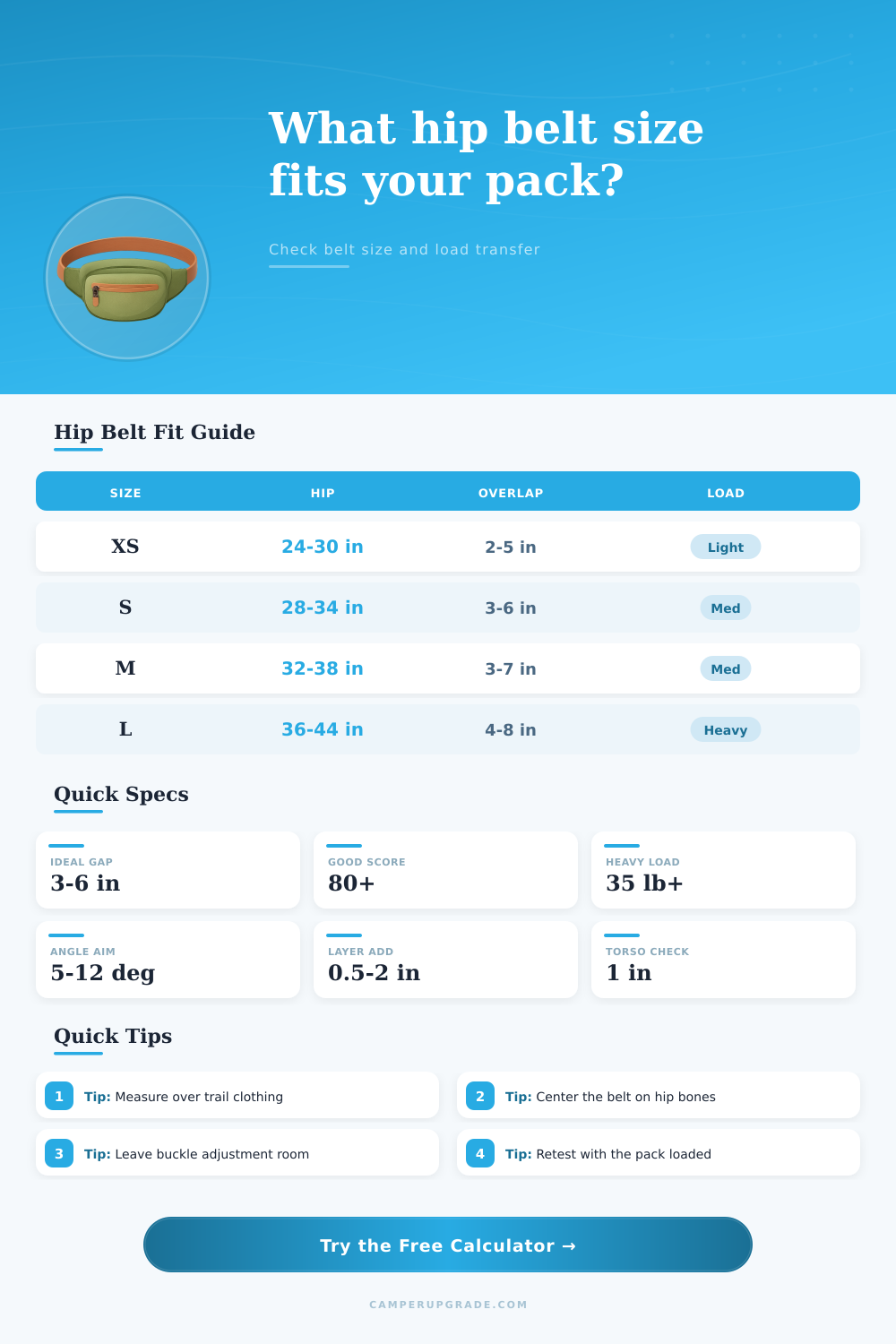
| Belt size | Base hip window | Pad wing feel | Common pack use |
|---|---|---|---|
| XS | 24 to 30 in / 61 to 76 cm | Short wrap, easy to over-tighten on wide pads | Youth packs, smaller adult frames, fast overnight loads |
| S | 28 to 34 in / 71 to 86 cm | Good for narrow hips when buckle travel stays centered | Day-to-weekend packs and smaller backpacking frames |
| M | 32 to 38 in / 81 to 97 cm | Most common adult range with balanced adjustment room | Three-season backpacking and thru-hike style packs |
| L | 36 to 44 in / 91 to 112 cm | Longer wings help heavy loads but can crowd the buckle | Expedition, winter, and high-volume backpacking packs |
| XL | 42 to 52 in / 107 to 132 cm | Maximum wrap with longer webbing and pad coverage | Large frame packs, bulky layers, and very heavy carries |
| Brand style | Calculator effect | Why it matters | Fit cue |
|---|---|---|---|
| True-to-hip sizing | No window shift | Named sizes usually track the printed hip chart | Choose the size that centers your iliac measurement. |
| Compact / shorter padded wings | Allows slightly larger hips in same size | Shorter pads leave more front gap before buckle contact | Useful if normal belts crowd the front buckle. |
| Generous / longer padded wings | Pushes recommendation down sooner | Longer pads can overlap or bottom out on smaller hips | Watch front wing overlap and webbing travel. |
| Interchangeable belt system | Favors centered adjustment | Swappable belts are easier to size by usable middle range | Pick the belt that leaves travel in both directions. |
| Unisex fixed belt | Adds a conservative score penalty | Fixed belts may not match hip angle or torso as cleanly | Confirm in person if you sit near a size edge. |
| Score | Fit status | Likely feel under load | Adjustment priority |
|---|---|---|---|
| 90 to 100 | Excellent starting fit | Hips carry the load with light shoulder pressure | Fine-tune belt angle and shoulder strap tension. |
| 80 to 89 | Good trail fit | Minor pressure points may appear late in the day | Retest with full food and water weight. |
| 65 to 79 | Usable but watch closely | Some shoulder load or front buckle crowding likely | Try adjacent size or adjust torso length first. |
| 50 to 64 | Borderline fit | Load transfer is inconsistent on climbs or descents | Check belt size, frame height, and lumbar placement. |
| Under 50 | Poor fit signal | Pack may slide, pinch, or hang from the shoulders | Do not rely on this belt size for heavy trips. |
| Preset | Hip pattern | Load pattern | What to watch |
|---|---|---|---|
| Weekend small frame | Smaller hip window with light layers | Low to moderate carried weight | Do not over-tighten the belt to chase transfer. |
| Winter layers | Layer allowance pushes the fit larger | Cold-weather kit adds weight and bulk | Check both base layer and insulated-layer settings. |
| Heavy load hauler | Needs centered travel and firm pad contact | High load punishes small sizing errors | Use the score as a trigger for in-person testing. |
| Compact brand cut | Shorter wings create extra front gap | Often comfortable if buckle stays reachable | Make sure pad coverage still reaches the front hips. |
This calculator gives a sizing estimate. Hip shape, lumbar pad shape, frame stiffness, shoulder strap geometry, and manufacturer charts can change the final best belt.
A backpack hip belt are a critical component of a backpack. The fit of a backpack’s hip belt determine how much of the backpack’s weight is transferred to the persons hips. If a person does not position a backpack’s hip belt correctly on there hips, the weight of the backpack will be placed upon the persons shoulders.
This is due to the fact that the backpack hip belt is essential to redistribute the weight of the backpack to the persons hips. The weight of the food and the weight of the water that a person is carrying in the backpack will increase the total weight of the backpack. As a result, a poorly fit backpack hip belt will be more uncomfortably for the person who is carrying the backpack.
How to Fit a Backpack Hip Belt
To determine the correct placement of the backpack hip belt, a person must measure the iliac crest of their body. The iliac crest is the bony ridge that make up the top portion of the hip. A person should place the backpack’s hip belt upon this portion of their body to effectly transfer the weight of the backpack to their hips.
A common mistake that many people make is to measure the waist of the person instead of the iliac crest. The waist is typically lower then the iliac crest. As a result, a person who measure the waist will pick a backpack hip belt that is the incorrect size for that individual.
The number of clothing layer that a person wears will impact both the circumference of the persons hips and the adjustment capability of the backpack hip belt. Those who wear thin base layers will have a smaller circumference of their hips than those who wear fleece layers and shells, for example. This impact the fit of the backpack hip belt for those individuals.
The calculation that must be performed to determine the proper size of a backpack hip belt require several specific input from the wearer of the backpack. These inputs include the circumference of the wearers hips, the number of clothing layers that the person wear, the weight of the load that the person is to carry in the backpack, the length of the torso of the individual, and the angle at which the backpack hip belt is formed. The weight of the load that the person will be carrying is an essential input for determining the size of the backpack hip belt because the additional weight will make errors in the sizing of the hip belt more readily apparent to the individual.
The length of the wearers torso is another of the essential inputs because if the persons torso length does not match the length of the backpack, the backpack hip belt will not effectively take the weight of the backpack off of the persons shoulders. The angle at which the backpack hip belt is form is an essential input for the same reasons as the length of the persons torso. If the angle of the backpack hip belt is too flat, the hip belt may slide down the persons hips.
If the angle is too steep, the backpack may place additional pressure upon the front buckle of the backpack hip belt. The adjustment range of a backpack hip belt is another specification that a person should consider when purchasing their backpack. The adjustment range of the backpack hip belt is the amount of space that remains on the webbing of the backpack hip belt after the individual has tighten the backpack.
If the individual picks a backpack hip belt whose webbing is at the end of its adjustment range when the backpack is empty of food, then the backpack hip belt will not be able to be tightened once the food has been added to the backpack. Additionally, if the individual adds or removes clothing layers while they are traveling, it is possible that the padded wing of the backpack hip belt will either crowd each other or leave too much space at the backpacks front buckle. In these instances, the backpack hip belt will not effectively cup the persons hips when they are walk.
Despite the number of specifications related to backpack hip belt size and fit, many individuals still make mistakes when purchasing a backpack hip belt. One reason that many individuals make mistakes is because they treat the backpack hip belt as a minor component of the backpack. For instance, they may use a size chart to determine the size of the backpack hip belt, but they do not consider the shape of their hips.
Another reason that individuals may make mistakes with the size of their backpack hip belt is because they measure their hips once, but they do not consider the change in circumference of their hips once they begin to load their backpack with food. Additionally, the manufacturers of backpacks use different sizing standard for their backpacks. A medium-sized backpack hip belt from one manufacturer may not fit the same as a medium-sized backpack hip belt from another manufacturer.
To determine the proper fit of a backpack hip belt, individuals should put the backpack on and load it with the same amount of weight that they will be carrying. They should then walk around with the backpack to determine the performance of the hip belt. If the backpack hip belt is creeping up the persons hips, or if the backpack hip belt pinches at the front of the persons backpack, then the fit of the backpack hip belt is incorrect.
In these cases, the individual will have to select a different size for their backpack hip belt. If the fit of the backpack hip belt is correct, it will remain centered upon the persons hips when the individual is walking. A backpack hip belt that remains correctly centered upon a persons hips will allow a person to keep their shoulders light when they are walking.