Pack Weight Percentage Calculator
Compare total backpack weight against body weight, target load, terrain, fitness, trip days, and the daily drop from food, water, and fuel.
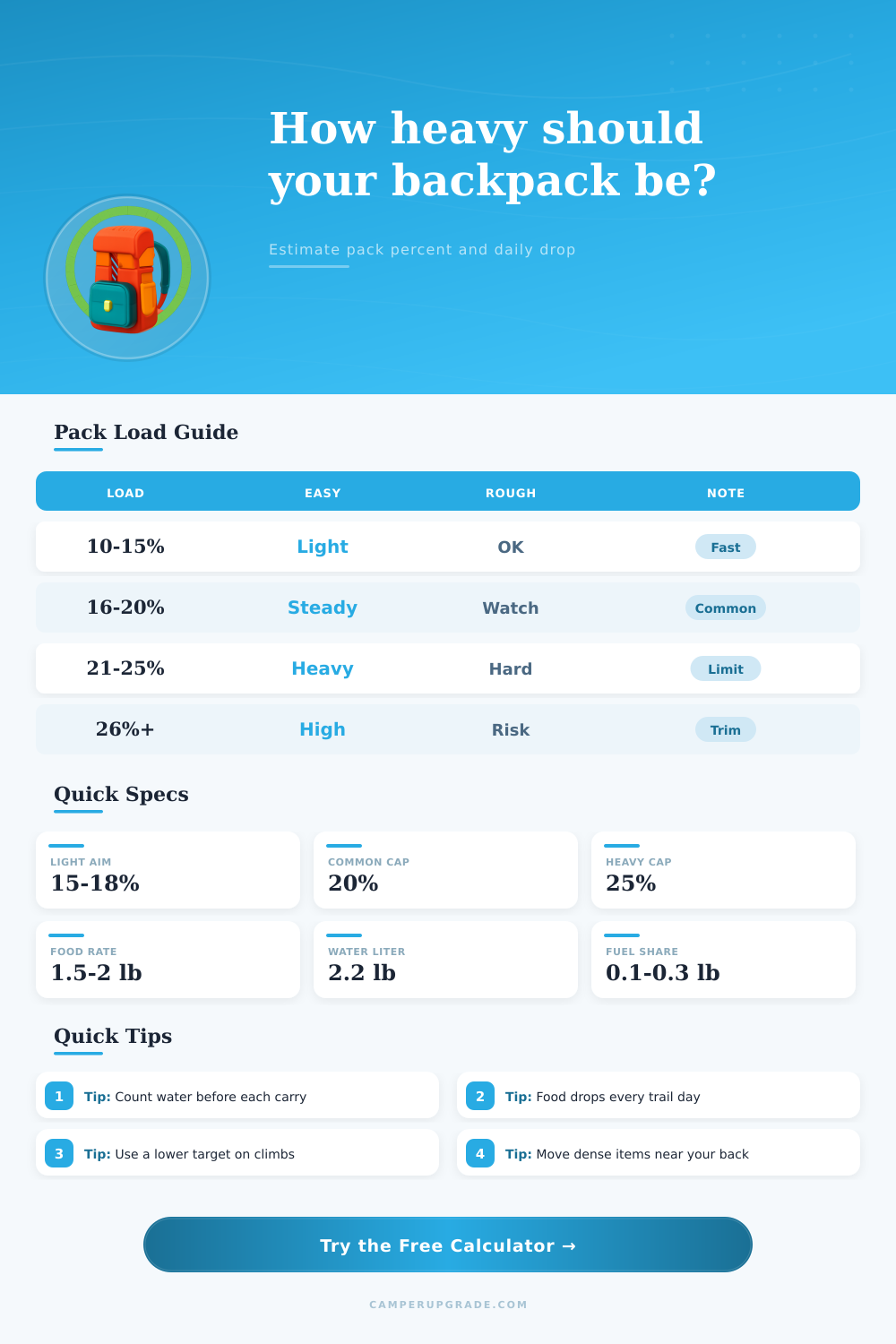
| Loaded pack percentage | General load feel | Best use case | Planning note |
|---|---|---|---|
| Under 10% | Very light daypack or fast overnight | Short routes, warm weather, reliable water | Comfortable, but verify safety margin and weather layers. |
| 10% to 15% | Light backpacking load | Experienced lightweight setups and short food carries | Often works well when sleep, shelter, and clothing are dialed in. |
| 16% to 20% | Moderate load | Typical three-season backpacking with normal consumables | A practical target for many hikers on maintained trails. |
| 21% to 25% | Heavy load | Cold weather, bear canisters, long dry stretches, shared gear | Use deliberate pacing and check shoulder, hip, and foot comfort. |
| Over 25% | Very heavy load | Specialized trips, winter loads, expedition-style carries | Recheck nonessential gear and consider shorter food or water carries. |
| Item | Common planning rate | Weight conversion | Calculator use |
|---|---|---|---|
| Food | 1.5 to 2.2 lb per person per day | 0.68 to 1.00 kg per day | Enter the total start food load, then divide by trip days. |
| Water | 1 to 4 liters carried between sources | 2.2 lb per liter | Enter the heaviest expected water carry for the section. |
| Canister fuel | 0.1 to 0.3 lb per day, group dependent | 0.05 to 0.14 kg per day | Enter the fuel contents or practical share at trip start. |
| Extra gear | Trip-specific added load | Convert all add-ons to the active unit | Use for bear canister, camera kit, snow tools, or group items. |
| Adjustment | Multiplier | Why it matters | Example effect |
|---|---|---|---|
| Smooth trail | 0.92 terrain factor | Lower grade and better tread usually tolerate a normal target. | A 20% target is treated close to 21.7% practical capacity. |
| Moderate trail | 1.00 terrain factor | Baseline for maintained backpacking routes. | A 20% target stays 20% before fitness adjustment. |
| Steep or rough tread | 1.08 terrain factor | Climbs, steps, and rough footing make the same load feel heavier. | A 20% target behaves more like an 18.5% cap. |
| Off-trail or snow | 1.15 to 1.22 terrain factor | Balance, footing, and energy cost usually call for a lower pack target. | Trim weight or shorten food and water carries when possible. |
| Preset | Starting load | Likely driver | Good target check |
|---|---|---|---|
| Ultralight weekend | Low to moderate | Low base weight and short food carry | Usually under 15% for many adult hikers. |
| Desert water carry | Moderate to high | Several liters of water at once | Use the heaviest water segment, not the average day. |
| Cold overnight | Moderate to high | Warmer sleep kit, layers, and stove fuel | Check the recommended max after terrain adjustment. |
| Long food carry | High at start, dropping daily | Food weight dominates the first half | Daily drop helps show how quickly the load improves. |
This calculator is a planning tool. Trail conditions, footwear, pack fit, injury history, altitude, and weather can make the same percentage feel easier or harder.
Calculating an pack weight percentage is a method that helps to determine whether or not the weight of a persons pack is appropriate for that individual. The percentage are calculated as the ratio of the weight of the pack to the weight of the individual that is carrying that pack. If the percentage is too high, the individual will experience more strain with they movement with a lower pace.
If the percentage is too low, the individual may not have enough supply. Thus, calculating the percentage allow an individual to plan their trip accordingly. To calculate the percentage correct, an individual must understand the difference between the base weight of the pack and the consumables that is contained within the pack.
How to Calculate Your Pack Weight Percentage
Base weight is the weight of the items that are contained within the pack for the entire of the trip. Base weight includes items like sleeping system, sleeping bags, clothing, cooking equipment, and shelter systems. Consumables are items that will be used up during the trip, such as food, water, and fuel.
The weight of the pack will decrease throughout the trip due to the consumption of these items. Thus, the weight of the pack when initially leaving for the trip will be higher then the average weight of that same pack during the trip. The terrain and fitness of the individual will change how an individual feel the percentage of their pack weight.
For instance, an individual that has high fitness level will be able to hike with more weight than an individual with lower fitness levels. Additionally, an individual that hike on even terrain will hike with a higher percentage of their pack than if they were to hike on rocky terrain. These two factor must be accounted for within the calculation of percentage of an individuals pack weight.
Another factor that can be calculated is the daily consumable drop. Consumables such as food and fuel will dissapear at a steady rate from the pack. Additionally, water are a consumable that will be refilled throughout the trip.
By calculating the daily drop of consumables, an individual can determine that the weight of their pack will decrease throughout the trip. Thus, a high daily consumable drop may permit for individuals to have a more higher starting pack percentage than they would of have otherwise. There are some common mistake that may occur during the calculation of an individual’s pack percentage.
One of the most common is to assume that a percentage of 20%, for example, will feel the same in all conditions and situation. The fitness of the individual and the terrain that must be travelled will change how an individual feels that percentage. Another common mistake is to input the average amount of water that an individual will need into their calculations instead of the heaviest amount.
The heaviest amount of water represent the most difficult portion of the hike with the individuals pack. Thus, reflecting the percentage of the most difficult portion of the hike will provide the most accurately calculation of how much that individual’s pack should weigh. In addition to the factors discussed above, the fit of the pack and the individuals footwear will change how that percentage feel.
For instance, if an individual well adjusts a pack, it will move the weight of the pack to the individuals hips, which is the easiest manner for the individual to carry that weight. Additionally, if an individual has supportive footwear it will allow for them to maintain their stability, which will permit for them to more easyy carry the weight of their pack. Though these factors are not accounted for in the calculation of the percentage, they will still impact an individuals experience with their hiking trip.
An individual should calculate their percentage of their pack weight prior to each hiking trip. The fitness of individuals, the terrain that will be traversed, and the amount of food and water that they will need to consume will change from trip to trip. By calculating the starting weight of the pack, the adjusted target percentage, and the daily consumable drop it is possible for the individual to determine whether or not the weight of their pack is appropriate for the trip that they are to take.
Thus, the calculation of an individual’s percentage allow them to match the weight of their pack with the conditions of the hike.