Mattress R Value Calculator
Estimate sleeping pad insulation from foam thickness, foam type, air gap, reflective layers, stacked pads, ground temperature, sleeper warmth, compression, and moisture loss.
Mattress insulation estimate
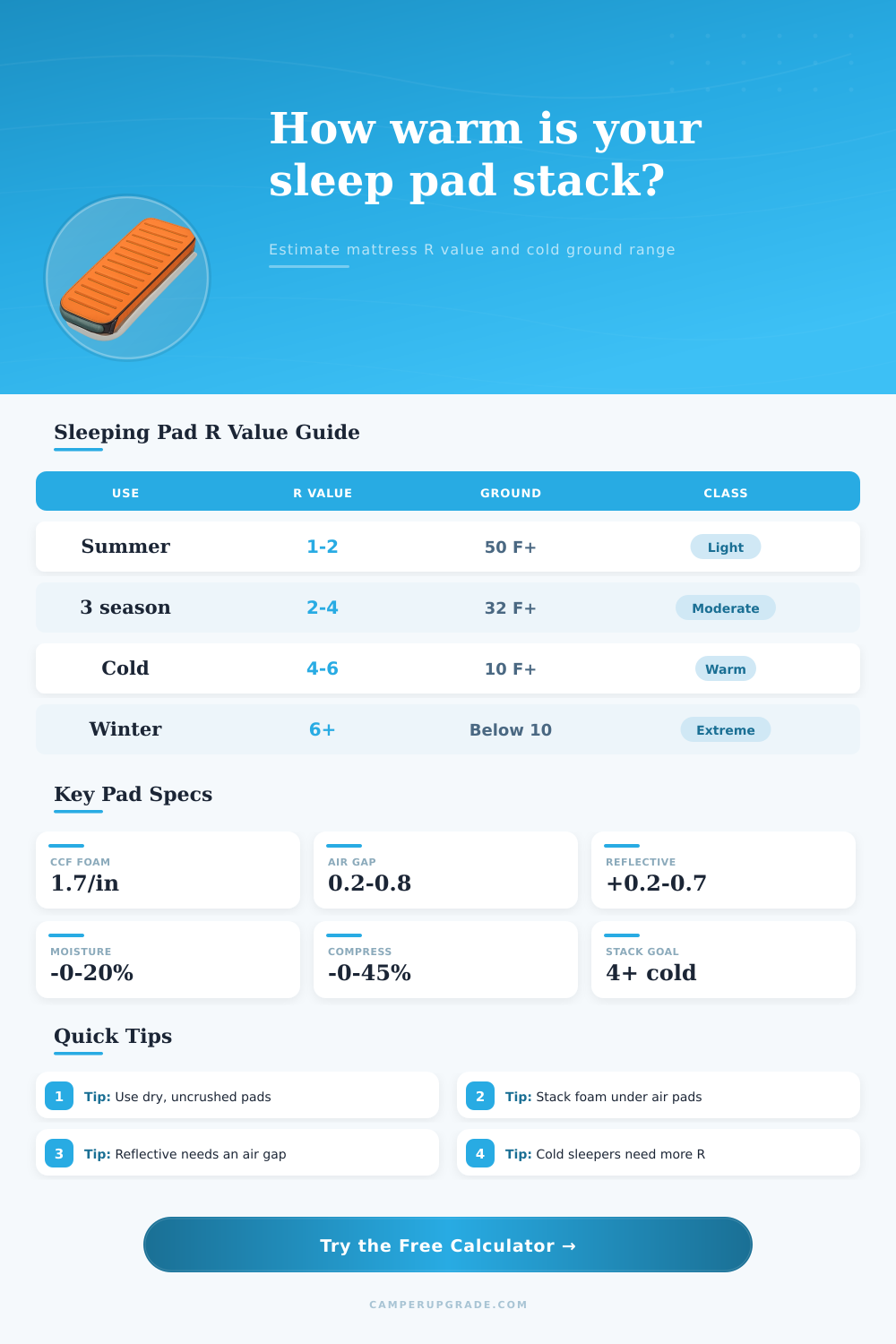
| Pad R value | Warmth class | Typical ground range | Best use |
|---|---|---|---|
| Below 1.5 | Minimal | Above 55°F | Warm cabins, mild summer, backup foam |
| 1.5 to 2.5 | Light | 45°F to 55°F | Summer camping and warm truck beds |
| 2.5 to 4.0 | Three-season | 32°F to 45°F | Most shoulder-season camping |
| 4.0 to 6.0 | Cold weather | 10°F to 32°F | Frost, early winter, cold sleepers |
| 6.0 and up | Winter | Below 10°F | Snow camping and deep cold ground |
| Material | Estimated R per inch | Compression behavior | Moisture behavior |
|---|---|---|---|
| Blue polyethylene foam | 1.1 to 1.4 | Moderate crush under hips | Closed cells resist water |
| EVA closed-cell foam | 1.5 to 1.9 | Good support for thin pads | Low water uptake |
| IXPE cross-linked foam | 1.7 to 2.1 | Good rebound for folding mats | Low water uptake |
| Open-cell upholstery foam | 0.7 to 1.0 | Crushes easily under load | Loses warmth when damp |
| Memory foam topper | 0.8 to 1.2 | Softens and compresses | Can hold condensation |
| Self-inflating foam core | 1.8 to 2.4 | Air plus foam support | Fabric moisture matters |
| Layer detail | Typical R contribution | Needs | Calculator note |
|---|---|---|---|
| Reflective film touching fabric | 0.05 to 0.15 | Little air space | Use the poor reflective setting |
| Single reflective face | 0.20 to 0.45 | Still air beside foil | Works best in baffled pads |
| Double reflective baffles | 0.40 to 0.70 | Multiple still gaps | Useful in cold inflatable pads |
| Thin still air gap | 0.15 to 0.45 | Low drafts | Small gaps outperform loose gaps |
| Drafty cot gap | 0.05 to 0.20 | Wind blocking | Add foam below or block airflow |
| Condition | Suggested derate | Why it matters | Practical input |
|---|---|---|---|
| Dry pad on dry tent floor | 0% to 5% | Near ideal field use | Moisture 0 to 5% |
| Condensation under pad | 5% to 12% | Fabric and foam conduct more heat | Moisture 8 to 12% |
| Damp ground or wet shell | 12% to 20% | Water bridges insulation gaps | Moisture 15 to 20% |
| Heavy hip compression | 20% to 35% | Foam thickness is reduced | Compression 25%+ |
| Foam under air pad | Additive stack | Protects air pad from cold base | Add rated R in stack field |
An R value are a number that describes the resistances of a material to heat flow. An R value is used to measure the insulating property of a material in terms of how well it will slows the loss of heat from the body. Even if you feel the comfort of the soft mattress you use daily, this doesnt mean that the mattress is warm for you.
Warmth is determined by how well the layers between your body and the ground prevents the heat from your body from leaving your body. Understanding these components is essential to help you make the best choices for your sleeping setup. An insulation material’s R value will increase with the resistance of that material to the flow of heat.
R Value and Sleeping Pad Warmth
The resistance of a material to the flow of heat is important because the ground will typically be colder than the human body. Closed cell foams will exhibit resistance to heat flow due to the tiny sealed pockets within the foam that resist both moisture and compression. Open cell foams may not be as effective at maintaining its rated resistance to heat flow as closed cell foams because open cell foams are susceptible to both moisture and compression.
Air trapped within a still gap will exhibit resistance to heat flow, but only if the air remain in that still position. A reflective layer can exhibit resistance to heat flow if the reflective layer face a small pocket of unmoving air. If the reflective layer is pressed against the sleeping fabric, however, it will no longer provide that benefit to the sleeping individual.
This calculator allow you to enter the thickness of your sleeping materials, the type of foam, the details of any gap, the reflective quality of any reflective materials, any pads you plan to stack, the ground temperature, and your preference for level of warmth to determine the total R value of your sleeping setup. Compression of sleeping pads can reduce their effectiveness. When an individual lie on a sleeping pad, the weight of the individuals hips and shoulders will compress the sleeping pad, making it thinner.
Memory foam sleeping pads will lose some of their insulating properties due to the fact that memory foam loses some of its thickness when a load is placed upon it. Moisture will also reduce the R value of sleeping materials. If moisture finds its way into a sleeping pad, water, which conduct heat more readily than air, will replace the air within the sleeping pad.
Condensation under a sleeping pad or wearing damp clothing on top of a sleeping pad will reduce the effectiveness of the insulation provided by the pad. Fields on the calculator will allow you to enter the derating of the pad due to moisture content and compression of the sleeping pad. These fields will have a more greater impact on the total R value of the sleeping setup than the type of sleeping foam used.
It is common for individuals to opt for sleeping pads of different types and to place them on top of each other to create a total insulation value higher than the individual sleeping pads. Placing a thin closed cell sleeping pad on the ground and an inflatable sleeping pad on top of the closed cell sleeping pad will allow the individual to benefit from the resistance of both sleeping pads to heat flow. The sleeping pads will have to remain flat and dry for this type of insulation benefit to be present.
Similar principles of insulation can be applied to cots or truck beds that may reach higher temperatures than the air surrounding the sleeping individual. The calculator allow for the individual to enter the R values of the sleeping pads that they plan to use and to make moisture adjustments to those values. Ground temperature will have a more greater impact on the body than air temperature due to the ability of the ground to absorb the bodys warmth.
A sleeping individual on a surface that is near 32 degrees Fahrenheit will lose warmth to the ground at a higher rate than an individual sleeping on a surface at a similar temperature to the air temperature. An individual who feel cold more frequently than the average sleeping individual will likely need to use sleeping pads with a higher R value to maintain comfort at the same ground temperatures. The calculator will account for these different sleepers by allowing the individual to set the warmth preference for the sleeper.
The reference tables provided on this calculator will provide context for the target R values. These tables will demonstrate the target R values for different ground temperatures and seasonal sleep uses. These tables will allow the individual to determine whether the R value calculated for their sleeping setup is appropriate for the environment in which they will sleep.
The tables also provide the R values for different types of sleeping foam and reflective materials. These reference tables will not replace the sleep test that an individual may perform with their sleeping pad, but they will assist the sleeping individual in making choices about their sleeping pad purchases. Forming the habit of calculating the difference between the total R value of the sleeping setup and the target R value for that particular ground temperature will allow the sleeping individual to understand whether they will experience cold spots on their body.
Having a positive margin between the total R value and the target R value means that the sleeping individual will likely sleep without experiencing cold spots. A larger margin means that the sleeping individual will have extra insulation for unexpected moisture on the sleeping individual or sleeping setup. If the margin is not positive, then the individual should refer to the minimum ground temperature recommendations to understand at what rate the ground will become too cold for the sleeping individual to maintain comfort.
This habit will allow the sleeping individual to avoid purchasing an insufficient sleeping setup for the sleeping conditions that they will experience. Thinking in terms of R values for sleeping setups will allow you to transform your feelings of coldness caused by your sleeping environment into a decision about what sleeping setup will provide the most comfort for you. You can use the R value to determine whether you need to add another sleeping layer, adjust the air gap within your sleeping setup, or find a spot that is drier than your current sleeping spot.
Using the R value for sleeping setups for your decisions will make this thought process automatic and ensure that you will never have to guess at whether your sleeping setup will provide you with the warmth that you require to enjoy your sleep.