Cot Weight Limit Calculator
Estimate adjusted load, remaining capacity, per-leg load, and safety factor from body weight, gear, movement, frame material, leg footprint, fabric tension, and safety margin.
🏕Cot Presets
⚙Weight, Frame, Fabric, and Footprint Inputs
This calculator is a planning check, not a certification test. Follow the official cot rating and stop using any cot with cracked, bent, or unstable parts.
🛏Cot Frame and Spec Grid
📊Reference Tables
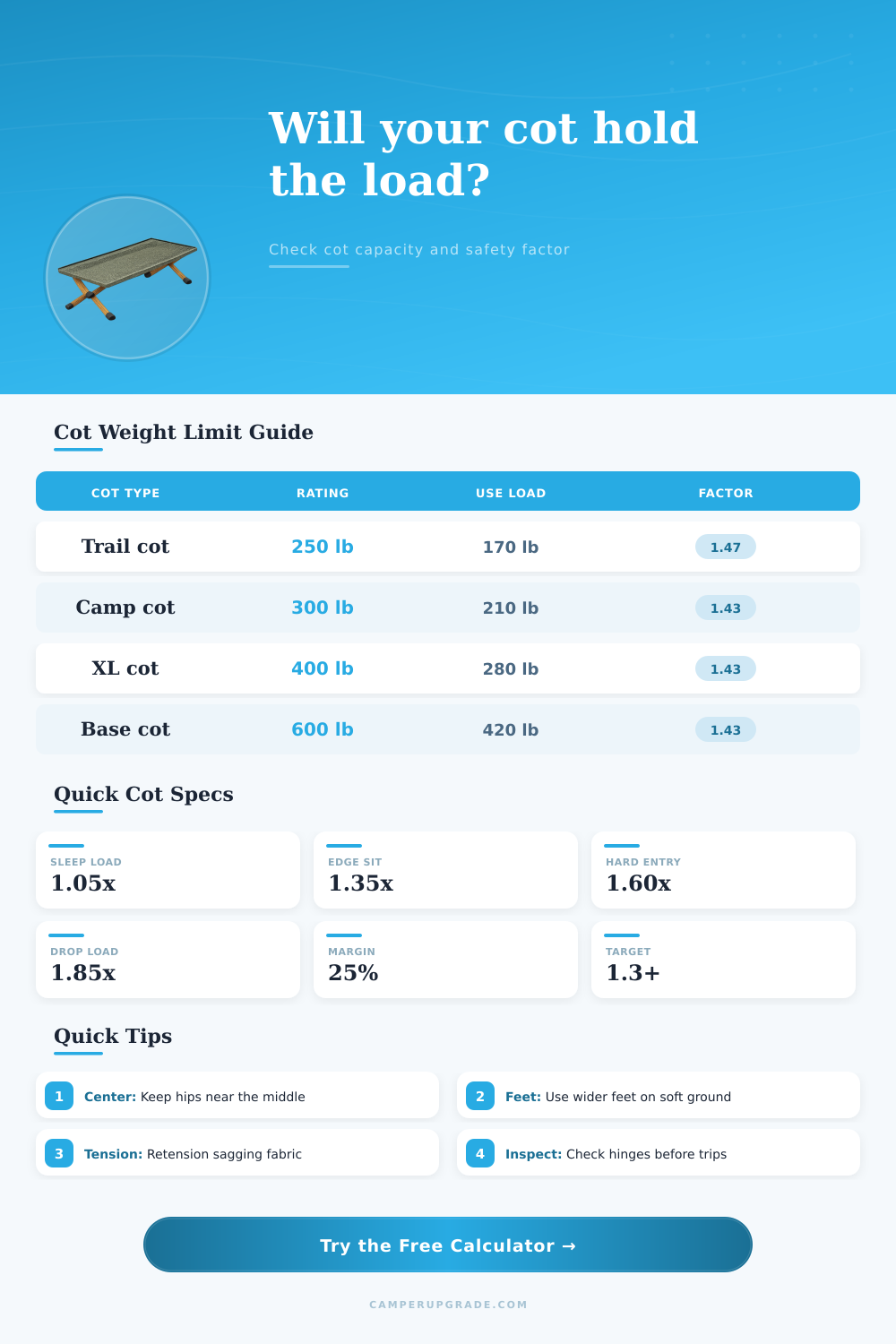
| Cot class | Typical rating | 25% usable | Common use |
|---|---|---|---|
| Backpacking cot | 220-275 lb | 165-206 lb | Low gear load |
| Standard camp cot | 280-325 lb | 210-244 lb | Car camping |
| Wide XL cot | 350-450 lb | 263-338 lb | Tall sleepers |
| Heavy-duty cot | 500-600 lb | 375-450 lb | Base camp |
| Movement | Factor | 200 lb base | Best use |
|---|---|---|---|
| Still sleeping | 1.05x | 210 lb | Quiet rest |
| Turning at night | 1.20x | 240 lb | Normal sleep |
| Edge sitting | 1.35x | 270 lb | Boot change |
| Small drop | 1.85x | 370 lb | Hard landing |
| Frame material | Modifier | Watch point | Typical role |
|---|---|---|---|
| Aluminum tube | 0.96x | Dents | Packable |
| Steel tube | 1.00x | Rust | Car camp |
| Aircraft aluminum | 1.03x | Joints | Premium |
| Plastic hinge | 0.88x | Cracks | Light use |
| Footprint | 50 lb foot | 75 lb foot | Ground note |
|---|---|---|---|
| 3 sq in | 16.7 psi | 25.0 psi | Can sink |
| 6 sq in | 8.3 psi | 12.5 psi | Common foot |
| 12 sq in | 4.2 psi | 6.3 psi | Wide cap |
| 24 sq in | 2.1 psi | 3.1 psi | Soft ground |
💡Cot Limit Tips
Choosing an camp cot for a weekend or for a week at base camp involve more than considering how comfortable the cot is. A person must consider if the cot will remain solid with others moving on it. Others can move during the night while sleeping, dogs can jump on the cot, and the person might need to sit on the edge of the cot to put on boot.
The weight ratings on the box of the cot tell a person about the weight the cot can hold. However, the weight ratings does not account for the movement that can happen on the cot. Therefore, the weight ratings do not accurately reflect the capacity of the cot.
How to Check if a Camp Cot Is Safe
The stability of the cot will depend on how the load are distributed on the cot. A person will not remain still on a cot while sleeping. A person will shift the body weight of the sleeping person towards one rail of the cot.
This shifting of body weight will increase the load on the legs and the seam of the cot. If the fabric of the cot has loosened due to sleeping, the load will be placed into those weakened seam. Additionally, if the cot has a smaller foot on each end, the cot will sink into the ground when the sleeping person shifts weight while sleeping.
The combination of all of these factors will work against the stability of a cot while sleeping on it. A calculator allow a person to adjust the weight rating of a cot for these specific factor. A person can input the numbers of each of these factor into the calculator.
The calculator will take the weight rating of the cot and adjust the number to allow the person to know the capacity of the cot. Additionally, the safety factor will show how much of a buffer there is for the sleeping person on the cot. A safety factor of 1.3 or higher indicates that the cot will allow for a comfortable buffer for sleeping.
However, a safety factor that is less than 1.3 indicate that the cot may reach its limit while sleeping with the sleeping person adding any extra gear. The material of the frame of the cot and the number of legs that the cot has will impact its stability. Most cots has steel tubes for their frame; they are durable but heavy.
Aluminum tubes are lighter but dent more easily. Any dent in the frame may become a place where the weight of the sleeping person create stress on that area. Most cots have six legs but when sleeping on an incline or declinate the cot will only have four or five effective leg.
The calculator accounts for this by reducing the number of effective legs if the sleeping person is not sleeping on level ground. The size of the footprint that each leg of the cot has will impact the sleeping person’s comfort. A narrow foot will sink into soft sand or damp grass.
If any part of the cot sink into the ground, the cot may tilt while sleeping. If the cot begins to tilt while sleeping, the sleeping person’s weight may not be evenly distribute on the cot. The solution to this problem is to use wider caps or plywood squares on the cot.
Using these will keep the sleeping persons cot level. The calculator will show the differences in pressure caused by each foot size of the cot so a person does not have to calculate this value themselves. Many people do not account for the gear that will be on the cot.
The sleeping person will have to sleep on the cot with a sleeping bag, sleeping pad, and a duffel bag. Additionally, the sleeping person will need to sit on the edge of the cot while wearing boot. These factors will add to the load on the cot but are not accounted for in the weight of the cot.
The sleeping person should account for these extra piece of gear and determine if the cot will have a sufficient safety factor. If the safety factor is too low for the sleeping person with their gear, they should opt for a sturdier cot. The conditions of the ground that the cot will sleep on will change how the cot distribute the sleeping person’s weight.
A sleeping person on a level tent floor will allow each leg of the cot to perform the same amount of work. If sleeping on rocky ground or sloped ground, the sleeping person will place more of the sleeping person’s weight on one side of the cot than the other. The calculator allow the person to adjust for these difference in ground conditions.
The impact of ground conditions is small when sleeping on firm soil but large on soft ground or ground that is on an incline. The fabric tension on the cot will impact how stable the sleeping person is on the cot. If the tension on the cot’s fabric is low, the sleeping person’s body weight will sag on the cot.
The sleeping person can retighten the fabric of the cot before sleeping. By retightening the cot’s fabric, the tension multiplier will be lowered in the calculator. Additionally, the sleeping person will ensure that the safety factor does not decrease over time due to the loosened fabric.
A person wants to know if the cot will be able to support the sleeping person comfortably before they leave home. The best way to do this is to calculate each of the variables of the cots support within the calculator. By determining the safe sleeping limit of the cot, a person can rest assured that they will not have to repack their vehicle after spending a night on a sagging cot.