Tent Ridge Pole Length Calculator
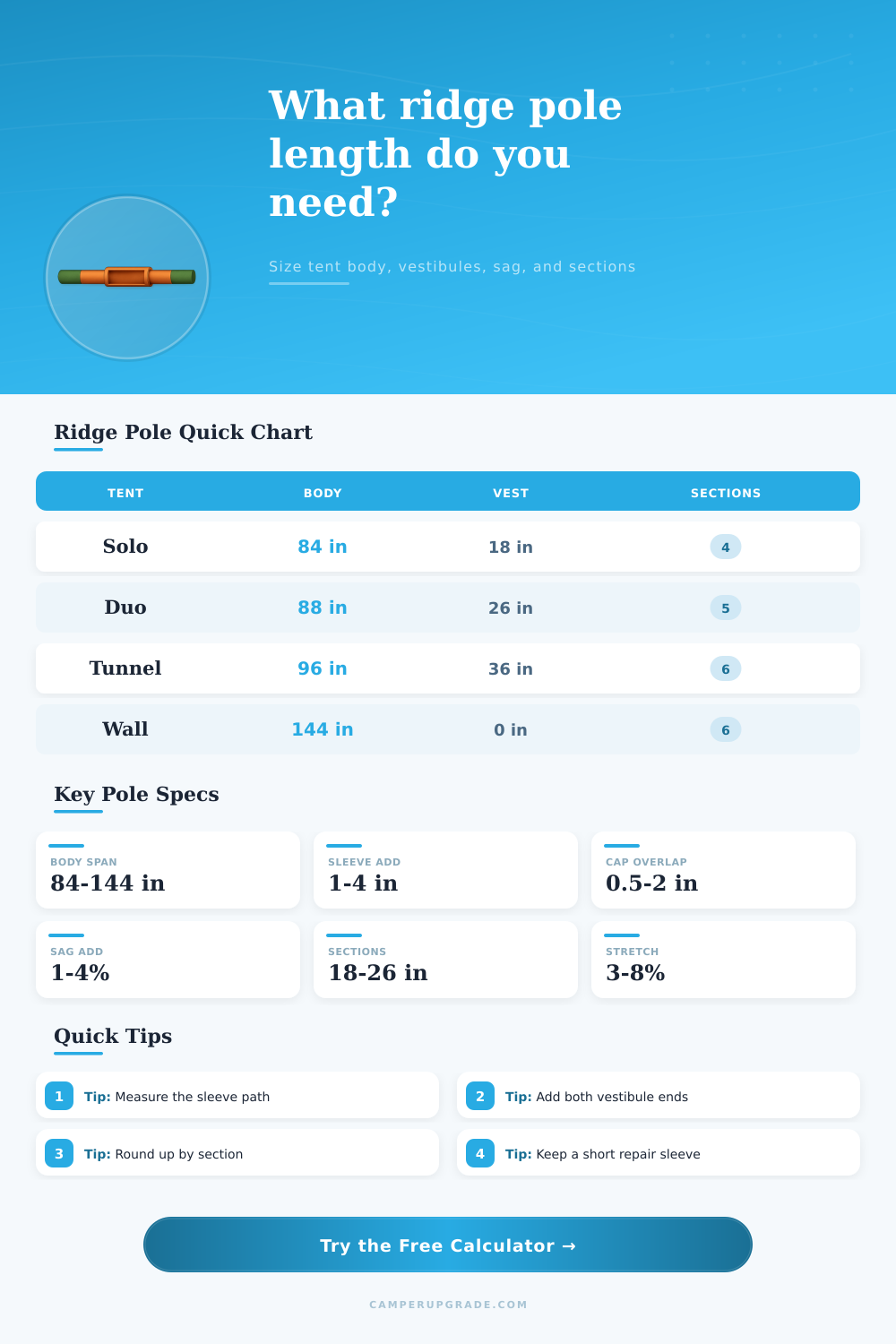
Estimate ridge pole length, sag-adjusted length, pole section count, and spare margin from tent body length, vestibule extensions, sleeve allowance, end cap overlap, shock cord stretch, and ridge or arch style.
Ridge pole length estimate
| Arch / ridge style | Path factor | Use case | Measuring note |
|---|---|---|---|
| Straight A-frame ridge | 1.000x | Classic ridge pole and tarp ridge | Measure end pocket to end pocket |
| Canvas wall tent rigid ridge | 1.000x | Wall tents with metal or wood ridge | Use hub or angle fitting centerline |
| Catenary tarp ridgeline | 1.010x | Slightly curved tarp ridge seam | Add only a light path allowance |
| Soft arched ridge | 1.018x | Dome ridge sleeves with a mild bow | Measure along the sleeve if possible |
| Tunnel tent ridge curve | 1.040x | Tunnel tents and long arched sleeves | Curve increases pole path length |
| High hoop or bow ridge | 1.075x | Tall hoop, bow, or steep arch supports | Use a cord trace for best accuracy |
| Section style | Typical section | Best use | Pack note |
|---|---|---|---|
| Short backpacking segment | 14-16 in | Small packs and bikepacking | More ferrules, easier packing |
| Standard backpacking segment | 17-21 in | Most tent pole repair kits | Balanced pack length and count |
| Long backpack segment | 22-24 in | Larger shelters and fewer joints | Check pack or pannier fit |
| Car-camping segment | 25-30 in | Cabin tents and wall tents | Fewer sections, longer pole bag |
| Rigid ridge rail | 36-48 in | Canvas wall tent roof frames | Often travels in a frame bag |
| Allowance item | Typical value | What it covers | Use in calculator |
|---|---|---|---|
| Sleeve allowance | 1-2 in | Fabric thickness and sleeve wrinkles | Small tents and simple ridges |
| Large sleeve allowance | 3-5 in | Long sleeves, hubs, or rough measuring | Family tents and older canvas |
| End cap overlap | 0.5-1.0 in each | Tips seated into grommets or pockets | Most shock-corded tent poles |
| Deep pocket overlap | 1.5-2.5 in each | Long vinyl, canvas, or pin pockets | Use when the pole disappears into a sleeve |
| Shock cord stretch | 3-8% | Internal tension reserve | Check cord slack, not tube length |
| Tent setup | Body plus vestibules | Style | Common section plan |
|---|---|---|---|
| Solo A-frame shelter | 84-96 in | Straight ridge | 5 sections at 18-20 in |
| Two-person dome ridge | 104-120 in | Soft arch | 6 sections at 18-21 in |
| Backpacking tunnel | 120-140 in | Tunnel curve | 7 sections at 18-21 in |
| Family cabin tent | 132-168 in | Straight or soft arch | 6-8 sections at 21-26 in |
| Canvas wall tent ridge | 120-180 in | Rigid ridge | 3-6 long frame sections |
| Extended vestibule tent | 135-170 in | Curved tunnel | 7-9 sections at 19-22 in |
A ridge pole helps to maintaining the shape of the tent. The length of the ridge pole will determine whether the tent will remain taut or if the tent fabric will sag. If the ridge pole is too short, it will collapse under a load of the tent.
However, if the ridge pole are too long, you will need to force the ridge pole sections together or to trim the ridge pole sections. The length of the ridge pole that should be chosen is one that takes into consideration the total path that the ridge pole will travel through the tent. The total path of the ridge pole begins with the length of the tent body.
How to Measure Ridge Pole Length for a Tent
However, you must also take the length of the vestibule extensions into consideration. If the tent have a front vestibule extension, you must add the length of that extension to the total path. If the tent has a rear vestibule extension, you must also take the length of that extension into consideration.
The total length of the tent and vestibule extensions will determine the length that the ridge pole will need to travel in a straight lines through the tent. However, the path of the ridge pole may be more complicated then the length of the tent. The ridge pole may encounter fabric bunching within the tents sleeves or pockets.
Additionally, the end caps and ferrules for the ridge pole will take up some of the length of the ridge pole. Finally, if the tent has a curved ridge pole style, the ridge pole will have to travel a longer distance than the floor measurements indicate. In addition to these factors, the length of the ridge pole must also include a sag allowance.
The allowance accounts for the way that the tent fabric may stretch out when it gets wet. Both wind and condensation will pull on the tent. Additionally, the ridge pole will need to account for the compression of the shock cord that is included within the ridge pole.
If you dont include the allowance in the length of the ridge pole, the ridge pole may fit the tent when it is first set up. However, after the tent fabric has settled, the ridge pole will no longer fit within the tent. The section count for the ridge pole will depend upon the length of the ridge pole.
Each section of the ridge pole will have a certain distance between its ferrule seats. The number of ridge pole sections will have to account for the total length of the ridge pole that will be create including the sag allowance. By rounding up the number of ridge pole sections that will be required, there will be a spare margin of extra inches for the ridge pole to fit comfortabley within the tent pockets.
A large spare margin of extra inches means that there will be more ridge pole than is required to fit the tent. However, a small spare margin means that the length of the ridge pole may create a ridge pole that is too short for the tent. Some of the mistakes that can be made when determining the length of the ridge pole are by only measuring the length of the floor shadow of the tent.
An individual could measure the length of the tent by placing a cord within the sleeve of the tent. The length of the ridge pole can also be calculated without considering the length of the vestibule extensions or the end-cap overlap for the ridge pole. If the length of the vestibule extensions is forgotten in the calculation of the length of the ridge pole, the ridge pole will be too short to fit within the tent.
Additionally, if the length of the end caps for the ridge pole is forgotten, the ridge pole will also be too short to effectively seat within the tents grommets. Outside of the tent itself, there are additional factors that will have an impact upon the length of the ridge pole. For example, if you use the tent in cold weather, the shock cord will be stiffly.
Additionally, the load that will be placed upon the tent may be heavier than the load that is typically placed upon moddern silnylon fabrics. After repeated wet setups, the tent fabric may have developed a permanent stretch. The length of each section of the ridge pole can also be influenced by the size of the individuals pack.
If shorter sections of the ridge pole are used, they will be easier to pack into smaller individual packs. However, the longer the sections of the ridge pole are, the more the ridge pole may feel more stiffer when entering into the tent. As discussed, in order to properly calculate the length of the ridge pole for a tent, there is a specific sequence that should be followed.
You should measure the length of the tent body, add the length of the vestibule extensions to the length of the tent body, add the length of the sleeve and end caps to the total length of the tent body and vestibule extensions, and finally, add the sag allowance to the tent length that has already been calculated. Following this specific sequence will ensure that the ridge pole will not only fit into the tent when it is first set up, but that the ridge pole will continue to fit the tent after the tent fabric has settled and stretched. You should of checked this twice.