Teepee Pole Length Calculator
Estimate teepee pole cut length from ground diameter, wall lift, cone pitch, pole overlap above the crossing, ground embedment, smoke hole offset, pole count, lash height, and safety buffer.
Teepee pole length estimate
| Finished diameter | Radius | Typical pole count | Common use |
|---|---|---|---|
| 6 ft | 3 ft | 7-9 poles | Children, display, or gear shade teepee |
| 8 ft | 4 ft | 9-11 poles | Backyard shelter or compact camp teepee |
| 10 ft | 5 ft | 11-13 poles | Small camp shelter with modest floor space |
| 12 ft | 6 ft | 13-15 poles | Family camp teepee or light hot tent layout |
| 14 ft | 7 ft | 15-17 poles | Hunting camp, cooking shelter, or group sleep space |
| 16 ft | 8 ft | 17-19 poles | Lodge-style teepee with stronger wind posture |
| 18 ft | 9 ft | 19-21 poles | Group camp with more standing room |
| 20 ft | 10 ft | 21-23 poles | Large event, base camp, or teaching shelter |
| Cone pitch | Cone rise on 6 ft radius | Visual shape | Planning note |
|---|---|---|---|
| 1.20 | 7.2 ft | Lower, wider cone | May need more footprint clearance and more smoke-hole care |
| 1.35 | 8.1 ft | Moderate camp cone | Good starting point for compact teepees |
| 1.45 | 8.7 ft | Balanced teepee cone | Common all-around planning ratio |
| 1.55 | 9.3 ft | Taller lodge cone | Raises pole angle and may improve headroom |
| 1.70 | 10.2 ft | Steep cone | Check pole stiffness, cover fit, and top overlap |
| Allowance item | Typical range | Adds to pole length? | Use when |
|---|---|---|---|
| Pole overlap above crossing | 1-3 ft | Yes | You want visible tips and trim room above the lash point |
| Ground embedment or foot trim | 0-1 ft | Yes | Ends sink into soil, sit in pockets, or need final trimming |
| Smoke hole offset | 0-2 ft | Geometry only | Crossing is intentionally shifted away from the footprint center |
| Safety buffer | 3-10% | Yes | You will trim after test pitching or use rough natural poles |
| Door/lift pole extra | 0-2 ft | Optional | Separate smoke flap or door poles are cut longer than cover poles |
| Diameter | Pitch | Lash height | Example cut length with allowances |
|---|---|---|---|
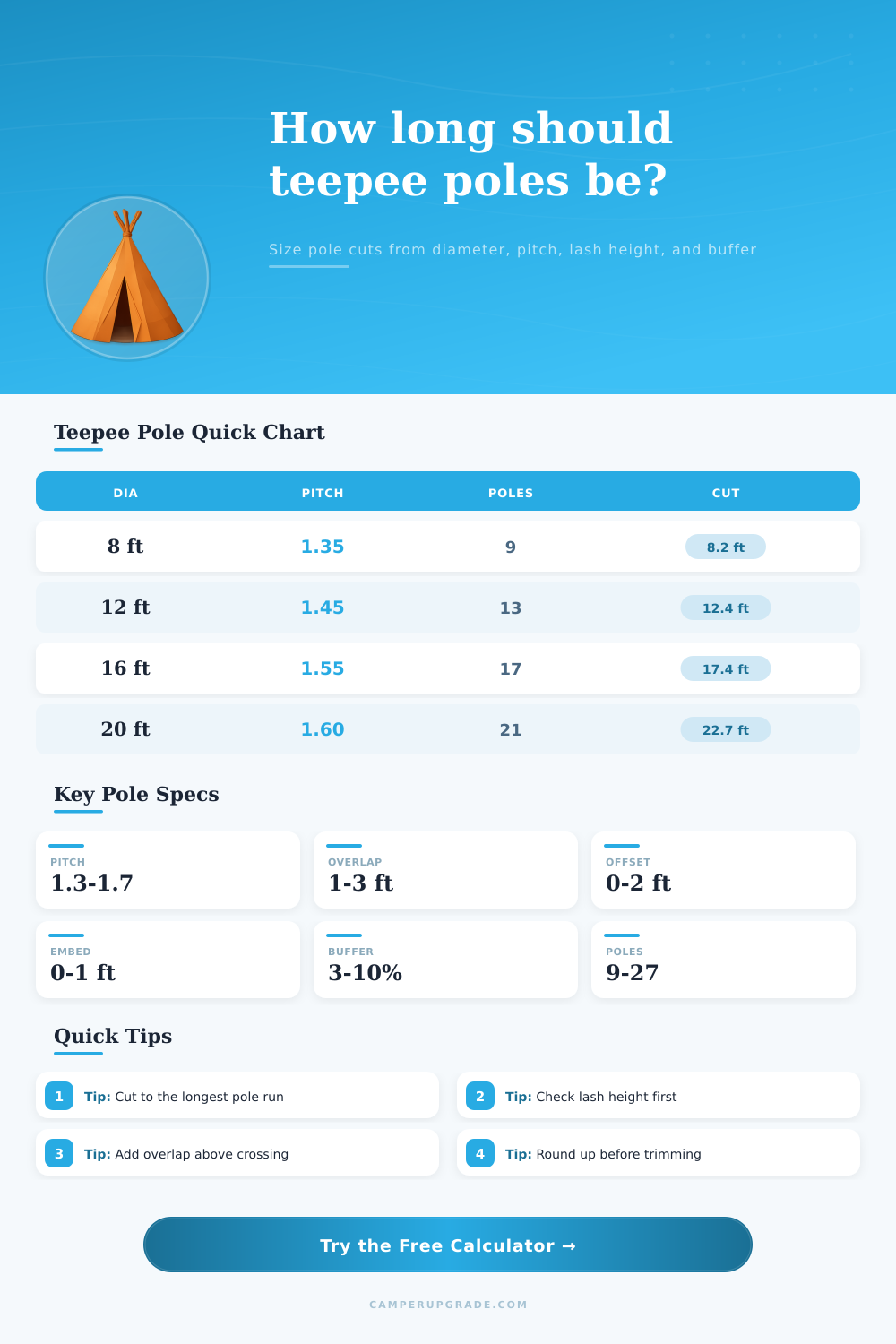
| 8 ft | 1.35 | 5.6 ft | About 8.2 ft with 1.2 ft overlap, 0.3 ft offset, and 5% buffer |
| 10 ft | 1.40 | 7.0 ft | About 10.3 ft with 1.6 ft overlap, 0.5 ft offset, and 5% buffer |
| 12 ft | 1.45 | 9.2 ft | About 12.4 ft with 2.0 ft overlap, 0.7 ft offset, and 6% buffer |
| 16 ft | 1.55 | 12.8 ft | About 17.4 ft with 2.6 ft overlap, 1.1 ft offset, and 7% buffer |
| 20 ft | 1.60 | 16.5 ft | About 22.7 ft with 3.0 ft overlap, 1.5 ft offset, and 8% buffer |
To build a teepee that will function proper, the length of the poles must be calculated correctly. The length of the poles should not be the height of the teepee, as the poles will travel at an angle to the ground. Additionally, the poles must extend into the ground, and the poles need to extend beyond the point where they will be lashed together to allow for trimming.
Using the wrong length for the poles will require cutting new poles while building the teepee, which will make the project less efficient. The first decision that a builder will make in building a teepee is the diameter of the finished floor circle. Small diameters, such as six feet, are appropriate for children or providing shade for those who sits in the teepee.
How to Measure Teepee Pole Length
Larger diameters, such as twelve or sixteen feet, provides more standing room for families. The builder will use the radius of the circle to calculate the length of the poles; multiplying the radius by the pitch will provide the height of the cone from the lash point to the ground line. The pitch, or the steepness of the roof of the teepee, will be considered when setting this value.
A pitch of approximately 1.45 is often considered to be balance by those who build teepees. Steeper pitches will result in the poles standing more upright, which is appropriate for those who intend to stand in the teepee, but the poles will be more difficult to lash to the cover. Flatter pitches are easier to construct with the poles, but provide less headroom for those who enter the teepee.
The poles will not meet at the center of the teepee. One decision that is made is the offset of the poles. It is common to offset the crossing point of the poles towards the location of the smoke hole.
This will make the poles that extend from the smoke hole shorter than the rest of the poles. It is necessary to cut all poles to the longest measurement; if any of the poles are not cut to this length, there is a chance that they will split or warp while constructing the teepee. In calculating the length of the poles, it is necessary to account for how much of the poles will overlap.
Overlap is the length of the poles that extend beyond the point at which the poles are lashed together. This extra length allows the poles to be repositioned when setting up the teepee, as well as to allow for trimming of the poles. An additional consideration is embedment, the amount of length of the poles that will extend below the ground line.
This is for allowing the poles to settle into the ground or to sit in shallow holes in the ground. Both of these measurements should be accounted for before adding a percentage to provide for errors in measuring the length of the poles. The height of the poles as they are lashed together is not to be confused with the height of the cone of the teepee.
Setting the height too low to the ground will cause the cover to hang too low. If the height is set above the calculated lash height for the teepee, the poles will stand more upright and may require extra staking to the cover. The number of poles used in the construction of a teepee will range from small numbers of nine or eleven poles for a small shelter, to seventeen to twenty-one poles for a larger lodge structure.
Using more poles will provide better stability of the teepee against the wind. Additionally, the even spacing of the feet of the poles will be even only if all of the poles are cut to the same length. In addition to the variables calculated by a person constructing a teepee, the poles themselves may have additional variables that will impact the structure of the teepee.
Natural poles, such as lodgepole pine or spruce trees, can naturally have a diameter that tapers along the length of the pole. Additionally, the poles may be bowed; curved along the length of the structure. The poles will be rough-barked, which provides some stability for the poles to remain in place within the structure.
However, it is difficult to slide the poles in case adjustment to the structure is required. The poles will be green wood; they will shrink over time as they dry. Therefore, poles that fit perfectly into place on the first day of constructing the teepee may become loose after a week.
Due to these variables in the poles, it is common for individuals to cut extra poles for those that may split or warp during the first year of use of the teepee. The ground upon which the teepee will be constructed will have an impact upon the length of the poles that are constructed. If the soil is rocky, the poles may not be able to sink into the ground.
Soft sand or forest duft allows for the poles to settle into the ground several inches. If the teepee will be moved frequently, there will be less embedment of the poles into the ground. Permanent camps may allow for the poles to be embedded in the ground to support the structure.
The construction of a teepee will follow a specific order in its building. First, the builder will measure and mark the diameter of the teepee into the ground. Second, the pitch for the structure will be decided.
Third, the lash height will be established. Fourth, the overlap length, embedment length, and a safety buffer will be added to the height calculation to arrive at the target length of the poles. Fifth, the builder will cut the poles to the target length.
Finally, once the poles are pitched into the ground and the cover is attached to the poles, the structure should be observed. Any trimming of poles will occur after this initial pitching of the poles into place. If the poles are too short while constructing the teepee, they cannot be lengthened.
However, if the poles are too long, they can be trimmed after pitching the poles into the ground. Thus, providing a safety buffer to the length of the poles and cutting all poles to the longest measurement will ensure that the teepee will be constructed properly and perform its intended function.