Fifth Wheel Garage Clearance Calculator
Check whether a fifth wheel fits a garage by comparing trailer length, rooftop AC height, door height, garage depth, approach slope, pin box projection, backing angle, door width, and safety buffer.
Fifth wheel garage clearance estimate
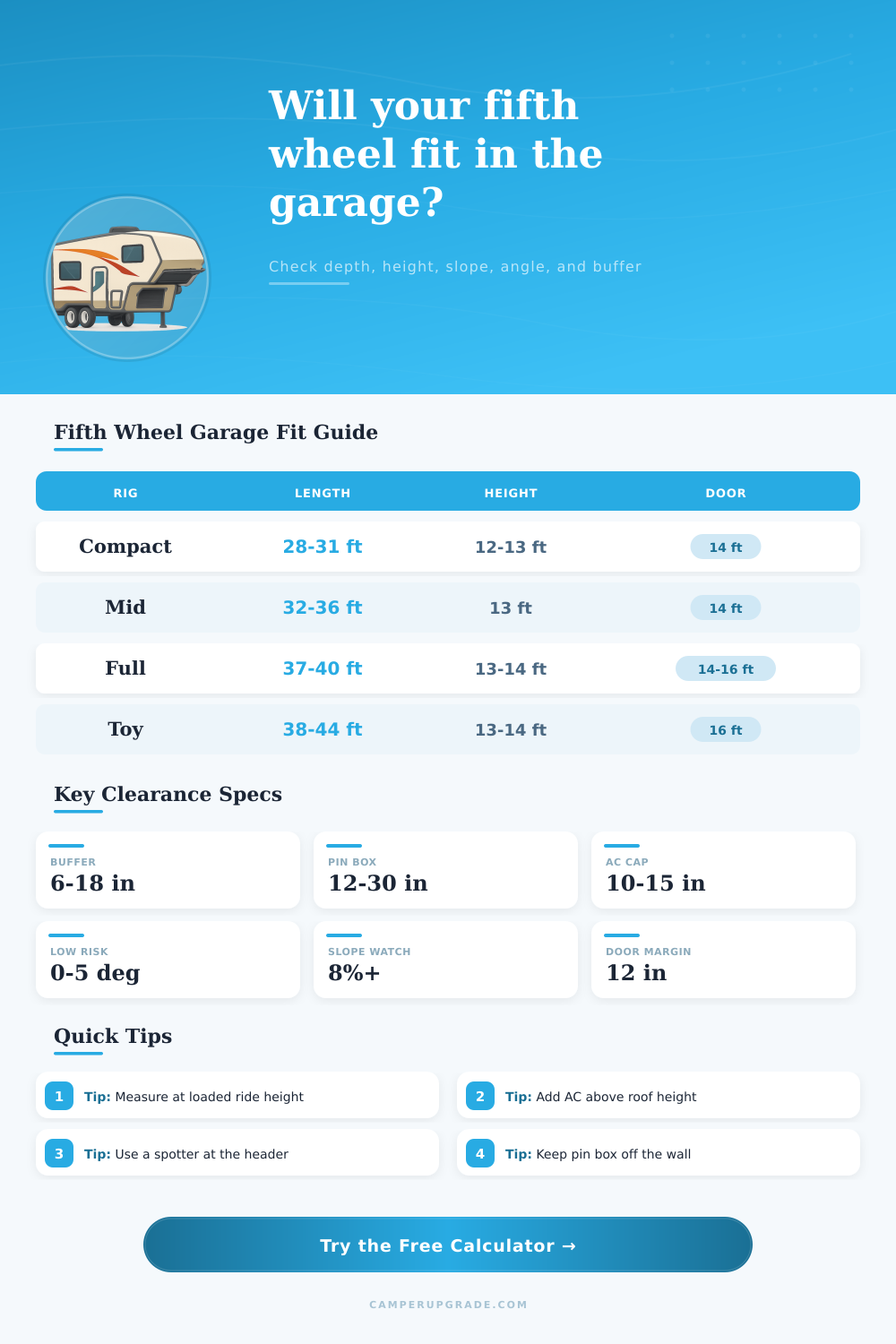
| Fifth wheel type | Length band | Height planning band | Garage planning note |
|---|---|---|---|
| Compact couples fifth wheel | 27-31 ft | 12.0-12.9 ft plus AC if separate | Can fit some 32-34 ft deep RV bays with a modest pin box buffer |
| Mid-profile fifth wheel | 31-35 ft | 12.5-13.3 ft plus rooftop gear | Usually needs a 14 ft clear door and 36-39 ft usable depth |
| Bunkhouse fifth wheel | 34-38 ft | 13.0-13.6 ft plus accessories | Check the rear ladder, AC, and garage depth before assuming model length is enough |
| Full-profile luxury fifth wheel | 36-41 ft | 13.3-13.8 ft plus rooftop gear | Often needs a 16 ft door or very accurate height confirmation |
| Toy hauler fifth wheel | 38-44 ft | 13.2-13.8 ft plus AC and vents | Garage depth and straight approach usually become the limiting factors |
| Wide-body fifth wheel | 39-44 ft | 13.4-14.0 ft plus accessories | Door width and backing angle matter as much as depth when entering the bay |
| Garage feature | Measure this point | Calculator input | Clearance guidance |
|---|---|---|---|
| Door height | Lowest clear opening under trim, seal, track, or opener arm | Garage door height | Use the smallest measured height, not the nominal door size |
| Inside depth | Door plane to usable back wall or stop point | Garage depth | Subtract cabinets, workbenches, door hardware, and tire stops |
| Door width | Narrowest clear width between jambs or trim | Garage door clear width | Angled backing can use several extra inches of opening width |
| Front wall space | Wall to where the pin box or nose projection can safely stop | Pin box clearance | Use more clearance if the front cap curves close to a shelf or wall |
| Approach transition | Driveway grade near the door threshold | Approach slope | Uphill approaches can raise the roofline at the header during entry |
| Measurement tolerance | Difference between tape measurement and real backing movement | Safety buffer | Use at least 6 in, and 12 in or more for tall or tight rigs |
| Condition | Low risk | Watch range | High-risk signal |
|---|---|---|---|
| Backing angle at doorway | 0-5 degrees | 6-12 degrees | More than 12 degrees or no spotter view |
| Door width margin | 24 in or more after buffer | 12-24 in after buffer | Under 12 in or negative margin |
| Approach slope | 0-4% | 5-8% | More than 8% near the threshold |
| Height margin | 12 in or more | 4-12 in | Under 4 in after AC and slope allowance |
| Depth margin | 24 in or more | 6-24 in | Under 6 in after pin box and buffer |
| Trailer length | Pin box space | Backing angle | Approx. required depth |
|---|---|---|---|
| 30 ft compact fifth wheel | 18 in | 0 degrees | 32.5 ft usable garage depth |
| 34 ft mid-profile fifth wheel | 20 in | 5 degrees | 37.0 ft usable garage depth |
| 36 ft bunkhouse fifth wheel | 24 in | 8 degrees | 39.6 ft usable garage depth |
| 40 ft luxury fifth wheel | 24 in | 8 degrees | 43.6 ft usable garage depth |
| 42 ft toy hauler fifth wheel | 30 in | 10 degrees | 46.2 ft usable garage depth |
Fitting a fifth wheel trailer into a garage requires precise measurement because a fifth wheel trailer have many different dimensions. Some people might think it is a simple task to fit a fifth wheel trailer into a garage. However, it is often more complicated due to the fact that the truck has to be at an angle and that the roofline change with the tire pressure of the trailer.
Furthermore, the opening of the garage door is often smaller than what is depicted in the trailer brochure. By the time people discovers the size of the garage is insufficient for the fifth wheel trailer, they may have already committed to the purchase of the fifth wheel trailer. To avoid this and to avoid the frustration of trying to fit a fifth wheel trailer into a garage that is too small, it is best to run the calculator to determine if the fifth wheel trailer will comfortably fit in the garage prior to attempt to do so.
Will a Fifth Wheel Trailer Fit in Your Garage?
Clearance is not a single measurement but a collection of various measurements for fifth wheel trailers. The length of the fifth wheel trailer is one measurement that is important, but the distance that the pin box need in front of the trailer is also a measurement that is important. The extra height of the air conditioner that may be on the fifth wheel trailer is another measurement that is important.
Additionally, the slope of the ground is another that is important because the slope may lift the front of the fifth wheel trailer. The width of the fifth wheel trailer is another measurement that is important in determining if the trailer will fit into the garage. This measurement is important because when using a backing angle, the trailer can swing wider than the width of the trailer.
These various measurements may be easily forgotten or estimated when fitting a fifth wheel trailer into a garage, but people that are attempting to complete the task without assistance will often miss one important measurement. The calculator perform the measurements for you once you have entered all of the dimensions for your trailer and your garage. You will have to enter the usable length of the garage, the body height of the trailer before the accessories, and the height of the rooftop accessories.
You will also have to enter the actual clear opening of the garage door, the depth of the garage after any cabinets or stops, and the slope of the ground. The calculator will tell you the remaining depth of the trailer once you have accounted for the pin box, the buffer, and the angle of the trailer. The calculator will also tell you the height that your trailer will have once you account for the slope of the ground and the garage hardware that may obstruct the trailer, and it will also provide a risk label regarding the trailer and the available width and angle of the garage.
Each of these inputs is important. The length of the trailer will not take into account the length of the trailer that is needed for the pin box to clear the garage. The height of the trailer will not take into account the height of any hardware for the garage doors.
The slope of the ground may change the height of the trailer when moving into the garage. The buffer for the trailer will force the individual to decide how much clearance is needed between the trailer and the structure of the garage. Some of the clearances that are often ignored is the clearance that is needed for the pin box.
This is one of the most common reasons why trailer does not fit into a garage bay. The coupler and the front curved cap on the trailer require space to clear the garage wall; if the wall has any padding or wheel stops, the trailer will not have the necessary space to clear the pin box. The person may think it will fit, but the pin box needs to be accounted for in the depth calculation; otherwise it will not due to the pin box requirement.
Furthermore, when adding the length of the pin box, the result may change from “will fit” to “may be difficult” to park into the garage. The backing angle for the trailer will create a cost that is often hidden from those that are attempting to park the trailer into the garage. The backing angle may require the trailer to swing further into the garage than the depth measurement indicated.
The risk label will account for the risk created by the backing angle for the trailer. The reference tables on the page may provide a general idea of the measurements of the different fifth wheel trailer categories. The reference tables may be helpful when comparing different trailers, as well as when determining whether or not a garage bay is worth pursuing for a fifth wheel trailer.
These reference tables may help to remind fifth wheel trailer owners of the various measurements that they often ignore, such as the clearance that is needed by hardware for sectional garage door or the change in the height of the door that is needed if the approach to the garage bay is inclined uphill. One of the most important measurement to take is the actual loaded height of the fifth wheel trailer. The height of the trailer that is depicted in the brochure will likely be different than when the trailer is loaded with its equipment and liquids.
Additionally, the fifth wheel trailer may gain or lose several inch of height depending on the loading of the fifth wheel trailer. The calculator does not know the current tire pressure of your fifth wheel trailer, nor the amount of water in your tanks. It is also helpful to measure the lowest point of the door opening of the garage that is being considered.
The height of the door that is advertised for the garage often does not account for the height of the door opening hardware. While the hardware for the garage doors will account for such clearance, it is always better to overestimate the height of the door than to underestimate it. The depth that the trailer will take up in the garage is important to calculate.
Any cabinets in the garage that are built into the walls or stops that is created by the fifth wheel trailer will reduce the depth of the garage that is available for the trailer. The depth field on the calculator should only ask for the depth after such obstruction have been subtracted from the total depth of the garage. The slope of the ground that the trailer will take up is yet another important calculation to perform.
If the ground that will be used to park the trailer into the garage bay is inclined uphill, the fifth wheel trailer will lift the front of the fifth wheel trailer as it approach the garage door. The calculator will account for the lift that the trailer may take up when performing its approach to the doorway. This calculation will help to prevent any mistake in thinking that the trailer can clear the doorway when the approach to the garage bay is actually a slope.
The risk label for the fifth wheel trailer that is being considered will account for the risk of the trailer getting into trouble when backing into the garage based on the width of the trailer and the depth of the garage. The risk may indicate that the backing of the trailer will be “low risk” or it may indicate the risk of the trailer may be “moderate risk” to high risk. While not a replacement for individual decision making, the risk label can help to indicate if it is easy to park the trailer into the garage or if a spotter may be of benefit to the fifth wheel trailer.
Those that are trying to determine if the trailer will fit into the bay without assistance often make these mistakes. For instance, people often mistake the length of the trailer for the distance from the bumper of the fifth wheel trailer to the pin box. The height of the door opening is often entered without accounting for the hardware for the garage doors.
Finally, the slope of the driveway is often ignored and entered as a 0 percent slope in these calculations. These mistakes will likely result in an outcome that is too optimistic to be entirely accurate regarding the maneuvering of the trailer into the garage bay. By entering each of the measurements accurately, the calculator will prevent these mistakes.
Now that you are familiar with each of the calculations and the potential mistakes with each measurement, you can make decisions regarding the fifth wheel trailer and its potential fit into your garage. For instance, you may decide to move a shelf into the garage to allow for the pin box to have more space. You may decide to incorporate a ramp into the approach to the garage to reduce the slope of the driveway.
You may also decide that one garage bay is better than another for your trailer due to the different depths and doors of the bays. While the calculator does not make any of these decisions for you, it removes the guesswork from the equation. Furthermore, by performing the calculations that are asked of you, you can be certain that you will have enough space for your trailer before you begin backing the truck into reverse.
Thus, the goal has been achieved.