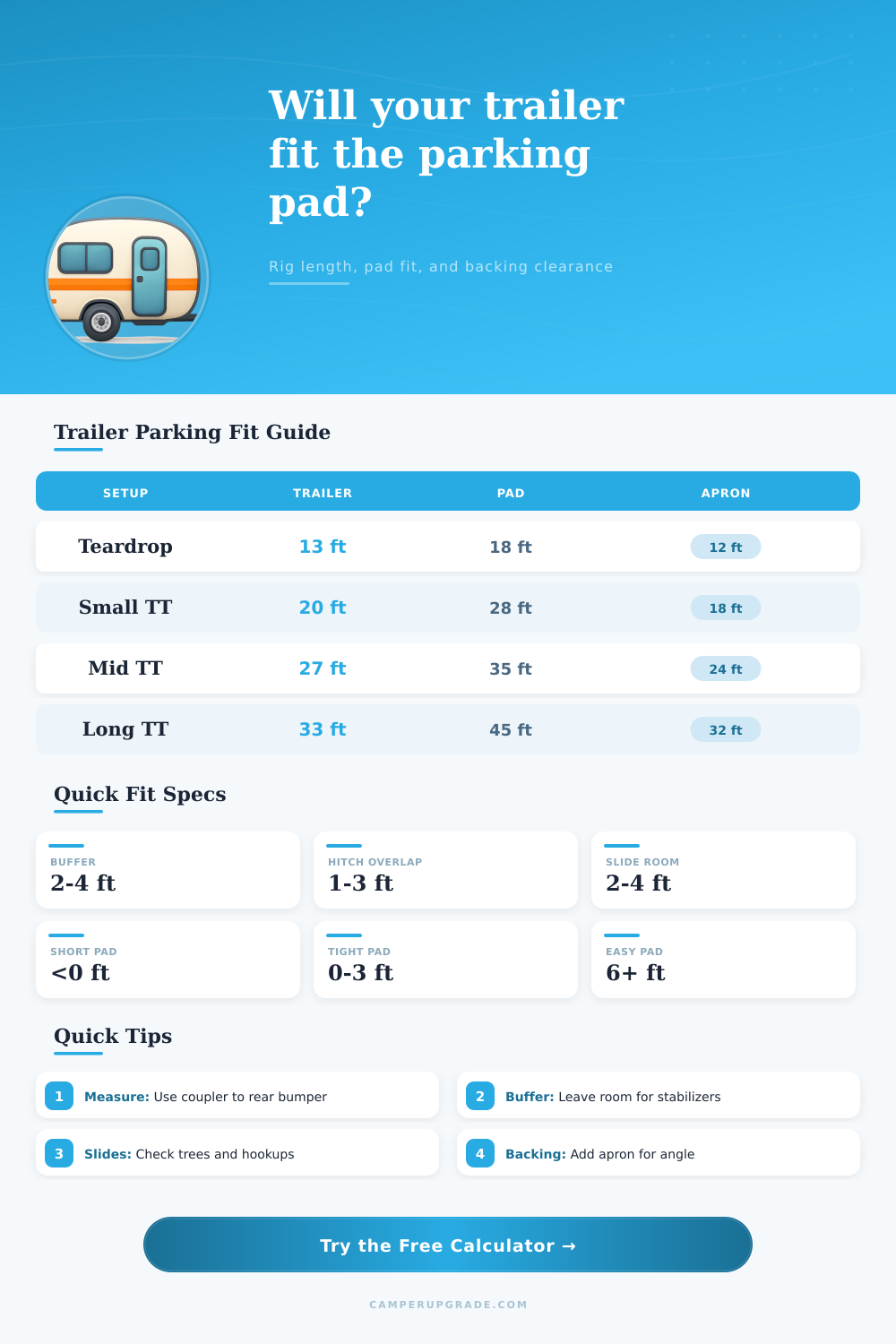
Travel Trailer Length Parking Calculator
Estimate combined rig length, campsite pad fit, clearance margin, and the backing envelope needed for a travel trailer, tow vehicle, driveway angle, slide-out, and turning apron.
Trailer parking fit estimate
| Trailer category | Typical body length | Tongue allowance | Pad length to target |
|---|---|---|---|
| Compact teardrop or squaredrop | 8 to 13 ft | 3 to 4 ft | 18 to 22 ft for trailer-only parking |
| Small single-axle travel trailer | 14 to 18 ft | 3.5 to 4.5 ft | 24 to 28 ft with a modest buffer |
| Couple travel trailer | 19 to 24 ft | 4 to 5 ft | 30 to 35 ft for easier leveling |
| Bunkhouse family trailer | 25 to 30 ft | 4.5 to 5.5 ft | 36 to 42 ft before tow vehicle parking |
| Long travel trailer | 31 to 36 ft | 5 to 6 ft | 44 to 50 ft when slide and rear clearance matter |
| Parking place | Useful dimension to ask for | Watch item | Calculator setting |
|---|---|---|---|
| Public campground back-in site | Pad length plus approach width | Posts, trees, ditches, and fire rings | Use normal or easy backing comfort |
| Private RV park pull-through | Total site length and tow parking zone | Pedestal, sewer riser, and neighbor slide room | Compare total rig length to listed site length |
| Residential driveway | Hard surface length and street width | Curb angle, mailbox, slope break, and garage door | Use actual driveway angle and apron length |
| Storage yard lane | Lane width, stall depth, and opposite clearance | Fence line and adjacent trailer overhang | Use storage backing style if the lane is straight |
| Boondocking pad | Flat usable length, not open clearing length | Ruts, rocks, branches, and departure angle | Add extra buffer and apron for correction pulls |
| Driveway or campsite angle | Added envelope factor | Typical backing feel | Planning note |
|---|---|---|---|
| 0 to 10 degrees | Minimal | Nearly straight approach | Backing apron can be close to tow vehicle length |
| 15 to 25 degrees | Moderate | Common campground correction angle | Plan one pull-forward if pad edge is narrow |
| 30 to 45 degrees | High | Sharper driveway or angled campsite | Apron depth and road width become important |
| 50 to 60 degrees | Very high | Often needs a wide road or spotter | Use generous envelope and check front swing |
| Over 60 degrees | Site-specific | Near jackknife approach if space is short | Measure actual turning path before committing |
| Slide-out depth | Minimum side space | Comfortable side space | Use case |
|---|---|---|---|
| No slide | 2 ft walkway | 3 to 4 ft walkway | Narrow pads, storage stalls, and quick overnights |
| 18 in shallow slide | 3 ft from trailer wall | 4 to 5 ft from trailer wall | Wardrobe or compact dinette slide |
| 30 in standard slide | 4.5 ft from trailer wall | 5.5 to 6.5 ft from trailer wall | Common sofa or dinette slide-out |
| 42 in deep slide | 5.5 ft from trailer wall | 7 ft or more from trailer wall | Large living room or opposing slide setup |
| Scenario | Trailer overall | Total rig estimate | Good pad target |
|---|---|---|---|
| Teardrop and midsize SUV | 14 to 17 ft | 29 to 34 ft | 18 to 22 ft pad plus small apron |
| 18 ft single-axle and pickup | 21 to 23 ft | 40 to 44 ft | 26 to 30 ft pad with 18 ft apron |
| 24 ft couple trailer and half-ton | 28 to 30 ft | 47 to 51 ft | 34 to 38 ft pad with 24 ft apron |
| 30 ft bunkhouse and crew-cab truck | 35 to 37 ft | 56 to 60 ft | 42 to 46 ft pad with 30 ft apron |
| 35 ft long trailer and long-bed truck | 40 to 42 ft | 63 to 68 ft | 48 to 52 ft pad with 36 ft apron |
Measuring the combined length of a travel trailers and tow vehicle is an essential task prior to towing the trailer to the location that is to be parked. Each of these trailer and tow vehicle lengths must be measured to ensure that the trailer will fit into the area that is to be used for camping or parking. If an individual dont measure these lengths prior to towing the trailer to the location of interest, it is possible that the trailer and tow vehicle will not fit into the trailer pad or driveway altogether.
By measuring the combined length of the trailer and tow vehicle, an individual can ensure that the space available for parking the trailer is large enough for both the trailer and tow vehicle. To calculate the total length that the trailer and tow vehicle will require for camping or parking, several length measurement must be obtained from the trailer and tow vehicle. Each of the length measurements that is required for the calculator include the length of the trailer body, the length of the tongue, the length of the tow vehicle, and the length of a pad where the trailer is to be parked.
How to Measure the Total Length of Your Trailer and Tow Vehicle
The length of the trailer body includes the distance from the front wall of the trailer to the rear bumper of the trailer. The length of the trailer body also includes any extra equipment that is mounted to the trailer. The length of the tongue is the length of the portion of the trailer that extend from the front wall of the trailer.
The length of the tow vehicle is the length of the truck or SUV that is towing the trailer. The length of the pad is the length of the trailer pad that is to be used for camping with the trailer. Additionally, the length of the pad must be large enough to include the length of the trailer body, tongue length, and tow vehicle lengths.
Driveway angle is another of the inputs that is required for the trailer and tow vehicle to be parked in the location of interest. The driveway angle is the angle of the driveway on which the trailer is to be parked. Additionally, the driveway angle determines the amount of space that is required for the trailer to maneuver into the spot where it is to be parked.
For instance, if the driveway is steep (more than 25 degrees), then the trailer will require more space to maneuver into the spot. The calculator include the driveway angle in the determination of whether the apron located in front of the trailer pad is of sufficient length to allow the trailer to straighten out. Furthermore, while many campground maps may include the length of the trailer pad on the map, the length of the trailer pad does not necessarily include space for the trailer to maneuver into the spot.
Slide-out depth is another of the inputs that is required prior to camping with the trailer. The slide-out depth is the depth of the portion of the trailer that can extend out from each of the sides of the trailer (typically the slide-out can extend from either the left or right side of the trailer). Additionally, the slide-out depth is important in calculating the length of the trailer in that when the slide-out extends out from the trailer, there must be clear ground for the trailer of interest.
For this reason, the slide-out depth must be accounted for in calculating the length of the trailer. If the depth of the slide-out is entered into the calculator, then that measurement will be subtracted from the total length of the side clearance of the trailer. If the result of this calculation is a negative number, then the depth of the slide-out is too deep for the available length for the trailer to have clearance on that side.
The trailer length calculator also includes two main calculations that is to assist the trailer and tow vehicle driver in understanding the available length and space for the trailer. Each calculation is either of the margin or the envelope of the trailer. The trailer margin is the length of the space that is left over after the trailer and tow vehicle are placed within the spot that is to be used.
If the margin is a large length, this indicates that there is more than enough space within the trailer spot for the trailer and tow vehicle. However, if the margin is small, it indicates that the spot may be too small for the trailer. The trailer envelope is the total length of the trailer and tow vehicle that is required to move into the spot for camping.
The trailer envelope is calculated to determine if the approach road and driveway are sufficient for the trailer to move into the spot. Additionally, the traveler can also adjust the size of the envelope using the backing comfort setting on the calculator; the tight setting indicates that the individual is comfortable making small adjustments to the trailer, but the easy setting for the trailer allows for more space for those just beginning to learn how to trailer a trailer. Many of the mistakes that an individual may make when attempting to park their trailer is when they only consider the length of the trailer itself, or when they do not account for the depth of the slide-out on the trailer.
For these reasons, an individual may find that their trailer is too long for the trailer pad, even though the length of the trailer is shorter than the length of the pad. Additionally, the individual may not account for the depth of the slide-out. For instance, the individual may find that there are trees on one side of the trailer spot, but the depth of the slide-out may mean that the trailer will extend into those trees if the slide-out is extended.
By using the trailer length calculator, an individual can account for each of these different variable prior to ever arriving at the camping spot.