Popup Camper Roof Support Calculator
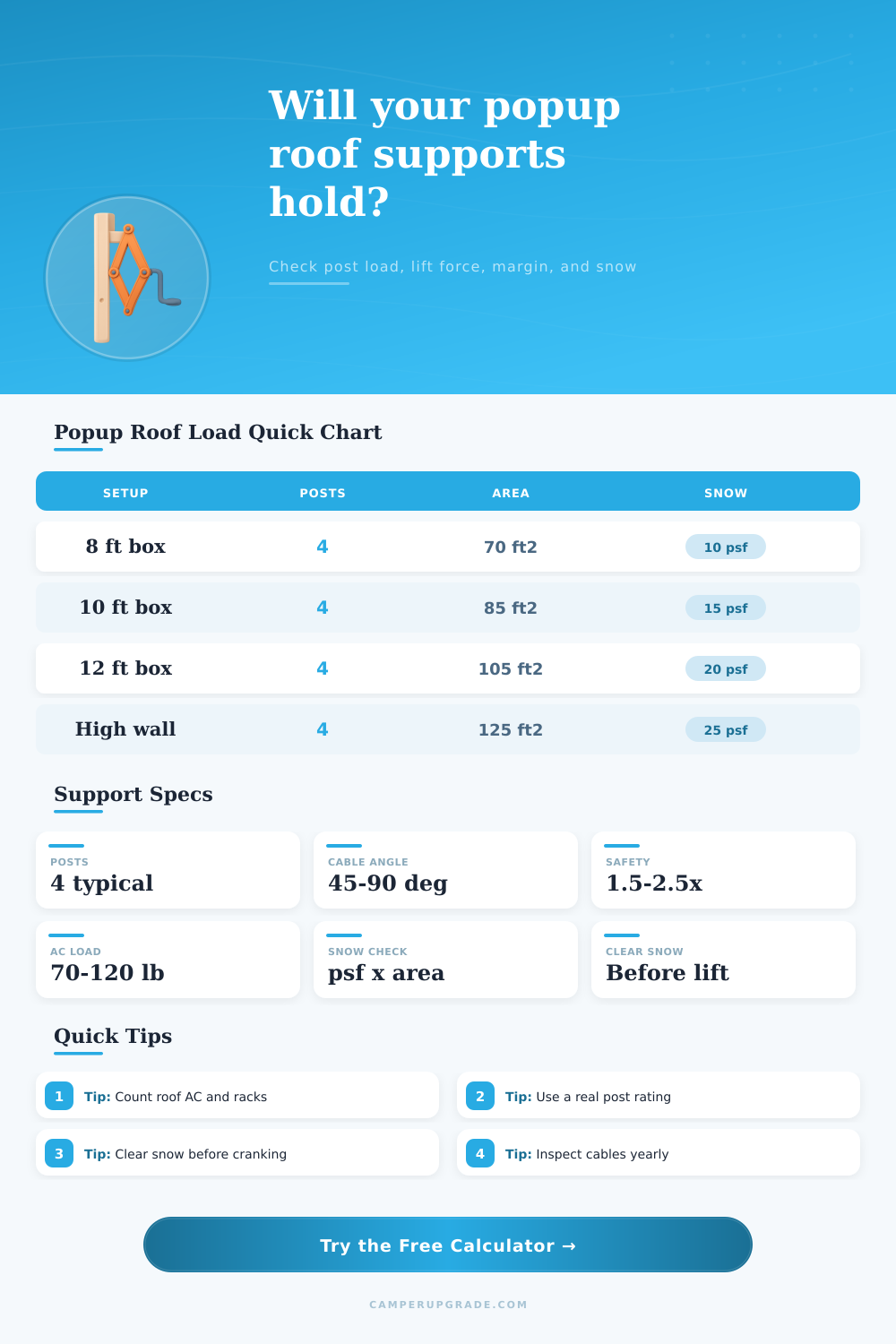
Estimate load per lift post, roof lift force, support margin, and snow limit from roof weight, post count, accessory load, snow load, post rating, crank force, cable angle, safety factor, and roof area.
Popup camper roof support estimate
| Popup camper setup | Roof weight | Accessory load | Roof area | Support note |
|---|---|---|---|---|
| 8 ft box light roof | 180-240 lb | 0-35 lb | 65-78 sq ft | Often manageable with light four-post systems |
| 10 ft box standard roof | 230-300 lb | 20-70 lb | 78-92 sq ft | Use added rack weight in the support check |
| 12 ft family popup | 290-380 lb | 40-110 lb | 95-115 sq ft | Watch lift effort when canvas and seals drag |
| Roof AC camper | 260-370 lb | 80-130 lb | 85-112 sq ft | AC load stays on the roof during every lift |
| High-wall popup | 360-520 lb | 70-150 lb | 110-135 sq ft | Use conservative ratings and inspect posts |
| Off-road rack roof | 300-430 lb | 110-220 lb | 95-125 sq ft | Remove cargo before lifting whenever possible |
| Per-post rating | Four-post capacity | At 1.5x safety | At 2.0x safety | Typical use |
|---|---|---|---|---|
| 200 lb per post | 800 lb | 533 lb working load | 400 lb working load | Light roofs with little added gear |
| 300 lb per post | 1,200 lb | 800 lb working load | 600 lb working load | Common standard popup planning value |
| 400 lb per post | 1,600 lb | 1,067 lb working load | 800 lb working load | Heavier roofs or roof AC checks |
| 500 lb per post | 2,000 lb | 1,333 lb working load | 1,000 lb working load | High-wall or reinforced support setups |
| 650 lb per post | 2,600 lb | 1,733 lb working load | 1,300 lb working load | Service props, braces, or upgraded supports |
| Snow condition | Planning load | Load on 90 sq ft roof | Load on 120 sq ft roof | Use in calculator |
|---|---|---|---|---|
| Trace or frost | 1-3 lb/sq ft | 90-270 lb | 120-360 lb | Small but still counts on weak supports |
| Light dry snow | 5-10 lb/sq ft | 450-900 lb | 600-1,200 lb | Common early warning range |
| Moderate packed snow | 15-25 lb/sq ft | 1,350-2,250 lb | 1,800-3,000 lb | Often beyond popup lift assumptions |
| Wet snow or ice crust | 30-45 lb/sq ft | 2,700-4,050 lb | 3,600-5,400 lb | Clear the roof and do not crank loaded |
| Drifted roof edge | Variable | Uneven post load | Uneven post load | Check the most-loaded corner first |
| Cable angle | Vertical efficiency | Lift effect | Inspection cue | Calculator note |
|---|---|---|---|---|
| 90 degrees | 100% | Best direct vertical support | Cable or post acts straight up | Lowest estimated cable demand |
| 75 degrees | 97% | Nearly vertical behavior | Small angle away from plumb | Good default for many systems |
| 60 degrees | 87% | Noticeable tension increase | Angled pulley path or corner routing | Adds about 15% cable demand |
| 45 degrees | 71% | High cable tension for same lift | Long diagonal brace or cable pull | Adds about 41% cable demand |
| 30 degrees | 50% | Very high tension | Shallow cable pull path | Needs careful hardware review |
A popup camper roof carry a significant amount of weight, and the lift posts and the cables must manage that weight. A popup camper roof may appear to be very lightly when the camper is rising. However, the weight of the roof include the weight of the roof itself and any accessories attached to that popup camper roof.
The lift posts distribute the weight of the roof. Additionally, if the popup camper includes equipment like an air conditioner or if snow falls on the roof, the total weight of that roof increase. As a result, the amount of load that the lift posts and cables must carry change.
How to Check Your Popup Camper Roof Support
A support check will help a person understand the load that is placed upon the popup camper roof. In order to complete the support check, a person enters the weight of the popup camper roof into the calculation. Additionally, the number of lift posts, the weight of any accessories loaded onto the popup camper roof, and the weight of the snow upon the roof is entered into the calculation.
The calculation will provide three different numbers. The first will show the weight that each lift post must hold (after accounting for a safety factor). The second will show the force that the cables must deliver.
The third number is a support margin that will show how much additional load the roof can take before the lift posts are near there limit. These three numbers will allow the individual to understand if the popup camper roof is within it’s limits or near its limit. The weight of the popup camper roof is a constant figure and will never change.
The weight of the roof is the canvas that makes up the roof, the weight of the seals, the weight of the vents that are included in the roof, and the weight of the hardware that make up the roof. Additionally, if an individual adds a rack or air conditioner to the roof, the total weight of the roof will change. The lift posts will support the total weight of the roof…
It dont consider the weight of the roof as separate from the accessories. For instance, if an individual adds a 100-pound roof air conditioner, the roof will weigh 100 additional pounds. This is a constant in the calculation.
The weight of the snow upon the roof is a variable. Snow can be very light or it can be very heavy (wet snow). When calculating the support of the roof, the depth of the snow is translated into pounds per square foot of the roof.
Additionally, the person multiplies the weight of the snow by the total area of the popup camper roof. This value is added to the total static load of the roof. The calculation will provide the remaining snow room for the popup camper roof, this is the amount of snow that the roof can still take before the lift posts is near their limit.
If the remaining snow room is near zero, the snow must be removed from the popup camper. The cables that raise the popup camper roof do not pull in a direction that is perpendicular to the roof. Instead, the cables are attached at an angle.
Pulling at an angle decreases the efficiency of the popup camper roof in lifting itself. A steep angle is more efficient than a shallow angle. For instance, if the angle of the cables is 75 degrees from the horizontal, the efficiency of the popup camper roof is greater than if the angle of the cables is 45 degrees from the horizontal.
This angle can be accounted for in the support calculation. Another number that is provided from the support calculation is the support margin. The support margin is the difference between the lift posts’ capacity and the total load of the popup camper roof.
The total load includes the roof’s weight, any accessories, the snow on the roof, and the safety factor. A healthy support margin allows for additional, unexpected loads upon the popup camper roof. A narrow support margin indicates that any additional load or binding of the popup camper roof may approach the limit of the lift posts.
This support margin is represented in pounds within the calculation to provide an indication of the lift posts adequacy or the need for temporary braces. The weakest component of the popup camper roof will dictate the limit of the popup camper roof. For instance, if the cables’ anchor point can support less load than the lift posts, the strength of those cables will be the limit of the popup camper roof.
Additionally, the shallow angle at which the popup camper roof cables are attached will increase the load upon those cables. The angle of the popup camper roof’s cables should be inspected and accounted for in the support calculation. The popup camper roof will not distribute the weight of the roof evenly when the popup camper roof is raised.
The canvas may bind in certain areas of the roof, the corners of the popup camper may sag, or the roof air conditioner may cause the weight of the roof to not be distributed evenly. The calculation assumes that the weight of the popup camper roof is distributed even across the roof. However, the actual weight of the popup camper roof may not be evenly distributed.
A visual inspection of the popup camper roof should be performed when it is rising. If one cable appears to be tighter than the others, or if one corner appears to be lagging behind the others, the rising of the popup camper roof should be stopped to investigate the cause. In addition to the calculations that determine the load that the popup camper roof must support, an individual can use the same logic to determine the load that should be removed from the popup camper before lowering the roof.
For instance, snow, bikes, or other cargo should be removed from the popup camper roof before the roof is lowered. The lift posts do not distinguish between the weight of items that belong upon the popup camper roof versus those that dont belong upon the roof. Therefore, removing any load from the popup camper roof prior to lowering the popup camper will remove any variables from that system.
Overall, an individual should treat the popup camper roof as a load that must be managed. The lift posts and cables are small components of the popup camper roof system. However, they are the components that determine whether or not the popup camper roof will remain in place.
Prior to each popup camper roofing season, or prior to adding any accessories to the popup camper roof, the support calculations should of been performed. These calculations will allow an individual to understand if the lift posts are sufficient to support the popup camper roof, if the angle of the cables is causing any difficulties for the camper, and how much snow the popup camper roof can take before the support margin for the system vanishes.