Truck Payload For Camper Calculator
Estimate remaining payload, rear axle added-load share, payload utilization, and gear allowance from your door-sticker payload, camper wet weight, passengers, fluids, batteries, gear, tie-downs, and safety margin.
Truck camper payload estimate
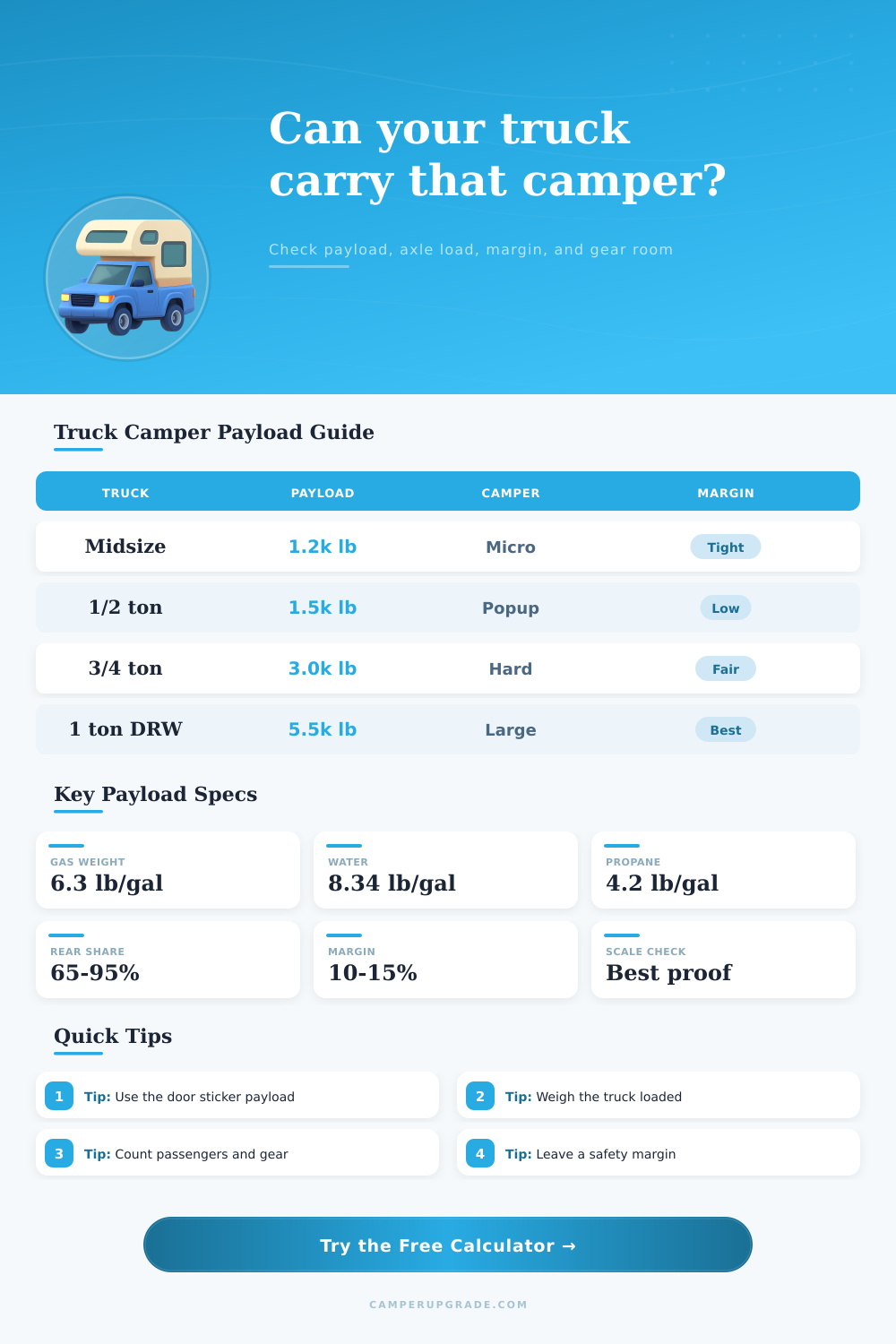
| Truck setup | Typical door-sticker payload | Camper fit band | Payload note |
|---|---|---|---|
| Midsize pickup | 900-1,400 lb | Micro shell or very light pop-up | Passenger and gear weight can use the margin quickly |
| Half-ton light payload | 1,200-1,700 lb | Small pop-up camper | Often tight once passengers, water, and tie-downs are counted |
| Half-ton high payload | 1,800-2,400 lb | Light pop-up or compact hard-side | Check exact sticker and rear axle scale weight |
| 3/4-ton gas truck | 2,600-3,600 lb | Medium hard-side camper | Good starting point for many wet campers under 2,500 lb |
| 3/4-ton diesel truck | 2,000-3,100 lb | Medium camper with closer math | Diesel engine weight can reduce door-sticker payload |
| 1-ton single rear wheel | 3,500-4,700 lb | Large hard-side camper | Rear tire and axle ratings still need a real scale check |
| 1-ton dual rear wheel | 4,800-6,500 lb | Large slide-in or expedition camper | Best margin for heavy campers, water, and family cargo |
| Component | Planning weight | Where it goes | Counting note |
|---|---|---|---|
| Fresh water | 8.34 lb/gal | Mostly camper payload | Use tank gallons actually carried on the road |
| Gasoline cans | 6.3 lb/gal plus can | Bed, rack, or rear carrier | Set fuel to zero for normal truck fuel already covered by payload sticker |
| Propane cylinder | 20 lb fuel plus tare | Camper compartment | Use total cylinder weight if wet camper weight excludes propane |
| Lead-acid battery | 45-75 lb each | Camper or bed box | Battery upgrades often add more than expected |
| Lithium battery | 25-35 lb per 100 Ah | Camper or storage bay | Lighter than lead-acid, but multiple batteries still count |
| Frame tie-downs | 40-90 lb | Truck frame and bed area | Add turnbuckles, mounts, brackets, and receiver hardware |
| Cab passengers | Actual body weight | Mostly front and mid chassis | Payload includes people, pets, child seats, and cab cargo |
| Load item | Rear axle share used | Why it matters | Best check |
|---|---|---|---|
| Slide-in camper wet weight | 90% | Most camper mass sits in or behind the bed | Weigh front and rear axles loaded |
| Hitch and tie-down hardware | 100% | Mounts, extensions, and steps are usually rear-biased | Compare empty and loaded scale tickets |
| Water, propane, batteries | 85% | Most tanks and camper utilities sit over the bed | Scale once full and once travel-light if needed |
| Loose gear | 70% | Gear location changes the axle split | Move dense gear forward when practical |
| Passengers | 35% | Cab load is shared by both axles | Use axle ratings and real loaded weights |
| Utilization | Calculator reading | What it suggests | Next check |
|---|---|---|---|
| Under 80% | Strong headroom | Usually enough room for small trip changes | Still verify axle and tire ratings |
| 80-90% | Workable but close | Watch water, passengers, and rear accessories | Use a certified scale loaded for travel |
| 90-100% | Very tight | Safety margin may be gone after real-world additions | Reduce load or move to a higher payload truck |
| Over 100% | Over payload | The entered setup exceeds the payload rating | Unload, travel dry, or change truck/camper match |
Payload is the difference between the weight a truck manufacturer says it can carry and the actual weight that is placed on the truck’s springs. Understanding the payload rating of a truck is essential when towing a truck camper because the payload determine if a truck is safe to drive once the truck camper is loaded. While it is easy to focus on the weight of the truck camper alone, there are a variety of other variable to the total weight that must be considered.
The total weight of a truck camper include not only the truck camper, but the passenger in the cab of the truck, the weight of the fuel, water, propane cylinder, batteries, and any gear that is placed in the truck bed. If the weight of the truck camper, its passengers, fuel, water, propane, batteries, and any gear in the truck bed exceeds the payload rating that is stated on the driver’s door sticker, the truck will sit lower than it should and the brakes will work harder than they are designed to work. The payload rating that is listed on the driver’s door sticker should be the only number that you use in your payload calculations for a truck.
How to Check Your Truck’s Payload When Using a Camper
While payload ratings may be listed in the manufacturer’s brochures for the truck and the truck camper, the user should not use the highest listed payload. Each truck has different specification than other trucks of the same make and model. The payload rating on the driver’s door sticker is the only accurate payload rating for a truck because it corresponds to the specifications of the specific truck that you own.
The weight that fluids contribute to the truck is significant. More specifically, water weigh more than eight pounds per gallon, gasoline weighs approximately six pounds per gallon, and diesel fuel weighs slightly more than gasoline. For instance, if a truck camper has a twenty gallon fresh water tank, the fresh water will weigh more than one hundred and sixty pound.
In addition, the weight of the fresh water tank must also be considered. Additionally, the weight of the propane cylinders also contribute to the total weight of the loaded truck. Propane cylinders contain the weight of the propane as well as the weight of the steel or aluminum propane cylinders.
Lastly, the weight of the batteries that are contained within the truck camper also add to the total weight of the loaded truck. The weight of the batteries is an element that is rarely accounted for in the advertised weight of the truck camper. Because the truck camper, water, propane, and batteries are all located behind the cab, these items place the majority of the truck’s weight on the rear axle and the rear tire of the truck.
The weight of the passengers and gear that is placed into the truck may have a different impact on the truck’s axle rating than the other component of the loaded truck. The weight of the passengers is distributed between the front and rear axle of the truck. In contrast, the weight of the gear within the truck can be distributed differently on the axles depending upon the placement of that gear within the truck bed.
For instance, if the gear is placed into the front of the truck bed, the truck will reduce the load on the rear axle. If the gear is placed into the rear of the truck bed, the load on the rear axle will increase. The only way to determine the actual weight that lands on each axle of the truck is to drive the loaded truck onto a certified truck scale.
The payload calculator that is provided in this article will subtract the total weight of the truck camper, the weight of the passengers, the weight of the fluids, the batteries, the hardware, and the gear from the payload rating. Additionally, the calculator will apply a safety margin that the user chooses. Finally, the calculator will estimate how much of the total weight of the loaded truck will land on the rear axle.
The result will indicate how much weight capacity remains for the loaded truck and if the gear indicated by the user will fit within the payload capacity of the truck. A safety margin of ten to fifteen percent of the payload rating of the truck is commonly applied to the payload calculation. The safety margin accounts for the fact that the payload calculation is only an estimation based off the payload numbers that are entered into the calculator.
For instance, the fuel level will change during the trip that the truck takes with the camper. Water will be added and used during the trip. It is also possible that the addition of items like a cooler or recovery boards to the truck bed at the last minute will also change the total weight.
Therefore, a safety margin will provide a buffer for these types of unexpected weights. Because the truck camper is located almost entirely behind the cab, the truck’s rear axle will carry a significant portion of the total weight of the loaded truck. Approximately ninety percent of the wet weight of the truck camper will be placed on the rear axle.
Additionally, the weight of the water and propane tanks and the weight of the batteries will all also be placed on the rear axle of the truck. Thus, it is possible for a loaded truck to read within the payload specifications for the truck but still feel as if it is heavy in the rear portion of the vehicle. The move of dense gear to the front of the truck bed will help reduce the load on the rear axle but does not change the fact that the truck camper’s mass is located behind the cab.
A common mistake in payload calculations is to use the payload rating of the truck camper to calculate payload capacity. For instance, many people will take the payload specification of the truck and subtract the dry weight of the truck camper from that payload. The resulting number will then be used to calculate the number of other items that can be placed into the truck camper.
This is an error because the wet weight of the truck camper also contributes to the total weight of the loaded truck. Additionally, the weight of the tie-down hardware that is used to secure the truck camper to the truck will also add to that total weight. The weight of the passengers in the cab will also add to the total weight of the loaded truck.
Another common error is to use the gross vehicle weight rating of the truck instead of the individual axle ratings of the truck. Even if the front axle of the truck has not reached its weight limit, the rear axle may have reached its weight limit. If an individual chooses a truck and a truck camper that have a large amount of payload capacity remaining within the payload rating, the driving experience will be enhanced.
For instance, a payload that has a large amount of remaining capacity will allow the truck to remain in a higher position. Additionally, the brakes and tires of the truck will remain within the specifications under which they were designed to work. It is better for the truck to remain at seventy-five percent of its payload rating than to be ninety-five percent of the payload.
The number that should of been used to calculate payload is the payload rating that is listed on the driver’s door sticker. The method that can be used to confirm the payload of a loaded truck is to drive it onto a certified truck scale. Thus, both the door sticker and the scale ticket will assist an individual in making a decision regarding the weight that the truck can carry.