Camper Van Fan CFM Calculator
Estimate required CFM, effective fan airflow after vent and screen losses, air change time, current ACH, and daily amp-hour use for camper van ventilation.
Camper van ventilation estimate
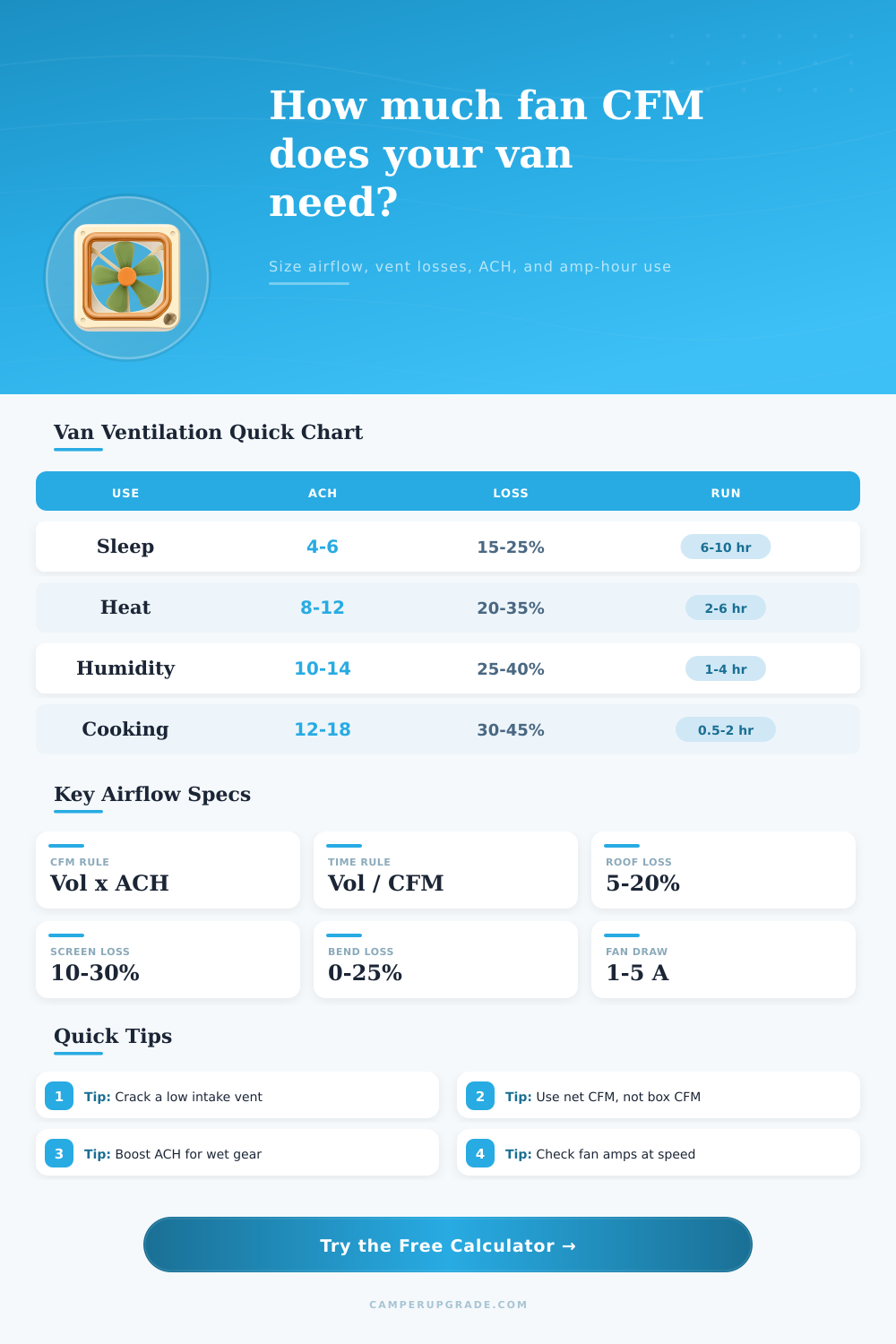
| Ventilation goal | Planning ACH | When to use it | CFM formula |
|---|---|---|---|
| Storage or parked airing | 2 to 4 ACH | Low odor control, dry weather, empty van | Volume x ACH / 60 |
| Sleeping ventilation | 4 to 6 ACH | One or two people sleeping with cracked intake | Volume x ACH / 60 |
| Warm weather purge | 8 to 12 ACH | Heat removal after sun exposure or hot parking | Volume x ACH / 60 |
| Humidity control | 10 to 14 ACH | Condensation, wet clothing, coastal air, cold glass | Volume x ACH / 60 |
| Cooking or shower boost | 12 to 18 ACH | Short high-output exhaust windows | Volume x ACH / 60 |
| Fan class | Rated CFM band | Useful amp band | Best camper van use |
|---|---|---|---|
| Small mushroom or puck vent | 20 to 80 CFM | 0.2 to 1.0 A | Storage venting, low draw background exhaust |
| Low speed roof fan | 80 to 160 CFM | 0.8 to 2.0 A | Quiet sleep airflow with cracked window intake |
| Mid speed roof fan | 160 to 300 CFM | 1.5 to 3.5 A | General heat and humidity control |
| High speed roof fan | 300 to 500 CFM | 3.0 to 6.0 A | Fast purge, cooking exhaust, wet gear dry-out |
| Dual fan layout | 300 to 900 CFM | 3.0 to 10 A | Large vans, gear garages, separate intake and exhaust |
| Restriction source | Typical loss | Higher loss trigger | Calculator input |
|---|---|---|---|
| Roof lid or rain cover | 5 to 20% | Low lid opening, tall cover, crosswind hood | Roof vent loss |
| Bug screen or dust mesh | 10 to 30% | Fine mesh, dirty screen, small intake area | Screen loss |
| Ducts, elbows, or filters | 0 to 25% | Sharp turns, long duct, filter pad, small grille | Duct / bend loss |
| Weak intake path | 10 to 35% | No cracked window or blocked low vent | Add to nearest loss field |
| Combined practical loss | 15 to 45% | Screen plus cover plus bend or filter | Calculator multiplies each loss |
| Fan speed plan | Current per fan | 8 hour use | Battery note |
|---|---|---|---|
| Trickle vent | 0.2 to 0.8 A | 1.6 to 6.4 Ah | Good for storage and mild nights |
| Quiet sleep speed | 0.8 to 1.8 A | 6.4 to 14.4 Ah | Common overnight draw for one fan |
| Moderate purge | 1.8 to 3.5 A | 14.4 to 28 Ah | Useful for heat and moisture bursts |
| High exhaust | 3.5 to 6.0 A | 28 to 48 Ah | Best for shorter cooking or heat purge runs |
| Two moderate fans | 3.6 to 7.0 A | 28.8 to 56 Ah | Plan battery capacity before all-night use |
Selecting the correct amount of airflow for a camper van is an important task. It is necessary to select the correct amount of airflow for the camper van in order to ensure the comfort of the individual in the camper van. While the fan that is selected for installation within the camper van may be powerful as described by the fan manufacturer, the installation of screens for the camper van will reduce the amount of air that the camper van fan moves.
Additionally, if you select the fan as being too powerful or oversized for the camper van, this can lead to additional problems, such as rapidly-drain battery or uncomfortable sleep due to drafts. Finding a balance between these different factors is what will ensure the camper van is comfortable for the individual who owns the vehicle. Due to the small amount of space within the interior of the camper van, the factors that influence the interior of the camper van change quickly.
How Much Airflow Does Your Camper Van Need
For instance, one person within the camper van can contribute to the humidity within the camper van. The humidity within the camper van can increase as a result of one sleeping, breathing, or even cook within the camper van. This same amount of humidity would increase the humidity within the camper van more than it would increase the humidity within a house.
Furthermore, if the camper van is parked in areas that receive a great deal of sunlight, the temperature within the camper van can reach temperatures that is above the temperature of the outside of the camper van. In these situations, moving air within the camper van is one of the best solutions. Based off these different factors, it is necessary to determine the amount of air that is required for the camper van to remain comfortable, as well as to account for any factors that can reduce the amount of air that is moved within the camper van.
The volume of the interior of the camper van will help to determine the amount of air that is required in order to maintain a comfortable climate within the camper van. If you calculate the interior volume of the camper van, you can determine the target number of air changes that occur within the camper van each hour. With the target number of air changes per hour calculated for the camper van, the theoretical amount of cubic feet per minute can be calculated for the camper vans fan.
The theoretical amount of cubic feet per minute that is calculated is merely a starting point for determining the amount of airflow that is required for the camper van; the installation of the camper van fan and the objects within the camper van will reduce the actual amount of airflow that is created. For instance, a fan that is rated at two hundred cubic feet per minute may only be able to move one hundred and thirty cubic feet of air per minute once the screen for the camper van are installed. This reduced movement of air within the camper van will cause the air within the camper van to become stale more quickly than if there were no reduction in airflow.
The amount of airflow that is required for the camper van will differ in different situations. For instance, air movement for quiet sleeping will be different than the air movement that is required to prevent heat buildup within the camper van. Heat buildup within the camper van can occur due to the camper van being parked in areas that receive sunlight for long periods of time.
Air movement is also required for the camper van if the individual within the camper van has been cooking or dampen items have been placed within the camper van. In these situations, different fan modes can be selected in order to allow for the camper van to remain at a comfortable temperature and humidity level. Each mode will allow for the camper van to handle more adverse conditions without adjusting the fan.
The intake path for the camper van is another factor in the movement of air within the camper van. The intake path can be overlooked in the installation of the camper vans fan. If the camper van utilizes a roof fan, it will not be able to move a large amount of air if the other windows of the camper van do not allow for the air to be replaced.
You can also adjust the pressure within the camper van by cracking a window or adding a low vent, which will allow the fan to reach closer to its effective rating. Without an intake path for the camper van, the fan will have to work harder to move the air within the van. However, the movement of the air will still be limited.
Most camper van builders will eventually realize this after a few sleeping nights within the vehicle. Another factor to consider is the power consumption of the fan. All fans draw some amount of current from the power source.
The higher the speed of the fan, the more current it will draw. Using a fan that draws a small amount of current at a low speed setting can still consume a significant portion of the batteries if the fan runs for many hours. Calculating how many amps are drawn by the fan and the runtime of the fan will give you an idea of how many amp-hours the fan will use.
Without performing this calculation, you might find that you have to purchase additional battery capacity for the camper van or the fan will have to be running at a lower speed than desired. The tables included on this page will help to show the typical ranges of CFM ratings according to the goal for the camper van and the class of fan that is to be used. These tables are not a replacement for the measurements of the CFM that can be measured in your camper van.
However, they can provide a general idea of the range of the performance of fans that are commonly used in these camper vans. A small puck style fan will be sufficient for airing out a camper van that is empty. A mid-speed roof fan will be a better option for one or two people livig in the camper van.
Using higher-output fans will be required for utilizing the camper van for cooking, showers, or wet gear. The tables also indicate the impact of screens on fans, which will allow you to make a decision on whether or not the fan will perform as well in the camper van as it does when uninstalled. Two of the most common mistakes that are made with camper van fans include assuming that the maximum rating of the fan is the same as the CFM that will be delivered into the camper van.
The ratings are provided under ideal laboratory conditions. The other mistake is underestimating the importance of the intake path for the camper van. If the camper van is sealed off in the interior, the exhaust fan will struggle to move the air within the van.
Both of these mistakes can be avoided by measuring the volume of the camper van and accounting for the air losses to provide an accurate estimate of the performance that the fan will deliver. The relationship between the volume of the camper van, the target air changes per hour, and the effective CFM of the fan is a simple one once the airflow losses are accounted for. The formula is simple, but the difficulty is in selecting the target airflow for the camper van.
The fan will always deliver a lower amount of air than what is indicated on the product box. Accepting that this is true will allow you to purchase a fan with a higher initial rating for the camper van and have accurate expectation regarding the power consumption of the fan. By considering the fan, the airflow losses, and the intake path of the camper van, you will have created a camper van that is comfortable for the individual(s) in the van yet does not consume too much of the battery power.