RV Gray Water Capacity Calculator
Estimate how many days your RV gray tank can handle, daily gray-water gallons, reserve gallons, and a practical dump schedule from showers, dishes, handwashing, sink flow, conservation, and trip length.
📌Gray Tank Presets
⚙Tank and Daily Use Inputs
Gray water capacity estimate
📊Tank and Use Spec Grid
📘Gray Tank Reference Tables
Gray Tank Capacity Planning
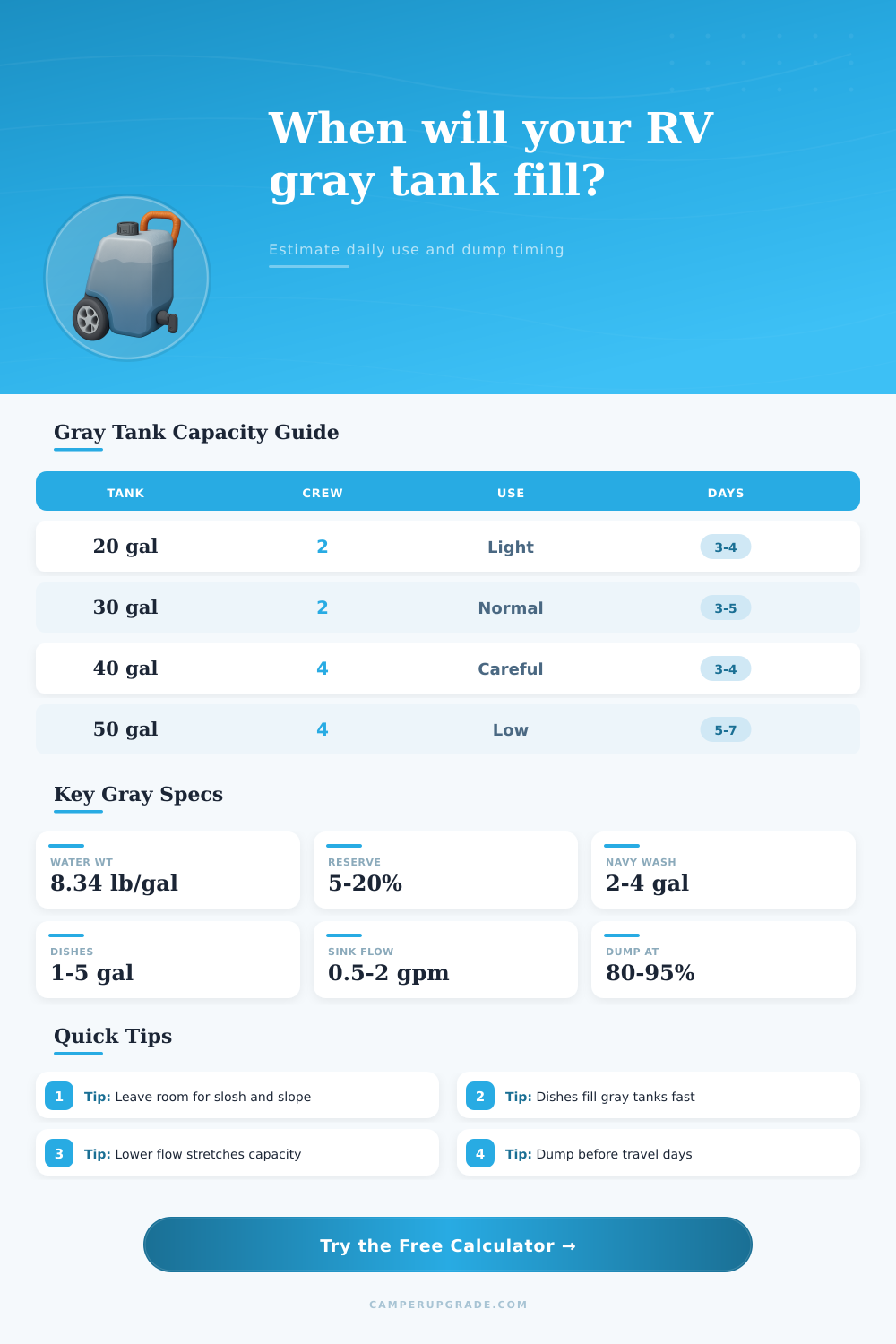
| Tank Size | Best Fit | Usable at 10% | Watch Point |
|---|---|---|---|
| 12-18 gal | Class B, teardrop, wet bath | 11-16 gal | Dump often if showering inside |
| 20-25 gal | Small trailer or couple | 18-23 gal | Dishes can become the limiter |
| 30-35 gal | Common travel trailer | 27-32 gal | Good for careful weekend use |
| 40-45 gal | Family trailer or motorhome | 36-41 gal | Works with low-flow showers |
| 50-65 gal | Large fifth wheel or split gray | 45-59 gal | Check which fixtures drain where |
Daily Gray Water Use Guide
| Fixture Or Habit | Low Use | Normal Use | Gray Impact |
|---|---|---|---|
| Navy shower | 2 gal/person | 4 gal/person | Largest single variable |
| Dishes | 1-2 gal/day | 3-6 gal/day | Use a basin to control volume |
| Handwashing | 0.1 gal/event | 0.2 gal/event | Depends on faucet flow |
| Incidental sink | 1-2 gal/day | 3-6 gal/day | Rinsing and cleanup add up |
| Outdoor shower drain | 0 gal gray | varies | Only count if routed to tank |
Conservation Factor Examples
| Factor | Use Style | How It Feels | Best For |
|---|---|---|---|
| 100% | Normal | Little rationing | Full hookups or short trips |
| 90% | Light care | Brief rinses | Weekend campground stays |
| 80% | Careful | Short showers, basin dishes | Default boondock planning |
| 70% | Strict | Low-flow habits all day | Longer dry camping |
| 60% | Extreme | Very limited sink time | Backup or emergency planning |
Dump Schedule Examples
| Tank | Daily Gray | Reserve | Dump Timing |
|---|---|---|---|
| 20 gal | 6 gal/day | 10% | About every 3 days |
| 30 gal | 8 gal/day | 10% | About every 3.4 days |
| 40 gal | 9 gal/day | 15% | About every 3.8 days |
| 50 gal | 10 gal/day | 10% | About every 4.5 days |
| 60 gal | 12 gal/day | 15% | About every 4.3 days |
💡Gray Water Calculation Tips
The gray water tank are used to store the used water in the RV. The gray water tank collects water from the showers, sinks, and outside wash station. It is important for individual to understand the gray water tank as it determine how long they can remain in one location before they have to dump the tank.
While many individuals focus on the fresh or black water tank, the gray water tank can easy become full if not monitored proper. Because the gray water tank fills based off the amount of water that is used in the RV, it is necesary for individuals to calculate how much water that they will use daily in order to understand how long the tank will last prior to filling. Individuals must calculate the amount of water that they will use for the showers, the dishes that will be washed, and how much water will be used to wash their hands.
How to Manage Your RV Gray Water Tank
Showers that use more water than other will fill the tank at a fast rate. Therefore, if an individual decide to utilize a navy shower, they will use less water and the tank will take longer to fill. Additionally, individuals will need to account for the water that is used to wash their dishes and their hands as that water also goes into the gray water tank.
Another factor that individuals can consider is the conservation factor that can be utilized to manage the gray water tank. For instance, using an 80% conservation factor will ensure that less water is used in the RV, thus allowing individuals to remain without dumping there tank for a longer period of time. Furthermore, using a 60% conservation factor will allow individuals to use even less water, which is beneficial for those who intend to travel long distances without the ability to reach a dump station.
However, the conservation factor will not change the size of the tank. Rather, it will change how many day that an individual can use the tank prior to it reaching its dumping capacity. It is also important to leave a reserve percentage in the gray water tank.
By leaving a portion of the tank unused, the tank will have some water in it in case the sensors that are located in the tank is not accurate in determining how much water is in the tank. For instance, should an individual leave 15% of the tank in the RV, there will be 15% of the tanks capacity in which the gray water can remain when the RV is in motion or on a slope. Due to the movement of the RV, the gray water may slosh within the tank.
As a result, the sensors may indicate that the tank is full when in reality the water are not. Thus, leaving a reserve percentage in the tank will prevent the RV from overflowing its tank with gray water. Additionally, the weight of the water that is contained in the gray water tank can be another factor to consider.
The weight of water is approximately 8 pounds per gallon of water. Thus, when the tank is filled, it will add to the weight of the RV. Dumping the tank prior to a long drive is one way to avoid adding to the weight of the RV.
Individuals can also have different methods of routing the water into the gray water tank. For instance, some RVs may only have a single tank into which the water is directed. Other RVs may have what are split tanks for gray water.
In these cases, one tank may be filled while the other still has capacity for additional water. Therefore, individuals must check their RV to determine which of the water fixture will empty into which tank to ensure that they dont overfill the tank. In managing the gray water tank, there are three main things that an individual must understand: the amount of water that is used in the RV and how that can be calculated; the need to leave a reserve percentage in the tank; and the weight of the water in the tank.
By calculating in advance how much water that is to be used in the RV each day, the individual will be able to understand when to dump the tank. By understanding these factors related to the gray water tank, individuals will be able to plan their trip accordingly. Additionally, should they understand these factors, they will also be able to ensure that they have enough time to find a dump station for the tank.