Bike Trailer Load Calculator
Estimate usable payload margin, tongue load, braking load, and hill effort from trailer rating, cargo weight, tongue percentage, wheel count, grade, braking factor, tire pressure, axle rating, and safety reserve.
Bike trailer load estimate
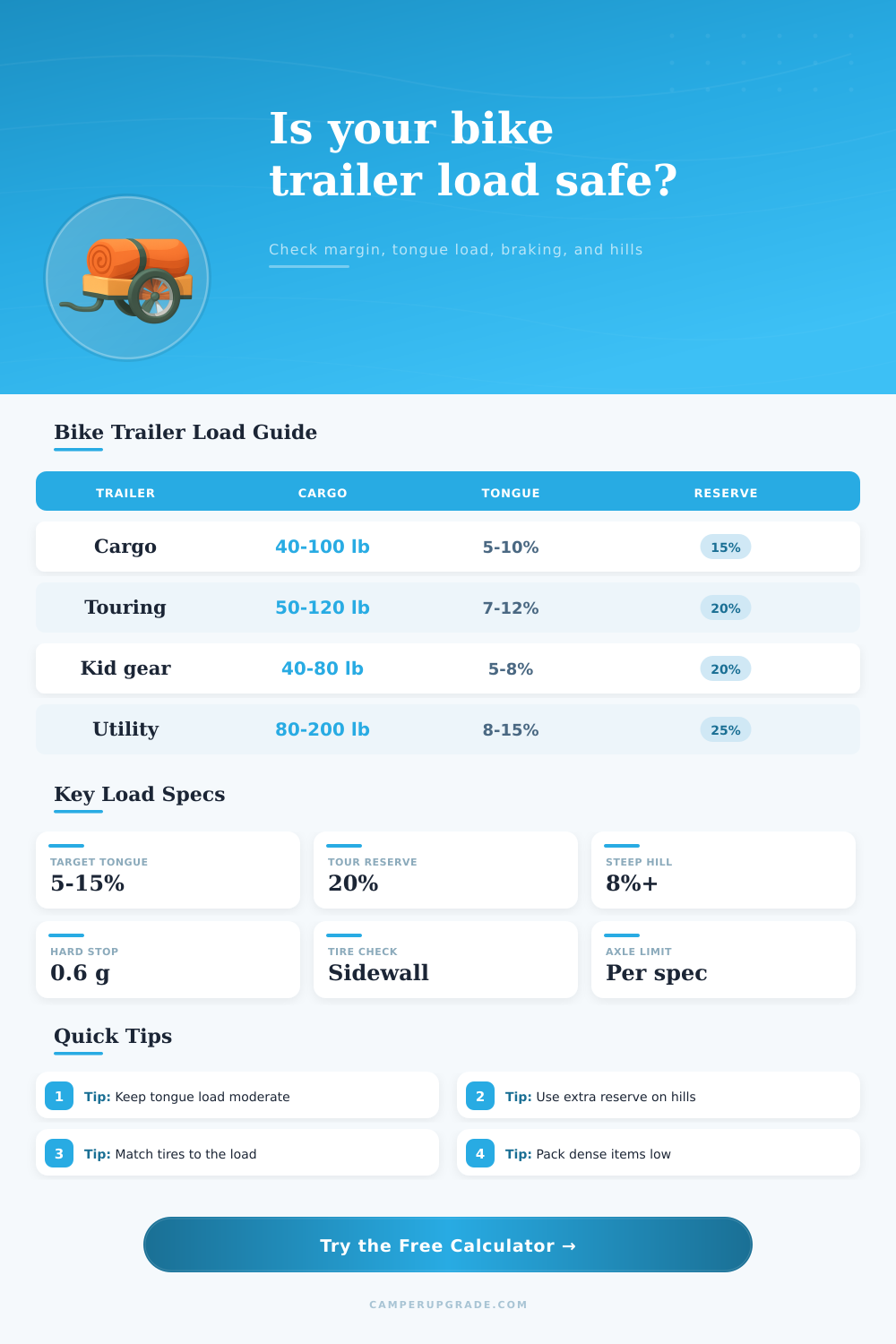
| Trailer style | Common rating band | Useful tongue range | Reserve to consider |
|---|---|---|---|
| Small cargo trailer | 40-100 lb payload | 5-10% of cargo | 15% for errands on smooth routes |
| Touring trailer | 50-120 lb payload | 7-12% of cargo | 20% for distance, weather, and rough patches |
| Child trailer used for gear | 40-80 lb payload | 5-8% of cargo | 20% because frames and wheels vary widely |
| Single-wheel trailer | 45-80 lb payload | 8-15% of cargo | 20% for sway and hitch loading |
| Utility cargo trailer | 80-200 lb payload | 8-15% of cargo | 25% for bulky or uneven loads |
| Heavy-duty bike trailer | 150-300 lb payload | 10-15% of cargo | 25% for braking and tire heat checks |
| Input value | What it means | Typical use | Calculator effect |
|---|---|---|---|
| 0.30 g braking | Gentle controlled stop | Dry path, low speed, long stopping room | Braking load equals 30% of cargo weight |
| 0.50 g braking | Firm stop | Traffic, steep approaches, heavier load | Braking load equals 50% of cargo weight |
| 0.70 g braking | Hard stop check | Conservative cargo and hitch planning | Braking load equals 70% of cargo weight |
| 4% grade | Moderate climb | Rolling neighborhood or rail trail | Hill force adds about 4% of cargo weight |
| 8% grade | Steep climb | Hilly town, bridges, mountain roads | Hill force adds about 8% of cargo weight |
| 12% grade | Very steep climb | Short ramps, campground roads, driveways | Hill force adds about 12% before rolling drag |
| Trailer tire type | Common pressure band | Load sign to watch | Calculator note |
|---|---|---|---|
| 12-16 inch cargo tire | 30-45 psi | Sidewall bulge when loaded | Use the sidewall maximum as the hard ceiling |
| 20 inch utility tire | 35-65 psi | Rim hits, squirm, heat | Often handles touring loads well when inflated |
| Fat or wide trailer tire | 10-30 psi | Bounce or casing fold | Good on soft paths but needs more reserve |
| Narrow high-pressure tire | 55-100 psi | Harsh ride, small contact patch | Low rolling drag but less forgiving on potholes |
| Small plastic wheel | Maker-specific | Heat, wobble, bearing drag | Use conservative cargo weight and reserve |
| Preset | Rating / cargo | Grade and stop | Why it is useful |
|---|---|---|---|
| Grocery run | 100 lb / 45 lb | 3% grade, 0.35 g | Everyday cargo with a comfortable margin |
| Commuter cargo | 80 lb / 35 lb | 2% grade, 0.30 g | Laptop bag, clothes, lock, and small errands |
| Kid gear day | 100 lb / 60 lb | 4% grade, 0.40 g | Gear-only use of a trailer with many soft items |
| Pet hauler | 90 lb / 55 lb | 5% grade, 0.35 g | Moderate load where smooth braking matters |
| Weekend tour | 110 lb / 70 lb | 6% grade, 0.45 g | Touring cargo with water and overnight gear |
| Camping kit | 140 lb / 95 lb | 8% grade, 0.50 g | Bulky outdoor gear and rougher path reserve |
| Single-wheel tour | 70 lb / 48 lb | 7% grade, 0.45 g | Higher tongue percentage and handling focus |
| Utility haul | 200 lb / 140 lb | 5% grade, 0.55 g | Heavy two-wheel cargo with stronger axle rating |
| Steep errand | 120 lb / 75 lb | 10% grade, 0.50 g | Shows hill effort when the route climbs hard |
| Heavy cargo | 250 lb / 185 lb | 6% grade, 0.60 g | Stress-check for utility trailers and big loads |
A bike trailer will allow a person to carry more cargo on there bicycle. However, the trailer will need to be used within specific weight and balance limit for the safety of the trailer, the bicycle, and the individuals riding on the bicycle. There are limits to the bike trailer itself, the bicycle, the tire, and the abilities of the individual to control the trailer and the bicycle.
Many people will focus on the total weight that the trailer can handle with the cargo. However, the total weight of the cargo isnt the only factor that will have to be consider when loading the trailer. The weight of the cargo will impact the tongue weight of the trailer, the axles of the bicycle will have to be able to handle the weight, and the road condition will also have to be considered.
How to Load and Use a Bike Trailer Safely
The calculator will help to determine the weight of the cargo that a bicycle and trailer combination can safely handle. The calculator will use several specific input to mathematically arrive at the number of the total cargo weight that can be safely ridden on the bicycle. These specific inputs will include the rating of the trailer, the weight of the cargo, the percentage of the tongue weight, the number of wheel, the hill grade, the braking factor, the tire pressure, the axle rating, and the safety reserve.
The trailer and axle will have different rating for the weight that they can take. The lower of the two number will be used for the initial calculation of the total safe cargo weight. The safety reserve will be a percentage of the total weight that will be subtracted from the total weight capacity of the trailer and bicycle combination.
This safety weight will account for bump in the road, heat of the bicycle tires, and the non-perfect way that the cargo is to be added to the trailer. The resulting number will be the total weight of the cargo that can be safely transport on the bicycle and trailer combination. Tongue weight will be a critical factor in the safe transport of the cargo with the bicycle.
Tongue weight will impact the bike trailer and the bicycle. The tongue weight is the portion of the total weight of the cargo that will be on the hitch of the bicycle. If the tongue weight is too low, the trailer may sway or bounce on the bicycle when traveling on even the slight slopes of the road.
Additionally, if the tongue weight is too high, the rear wheel of the bicycle may become overload with the weight of the trailer. An overloaded rear wheel can impact the way in which the individual steers and brakes the bicycle. The calculator will show the specific tongue weight that the bicycle can support based off the percentage of the total weight of the trailers cargo that may be represent by this tongue weight.
This will allow the individual to select the proper percentage of tongue weight to ensure that the tongue weight is within the capabilities of the hitch of the bicycle and the bicycles frame. Braking load and hill effort are two important factors to consider because these two variables has an impact upon the movement of the bike trailer. When you apply the brakes to the trailer, the cargo within the trailer desires to continue to move forward.
The braking factor is essentially the force of that movement. A higher braking factor is required to stop the trailer in traffic then is required to gently stop the trailer on a flat path. The braking load feature in the trailer brake calculator will convert that braking factor into the forward load that the trailers hitch and the trailers frame must resist.
Hills can also increase the effort that is required for moving the trailer. The mode feature on the calculator accounts for the rolling drag of the trailer on different types of terrain; gravel create more rolling drag than smooth pavement, for instance. Tire pressure is another important variable to consider when using the trailer brake calculator.
If the pressure in the trailers tires is too low, the resistance that the trailer tires exert against the movement of the trailer will increase, and the tires will create more heat. If the pressure in the trailers tires is too high, the ride will be harsh upon the trailer and the trailers cargo. The trailer brake calculator compares the actual tire pressure to the tire pressure that is recommend for the trailer based upon its load and the type of surface upon which it will be traveling.
Many trailer riders make mistake. Many trailer riders treat the trailers load and rating as the only rating that limit the trailers use. Other components of the trailer, such as the trailers axle, hitch, and tires also have limit that should not be exceeded by the trailers rider.
Furthermore, care should be taken in how the cargo is loaded into the trailer. If the trailers load creates change in the tongue weight of the trailer, it is important to consider how that may impact the trailers stability. Finally, it is recommended to always use the safety reserve that is build into the trailer.
This safety reserve provides additional capacity for the trailer in case the trailer riders becomes fatigued or if the weather change while the trailer is in use. If the safety margin calculated by the trailer brake calculator is too small for the trailer, the rider should reduce the weight of the trailers cargo, or choose a different route for the trailer.