Snow Load Shelter Calculator
Estimate shelter roof snow pressure, total roof load, frame margin, and a practical clearing interval from snow depth, density, drift, wetness, pitch, span, and frame rating.
Shelter Snow Load Results
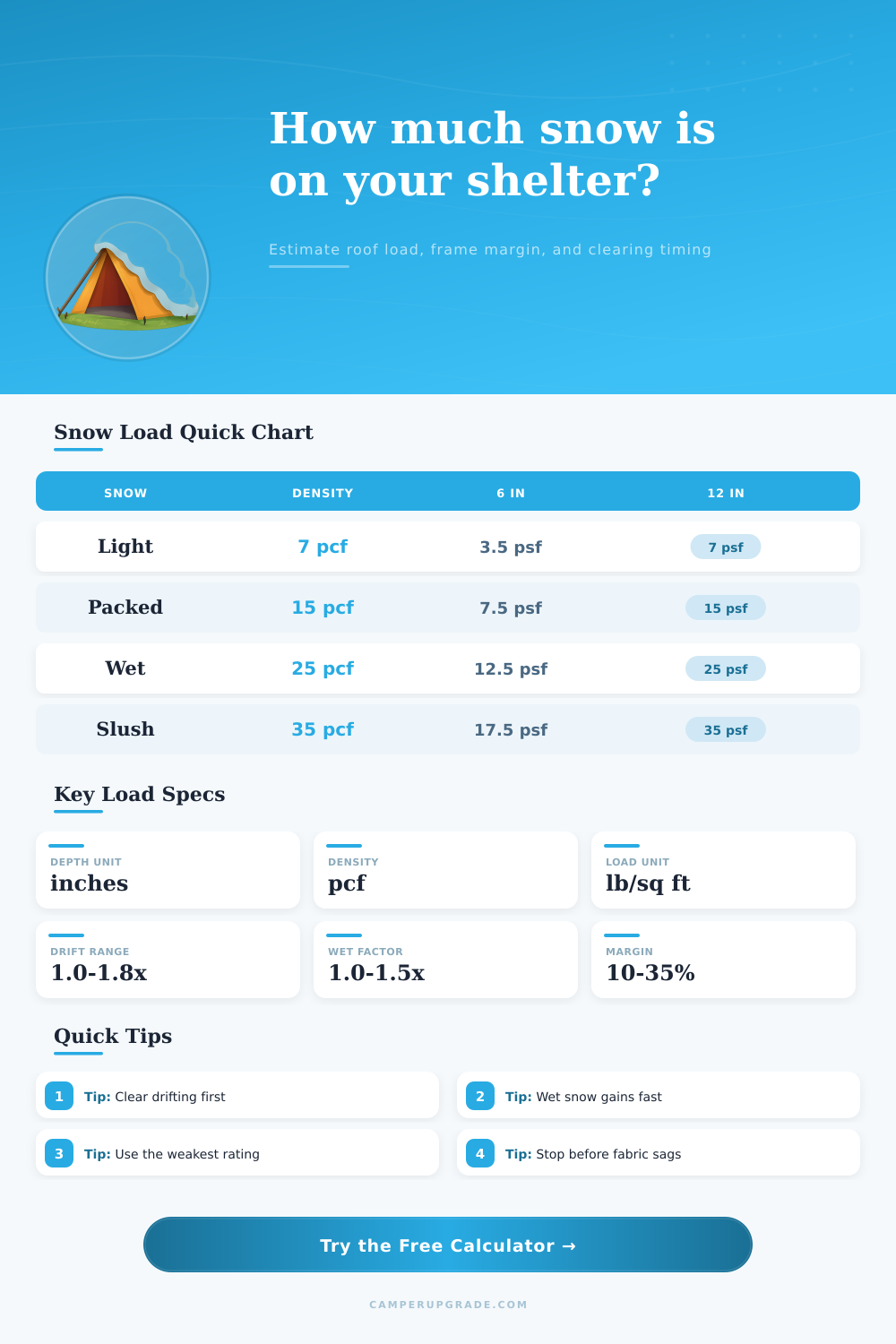
| Snow condition | Typical density | Load from 6 in | Load from 12 in | Field note |
|---|---|---|---|---|
| Cold light powder | 5-8 lb/cu ft | 2.5-4 psf | 5-8 psf | Can drift deeply in wind |
| Settled dry snow | 10-12 lb/cu ft | 5-6 psf | 10-12 psf | Common after overnight settling |
| Wind packed snow | 15-20 lb/cu ft | 7.5-10 psf | 15-20 psf | Often found near edges and ridges |
| Wet heavy snow | 20-30 lb/cu ft | 10-15 psf | 20-30 psf | Clear early if the fabric sags |
| Slush or rain on snow | 30-40 lb/cu ft | 15-20 psf | 30-40 psf | Load can jump before depth grows |
| Planning factor | Low setting | Moderate setting | High setting | Use the higher value when |
|---|---|---|---|---|
| Roof pitch factor | 0.72 at 50+ deg | 0.88 at 30 deg | 1.00 below 20 deg | Fabric is sticky, icy, or sagging |
| Drift factor | 1.00 even cover | 1.30 side drift | 1.80 pocket drift | Shelter sits near wind breaks or walls |
| Wet snow factor | 1.00 dry snow | 1.30 wet snow | 1.50 rain on snow | Rain, thaw, or refreeze is happening |
| Span penalty | 1.00 under 10 ft | 1.10 at 14 ft | 1.25 at 18 ft | Poles bow or ridge line dips |
| Shelter frame | Typical rating range | Useful roof area | Best snow approach | Watch point |
|---|---|---|---|---|
| Pop-up canopy | 5-12 psf | 80-120 sq ft | Clear every accumulation | Corner joints and fabric sag |
| RV awning | 5-15 psf | 80-180 sq ft | Retract or support before storm | Roller tube bend and brackets |
| Canvas wall tent | 15-30 psf | 120-300 sq ft | Knock snow off sidewalls often | Ridge pole and eave elbows |
| Portable carport | 20-40 psf | 160-400 sq ft | Clear drifts along the wind side | Peak connectors and anchor movement |
| Cabin-style shelter | 25-50 psf | 120-500 sq ft | Compare to local design load | Unsupported span and rafter spacing |
A snow load shelter calculator is a tool that allows a person to determine if a shelter can support the weights of the snow that accumulates on it. While the depth of the snow are a factor in determining the weight of the snow, it isnt the only factor. The other factor is the density of the snow, which determine how many pounds of snow are pressing down on the shelter.
By entering the depth and density of the snow into the calculator, an individual can determine the total load that the snow will place upon the shelter in pounds per square foot. The density of the snow is a variable that change with the weather. The density of the snow will change the weight of the snow falling on the shelter.
How to Use a Shelter Snow Load Calculator
Powder snow has a low density, while snow that is wet or slushy has a highly density. Because wet snow is much more denser than powder snow, the wet snow factor must be used in the calculation of the snow load on the shelter. By failing to use the density of the snow as a variable in the calculation of the snow load, an individual will likely underestimate the true weight of the snow on the shelter.
The shape of the shelter will also impact the weight of the snow on the shelter. The pitch of the roof will impact how much snow accumulate on the shelter; steep pitches will shed the snow better then flat pitches. Additionally, the wind will blow the snow in drifts, which will add to the load on the shelter compared to snow that falls in even amount over the shelter.
The drift factor is used in the shelter snow load calculator to provide an accurate estimate of the load of the snow on the shelter. An individual must account for drifts in the calculation of snow load. The snow load on a shelter will not be uniform across the shelter.
Another variable in determining the load of the snow on a shelter is the span length of the shelters frame. The frame of the shelter has a published load that it can take. This load is calculated under the assumption that the span length of the shelter is short.
For snow sheds that has a long span length, the load of the snow will weaken the frame. A span penalty is applied to the calculation of the load of the snow to reflect the capacity of the shelter frame for long spans. The span length of the shelter should be considered when calculating the load of the snow on the shelter.
A frame margin is provide for the shelter for the individual to maintain to ensure the shelter does not collapse under the load of the snow. The shelter snow load calculator calculates the frame margin by adding a percentage to the calculated weight of the snow and then comparing that calculated load to the published loading of the shelter frame. By calculating a frame margin for the shelter, it ensures that the shelter will not fail before its maximum load rating.
For instance, the shelter may fail under other condition, such as if the anchor point should fail or if one of the pole begins to bend. The shelter will provide a clearing interval after calculating the frame margin for the shelter. The clearing interval tells the individual how often to remove the snow from the shelter.
If the frame margin is small, the clearing interval will be short; the snow must be removed more often. If the frame margin is large, the clearing interval will be long; the snow dont need to be removed from the shelter as often. However, regardless of the calculations of the shelter, an individual should always monitor the shelter for changes in the weather, as the snow load could change at any time.
There are specific steps that must be followed in order to properly use the shelter snow load calculator. The depth of the snow should first be measure in a few different locations in the shelter. The density of the snow, the wet snow factor, and the drift factor should then be adjusted to reflect the current weather conditions in the area.
The load of the snow should then be calculated and compare to the lowest weight load rating of the shelter. Finally, using the frame margin that was calculated, an individual can decide whether to remain in the shelter or to clear the snow from the shelter. If the frame margin is low, an individual should clear the snow, as more snow will continue to fall on the shelter.