Raft Size Calculator
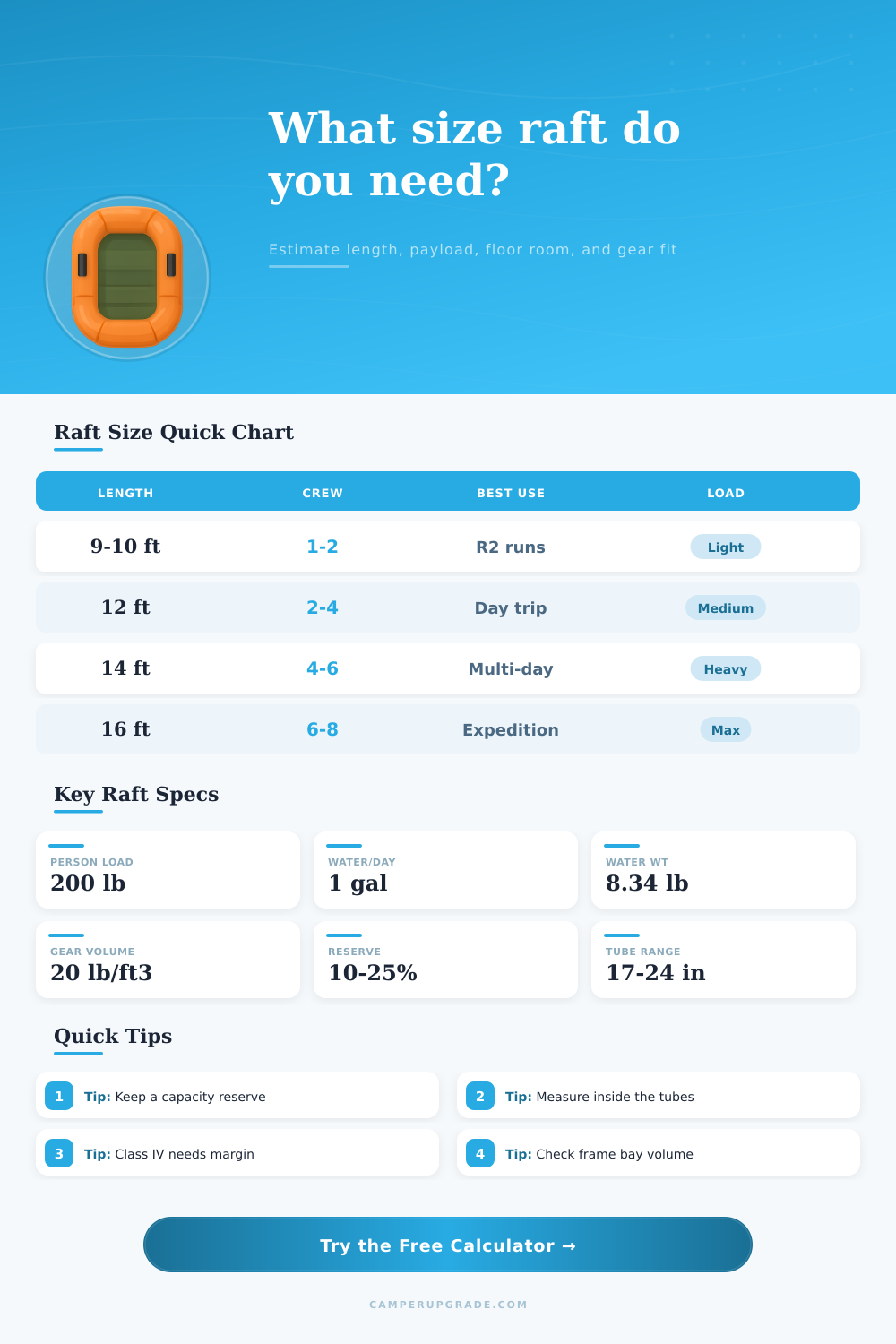
Estimate recommended raft length, payload margin, usable floor area per paddler, and gear volume fit from paddlers, gear weight, river class, tube diameter, raft dimensions, load capacity, drybox volume, water days, and reserve.
Raft size estimate
| Raft length | Typical crew | Common use | Planning note |
|---|---|---|---|
| 9-10.5 ft | 1-2 paddlers | R1, R2, narrow creeks, light day runs | Quick handling, little gear space |
| 11-12.5 ft | 2-4 paddlers | Day trips, paddle crews, smaller fishing frames | Good for light loads and tighter water |
| 13-14 ft | 4-6 paddlers | Common all-around day and overnight raft | Balanced capacity, floor room, and maneuvering |
| 14.5-15 ft | 5-7 paddlers | Multi-day gear raft or larger paddle crew | More bay volume and reserve for coolers |
| 15.5-16.5 ft | 6-8 paddlers | Heavy expedition load and big desert trips | High payload, slower in technical moves |
| 17 ft and up | 7+ paddlers | Very large loads, cargo, or commercial style use | Needs wide channels and experienced handling |
| River class | Minimum reserve | Length adjustment | Why it matters |
|---|---|---|---|
| Class I | 8% | 0 ft | Low wave impact and broad recovery room |
| Class II | 10% | 0 ft | Small waves still reward a clean trim line |
| Class III | 15% | 0.5 ft | Moderate holes and wave trains punish overloaded rafts |
| Class IV | 20% | 1.0 ft | Technical water needs flotation and room for rescue gear |
| Class V | 25% | 1.5 ft | Expert water should be planned with conservative margins |
| Item or bay | Typical volume | Load estimate | Calculator use |
|---|---|---|---|
| Medium cooler | 2.5-4 cu ft | 60-120 lb loaded | Add outside box volume to rigid volume |
| Large cooler | 5-7 cu ft | 120-220 lb loaded | Needs a real frame bay on small rafts |
| Drybox | 3-6 cu ft | 40-140 lb loaded | Include hard box volume, not just contents |
| Soft dry bags | 20 lb/cu ft | Compressible | Calculator converts remaining gear weight to volume |
| Water jugs | 0.134 cu ft/gal | 8.34 lb/gal | Added from paddlers and water days |
| Frame bay depth | 0.8-1.4 ft | Varies by tube | Estimated from tube diameter and clear floor |
| Check | Green zone | Caution zone | What to change |
|---|---|---|---|
| Payload margin | Above 15% | 0-15% | Reduce load, add raft length, or raise capacity |
| Floor per paddler | 7+ sq ft | 5-7 sq ft | Shorten gear stack or use a longer raft |
| Gear volume fit | Positive spare | Small deficit | Compress soft bags and recheck hard boxes |
| Tube clearance | Interior width above 3 ft | Under 3 ft | Check real inside dimensions before committing |
| Water load | Less than 20% payload | 20% or more | Stage water or split load across rafts |
To determine the appropriate size for a raft, a person must consider the weight of the gear and the numbers of people that will be traveling on the raft. Choosing the appropriate size for a raft is important to ensure that the raft will properly float and that the raft will be able to handle the weight of the group that will be traveling on the raft. If the raft that is chosen is too small to handle the weight of the gear and the number of individuals that will be on the raft, the raft will sit low in the water and can be difficultly to maneuver.
If the raft chosen is large enough to handle the weight of the gear and individuals, the raft will be more easier to control while in the water. The number of individuals that will be paddling the raft is one of the first factor to consider in relation to the size of the raft that is purchased. Each individual that is in the raft add to the weight of the raft, as well as takes up the space on the raft.
How to Choose the Right Size Raft
Therefore, a small group of two individuals can utilize a small raft by themselves. However, if there are to be more individuals in the raft, the weight and the size of the raft will have to be increased to provide the necessary space and weight to accommodate an additional individuals. The total weight of the gear that will be transported on the raft is the second factor to consider in purchasing the raft.
The total weight of the gear include the weight of the raft itself, the oars, the kitchen supplies, camping gear, and the weight of the water that the individuals on the raft will transport. An individual needs to consume a certain amount of water each day, and the weight of water is very heavily. Knowing the weight of the gear and the weight of the water will allow the individuals to calculate the total weight of the raft that is required to transport the gear and individuals without sinking too low into the water.
The class of the river that will be traveled is the third factor to consider when purchasing a raft of the appropriate size. The class of the river represents how difficult the river will be to navigate. Different classes of rivers have different safety margin for the raft that is used.
On the easier rivers, the gear and the weight of the raft can be close to the maximum capacity of the raft. On the more difficult rivers of class III and IV, there will be more significant wave that push against the raft, which will increase the weight of the raft. Therefore, the size of the raft should be considered for higher class of the river.
The diameter of the raft and the dimensions of the raft will help to determine the amount of space that will be available for the gear and the individuals that are to travel on the raft. Raft with larger diameter tube will provide more flotation for the raft, but will take up more space on the raft. The space on the raft is for the individuals and the gear, so too much space will result in some of the individuals feeling too crowded on the raft.
The volume of the gear is just as important than the weight of the gear. Some gear will take up more volume than other gear, such as coolers take up more volume than soft bags for instance. Therefore, the volume of the gear must be considered to ensure that the gear will fit into the raft.
Using a raft sizing tool will help to determine the size of the raft that is appropriate for the gear and the individuals. The sizing tool will ask the individuals for the number of paddlers, the weight of the gear, and the class of the river that will be traveled. This will indicate the raft size that is appropriate.
Furthermore, these calculations should of be performed more than once when purchasing a raft. The calculations can be performed with the estimated weight of the gear, but then the calculations can be performed again with the true weight of all of the gear that will be transported on the raft. Finally, the size of the raft should be matched to the demands of the crew, the gear, and the river.
The raft should be able to handle the gear and the individuals without sinking too low into the water. Furthermore, there should be enough space for the individuals and the gear to fit in the raft. Therefore, if the size of the raft matches the demands of the trip, the raft will be easier to control and safer to travel on the river.