Rappel Descent Calculator
Estimate rappel descent time, required rope, rope remaining, rope stretch allowance, edge friction allowance, and heat caution from height, rope length, speed, device, load, knots, tails, and contingency.
Rappel descent estimate
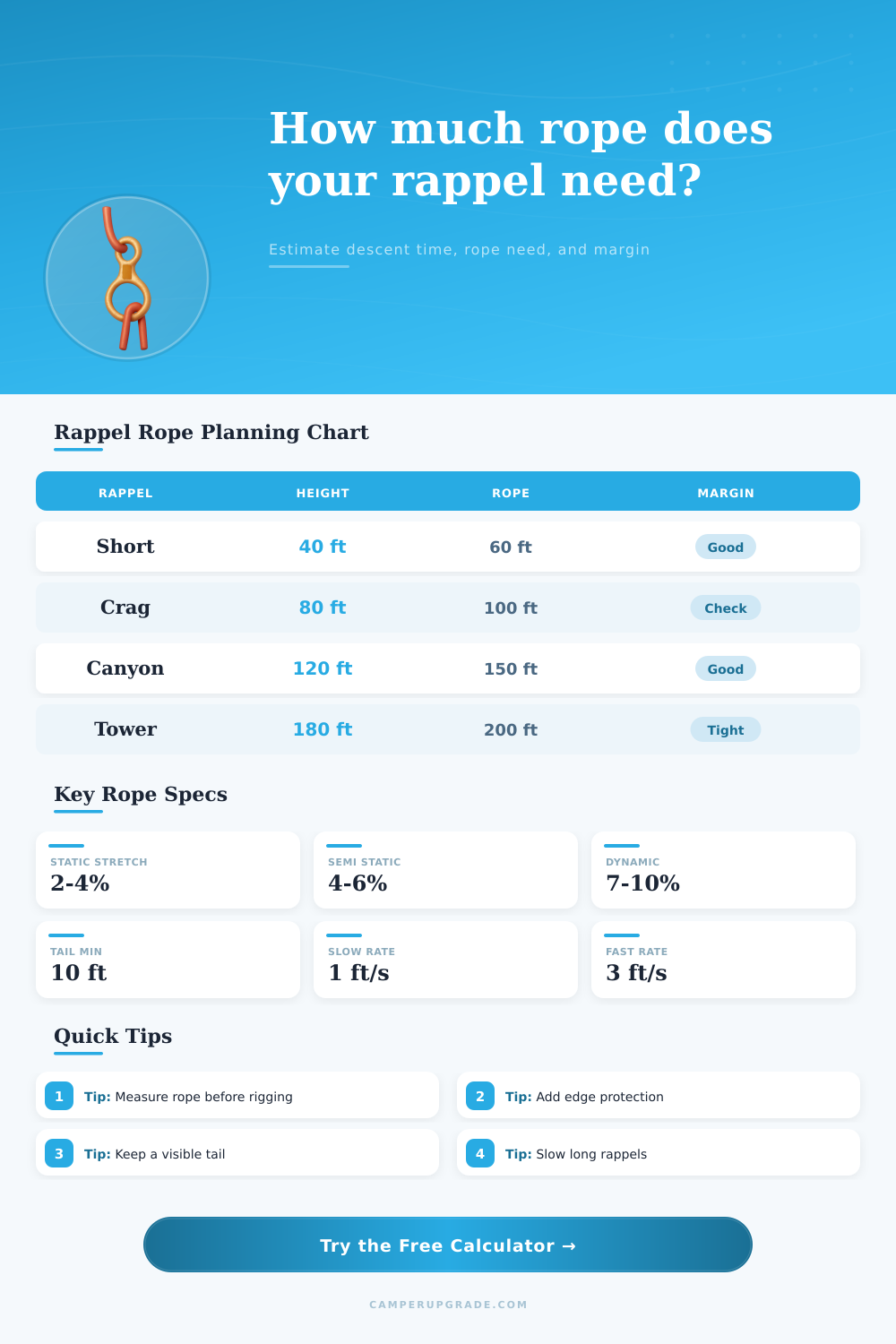
| Rappel height | Base rope need | With 10 ft tail | With 10% contingency |
|---|---|---|---|
| 40 ft short practice rappel | 40 ft | 50 ft | 55 ft |
| 80 ft single-pitch rappel | 80 ft | 90 ft | 99 ft |
| 120 ft canyon rappel | 120 ft | 130 ft | 143 ft |
| 160 ft wall rappel | 160 ft | 170 ft | 187 ft |
| 200 ft long descent | 200 ft | 210 ft | 231 ft |
| Rope category | Planning stretch | Typical use | Calculator note |
|---|---|---|---|
| Static rope, 10-11 mm | 2-4% | Rescue, access, fixed rappel lines | Use 3% as a conservative starting point |
| Semi-static rope, 9-10.5 mm | 4-6% | Canyons, caving, work positioning | Use 5% when exact spec is unknown |
| Dynamic single rope | 7-10% | Climbing ropes used for rappels | Use 8% or more for planning margin |
| Canyoneering rope | 3-5% | Wet rappels and abrasion exposure | Use 4% before checking the rope card |
| Thin specialty line | 5-9% | Skilled systems and compact kits | Use exact manufacturer data when available |
| Device | Heat factor | Friction feel | Planning caution |
|---|---|---|---|
| Tube-style belay device | 1.00 | Moderate | Watch heat on long fast rappels |
| Figure 8 descender | 1.15 | Smooth and fast | Higher caution with heavy loads |
| Canyon descender | 0.95 | Adjustable | Set friction before committing |
| Brake bar rack | 0.85 | Very adjustable | Good heat spread on long drops |
| Assisted-braking device | 1.10 | Controlled | Check rope diameter compatibility |
| Munter hitch | 1.20 | Variable | Add caution for rope twist and heat |
| Scenario | Height | Speed range | Planning note |
|---|---|---|---|
| Training wall or short crag | 25-50 ft | 0.8-1.5 ft/sec | Tail reserve often dominates rope margin |
| Single-pitch anchor | 60-100 ft | 1.0-2.0 ft/sec | Confirm rope reaches both ends before use |
| Canyon drop with edge | 80-160 ft | 0.7-1.5 ft/sec | Edge friction and wet rope can change feel |
| Big wall or tower descent | 140-220 ft | 0.6-1.2 ft/sec | Long time under friction raises heat caution |
| Heavy pack rappel | 50-140 ft | 0.5-1.0 ft/sec | Load weight increases control demand |
Rappel planning is a process that combine the physics of the situation with the decisions of the human. Furthermore, rappel planning is a process that help to manage the variables that occur when a person is on a rope. In planning a rappel, a person must measure more than just the height from the rappeller’s anchor to the ground.
The length of the rope that is lost to the stretch of the rope must be accounted for. Furthermore, the length of the rope that is lost to friction at the edges of the cliff must also be accounted for. Additionally, a person must account for the length of the rope that is required to create the rappel system’s knots and the tail reserve.
How to Plan a Safe Rappel and Calculate Rope Length
By using a rappel calculation calculator to calculate each of these variables, a person can determine the length of rope that is required for the rappel, and ensures that they dont forget any of the mental checklists when they begin to rappel. The inputs for the rappel calculation calculator include four different variable: the height that must be descended, the stretch allowance for the rope, the length of rope that is lost to friction at the edges of the cliff, and the length of rope that is used for the rappel system’s knots and tail reserve. The amount of stretch that occurs with a rope is one of the factors that must be accounted for in the rappel calculation; every rope will stretch when the rappeller is descending the wall.
Additionally, the amount of stretch will differ with the type of rope that is utilized. For instance, a static rope will exhibit a stretch of only 2-4% of the length of the rope, while dynamic ropes will stretch 7-10% of the length of the rope. If these percentages are not accounted for in the rappel calculation, a rappeller may find their rope several feet too short for the rappel.
The length of rope that is lost to friction at the edges of the cliff is another variable that is exhibited in the rappel calculation; any rope that is dragged across the edge of the cliff will exhibit friction that shortens the length of that rope. Finally, the length of rope that is required to create the rappel’s knots and tail is a third variable. Should any portion of the rope become visible beneath the rappeller when they land on the ground, it will indicate to the following rappeller that the rappel system isnt stuck on the cliff face.
Furthermore, a person must account for the amount of rope that is required for the creation of the tail in the rappel calculation. Factors related to the descent that will influence the rappel calculation calculator include the descent speed and the load that will be utilizing the rope. Descent speed is not just the speed that a rappeller will descend the cliff at; it also includes the time that they spend at the different cliff edges.
Additionally, the slower a person descends a cliff, the less likely it is that their descent device will become too hot to touch. Load weight is another variable that must be accounted for. The load weight will include the weight of the rappeller, their pack, the amount of water that they are carrying, and the weight of their rappel tools.
Additionally, the greater the weight of the rappeller and their gear, the more friction that will be generated at the rappel device. Three different variables are output by the rappel calculation calculator. The first variable is the length of rope that will be required to make the rappel.
The second variable is the length of rope that will remain in the rappeller’s coil after the rappel; this ensures that the rappeller does not have insufficient rope to descend the height that they have measured. The third variable is the amount of time that it will take for the rappeller to make the rappel descent. Finally, the rappel calculation calculator will provide an output of the heat caution that a rappeller should have for the rappel that is to be made; the higher the score for heat caution, the greater the heat that will be generated during the rappel.
Separate from the calculations made by the rappel calculation calculator are the variables that relate to the type of rope that will be used for the rappel. Static ropes will exhibit minimal changes to length when descending a cliff; they do not stretch as much as dynamic rope, and they exhibit abrasion resistance. These characteristics of static rope make it the default rope choice for many rappelling teams.
Semi-static ropes are another class of rope that includes characteristics that may be of interest to rappelling teams; semi-static rope exhibits some of the same characteristics as static rope, but is more tolerant to wet rock. Dynamic ropes will stretch more than static rope, and may be used when the anchor for the rappel is set back some distance from the cliff edge. However, the increased stretch of dynamic rope means that allowances for stretch will be made in the rappel plan.
A rope-type selector is included in the rappel calculation calculator to allow for the entering of a typical percentage of stretch for each type of rope. This input can be edited for the rappeller to adjust for the age, diameter, and the manufacturer of the specific rope that is to be used during the rappel. Many rappellers make mistakes when planning their rappels.
One mistake that many rappellers make is treating one variable as a fixed number when that variable can change. For instance, rope measurements are taken once for planning the rappel, but the rope may change with different temperatures, moisture, and loading of the rope prior to the rappel. Furthermore, many rappellers may make a mistake with the selection of descent speed; many rappellers will choose a descent speed that allows them to reach the ground quickly and efficient during their practice rappel.
However, a similar rate of descent may result in the rappel device overheating if the rappeller is descending a long distance with a heavy load. These variables are accounted for in tables included in the rappel calculation calculator. These tables will provide reference for the amount of rope that will be needed with different rappel heights, and how the percentage of stretch will change according to the rope category.
Additionally, these tables will help to show how a change in rappel device will impact the heat factor in the rappel. While helpful, these tables do not dictate the device that will be used. They provide a means of understanding the tradeoffs between the different rappel variables.
Factors related to the weather and the condition of the rappel cliff are three additional variables that impact a rappel but which cannot be seen by the rappel calculation calculator. For example, if the rope that will be utilized becomes wet during the rappel, it may pick up grit from the rocks that will increase the friction of the rope and increase the heat generated during the rappel. Similarly, if the rappel’s anchor is established in such a way that the rope experiences friction against a cliff edge, that variable can be seen in the rappel calculation calculator, but may have other factors that increase the friction of the rope.
These factors is additionally important to consider in instances in which the length of the remaining rope is close to zero. Another factor that may be considered prior to setting up the rappel system is the actual length of the rope that will be used. The length of the rope that is measured from the rappeller’s pack may not be the same as the length that is stated on the rope’s label.
For instance, ropes may shrink when they are left in a rappel pack for extended periods. Furthermore, ropes may be cut with slight margins of error when they are purchased from various ropemaking companies. Additionally, rope spools may be labeled to indicate the length of rope that they contain, but those labels may be outdated.
Thus, it is important for a team to measure the actual length of the rope that will be utilized. Once the length of the rope that will be used is known, the other variables within the rappel calculation calculator become easier to determine. Thus, planning with the rappel calculation calculator will allow a rappeller to determine the total length of rope that will be required for the rappel, the length of time that will be required to make the rappel, and the heat that may become a factor in the rappel.