Battery Watt Hour Calculator
Estimate nominal watt-hours, usable watt-hours, inverter runtime, and required battery count from voltage, amp-hours, depth of discharge, chemistry, inverter efficiency, load watts, runtime target, series strings, parallel strings, and temperature derate.
Battery watt-hour estimate
| Chemistry | Nominal voltage example | Planning DoD | Runtime note |
|---|---|---|---|
| LiFePO4 deep-cycle | 12.8V for 4 cells | 80-90% | Strong voltage stability for camper loads. |
| Lithium-ion power station | varies by pack | 75-85% | Use published DC or AC watt-hour rating when available. |
| AGM lead-acid | 12.0V nominal | 45-55% | High loads reduce practical runtime through voltage sag. |
| Gel lead-acid | 12.0V nominal | 45-55% | Plan conservative discharge and moderate current. |
| Flooded lead-acid | 12.0V nominal | 40-50% | Best runtime estimates use a lower usable fraction. |
| Bank setup | Nominal Wh | Usable Wh | Example runtime at 120W AC |
|---|---|---|---|
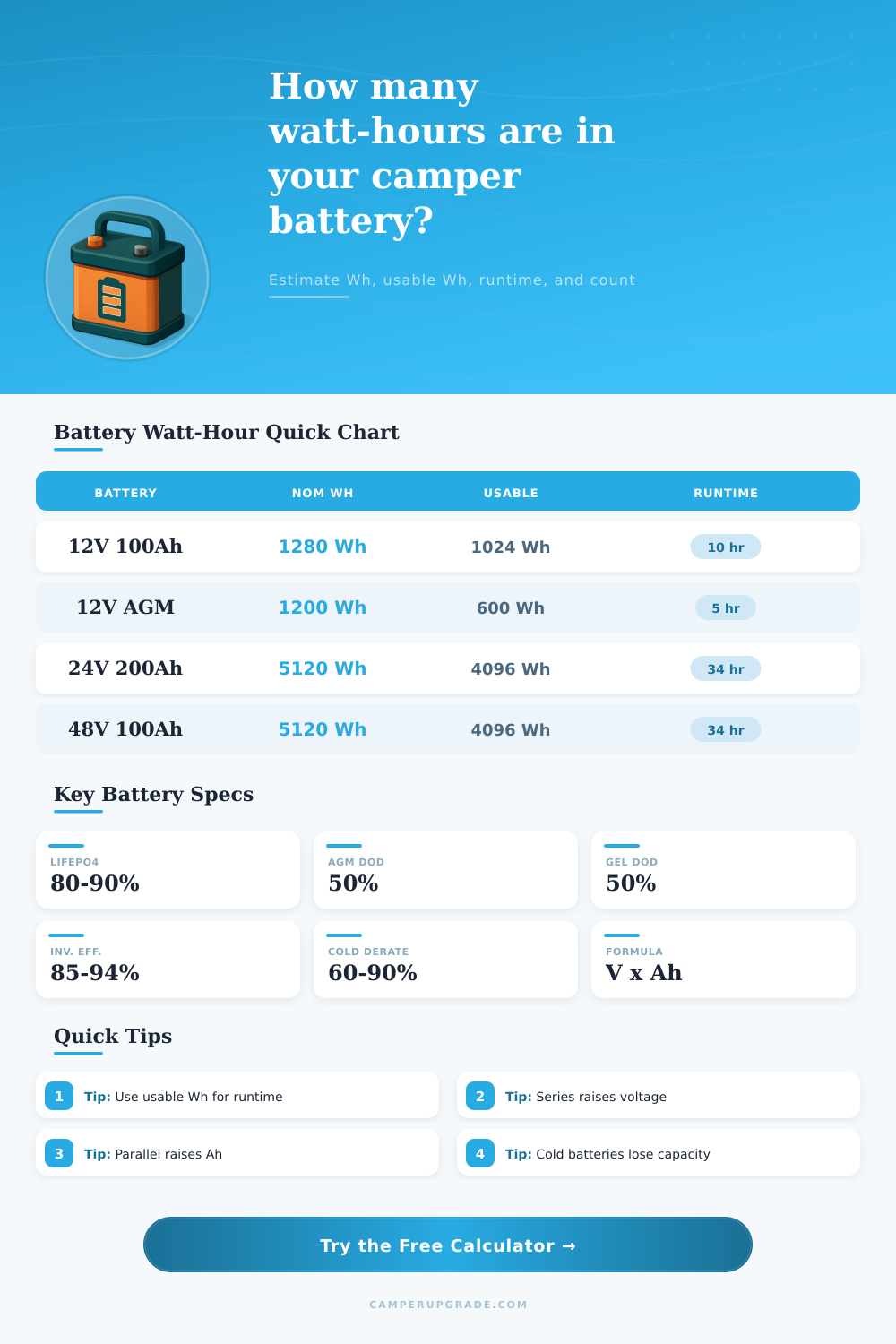
| 1 x 12.8V 100Ah LiFePO4 | 1,280 Wh | 1,024 Wh at 80% DoD | 7.7 hr at 90% inverter efficiency |
| 2 x 12.8V 100Ah LiFePO4 parallel | 2,560 Wh | 2,048 Wh at 80% DoD | 15.4 hr at 90% inverter efficiency |
| 2 x 12.8V 100Ah LiFePO4 series | 2,560 Wh | 2,048 Wh at 80% DoD | 15.4 hr at 90% inverter efficiency |
| 4 x 12.8V 100Ah LiFePO4, 2S2P | 5,120 Wh | 4,096 Wh at 80% DoD | 30.7 hr at 90% inverter efficiency |
| 1 x 12V 100Ah AGM | 1,200 Wh | 600 Wh at 50% DoD | 4.5 hr at 90% inverter efficiency |
| 2 x 12V 100Ah AGM parallel | 2,400 Wh | 1,200 Wh at 50% DoD | 9.0 hr at 90% inverter efficiency |
| Camper load | Typical watts | Use case | Energy for 8 hours |
|---|---|---|---|
| CPAP without heated humidifier | 35-70 W | Overnight medical device load | 280-560 Wh before inverter losses |
| 12V compressor fridge average | 25-55 W | Daily food storage average draw | 200-440 Wh before wiring losses |
| Starlink or satellite internet | 50-90 W | Evening remote work connection | 400-720 Wh before inverter losses |
| Laptop workstation | 60-140 W | Computer, monitor, and chargers | 480-1,120 Wh before inverter losses |
| Diesel heater electrical load | 15-45 W | Fan, controls, and fuel pump after startup | 120-360 Wh before wiring losses |
| Small induction or coffee load | 800-1,500 W | Short heating burst, not overnight | Use minutes instead of long runtime |
| Battery condition | Derate input | What it means | Planning note |
|---|---|---|---|
| Mild indoor battery bay | 95-100% | Near rated capacity | Good default for heated camper interiors. |
| Cool shoulder-season camping | 85-95% | Small capacity reduction | Useful for spring and fall nights. |
| Cold-soaked lithium bank | 70-85% | Capacity and charge limits matter | Confirm BMS low-temperature behavior. |
| Cold lead-acid bank | 60-80% | Voltage sag and lower usable energy | Use conservative DoD and derate together. |
| Hot battery compartment | 90-100% | Capacity may be present but lifespan falls | Runtime is not the only limit in heat. |
When planning a camper power system, one must determine the amount of energies that the batteries can provide to the camper’s lights, fridge, and devices. A person may look at the number of batteries that they have for their camper, but the number of batteries that will power the campers devices is not the most important factor. The most important factor is the length of time that the batteries will run those devices while the camper is camping and off-grid.
In the battery, there are two numbers that define the battery. Those two numbers are voltage and amp-hours. Both of these values tell only half of the story of the battery’s capacity.
How to Find Usable Energy from Camper Batteries
In order to find the battery’s nominal watt-hours, a person must perform a watt-hour calculation that finds the product of the battery’s voltage and its amp-hours. This value will tell a person how much usable energy the battery contains, and that number can be compared to the energy requirement of the camper’s devices. The voltage and amp-hour values will tell a person the total wattage capacity of the battery, but the usable energy that the battery will provide is less than this value.
The energy that can be drawn from the battery will be less than the calculated value because of various factors that will reduce the available energy from the battery. These factors include the depth of discharge of the battery, the temperature of the battery, the energy loss that the inverter will cause, how the batteries are wired to one another, the energy ratings of the batteries themselves, and the energy that the camper’s devices will use while camping. Each factor will reduce the amount of energy that will be available to the camper’s devices, and an online battery calculator can help to model each of these factors so that a person can find the usable energy that will be available to them.
The first factor that will reduce the energy of the battery is the depth of discharge of the battery. Most lead-acid batteries lose their lifespan rapidly if they are discharged to a level below half of the battery’s total capacity. In contrast, lithium iron phosphate batteries can handle deeper discharges of eighty or ninety percent of the battery’s total capacity without losing their lifespan as rapidly as lead-acid batteries.
Because of this ability to deeply discharge its batteries, a lithium iron phosphate battery can provide more usable energy than a lead-acid battery of the same size. The usable watt-hour figure from the battery calculator already takes into account the depth of discharge so that the number is representative of the energy that the camper can actualy use. The second factor that will reduce the amount of energy that a battery can provide is the impact that temperature has upon the battery.
Batteries will provide less energy to the camper than the battery specifications rate when it is colder outside. The impact of cold weather upon lead-acid batteries is stronger then the impact that it has upon lithium batteries. A battery bank may lose twenty or thirty percent of its total battery capacity in response to cold weather conditions.
The temperature derate feature in the battery calculator will help a person to model the amount of energy that will be lost due to cold weather. The third factor that will reduce the amount of usable energy that is provided from the battery bank is the energy that the inverter loses. An inverter will lose energy as heat due to the translation of DC energy to AC energy.
High-quality inverters will still lose energy at a rate of between six and fifteen percent of the total energy that it translates. The runtime estimates from the battery calculator account for the energy loss of the inverter so that a person can accurately model how much energy is available to each device based off whether the device is directly connected to the battery or an inverter. The fourth factor that may impact the amount of energy available to a camper is the way in which the batteries are wired together.
The total amount of energy that the battery bank provides is not affected by how batteries are wired in series or in parallel with one another. If batteries are placed in series with one another, the voltage of the battery bank is increased. If the batteries are placed in parallel with one another, the amount of amp-hours that the battery bank can provide is increased.
However, the total number of watt-hours that the battery bank can provide is not altered by its wiring configuration. Higher voltages require less current to provide the same amount of power to the camper’s devices. A higher voltage battery bank will allow for the camping battery bank to use smaller diameter cables to transport the energy to the camper’s devices.
The resulting voltage and amp-hours of the battery bank can be seen on the battery calculator. The fifth factor that may impact the energy available to the camper is the energy ratings of the batteries themselves. Each battery has a different amount of energy that it can provide to the devices based upon its chemical composition.
A battery calculator will model each of these factors in the calculation of the available energy of the battery bank. The next factor that will impact the amount of energy available to the camper’s devices is the number of watts that each device uses. Devices such as a CPAP machine may use less than one hundred watts, but devices such as a laptop workstation with a monitor may use more than one hundred and twenty watts.
An eight-hour running time may be specified for a CPAP machine, but that same amount of running time will use a significantly different amount of energy from a laptop workstation. Seeing the wattage that the camper’s devices require will allow the camper to more easily determine how many batteries of each type are required to power the devices. Two common mistakes that campers may make when attempting to calculate the energy that will be available from their batteries are underestimating the energy requirement of the batteries of their devices, and failing to account for devices that require a high wattage of energy even if they are not continuously running.
An energy calculator will show how a device with high wattage and short run times will use up some of the total usable energy of the battery bank. The last factor that will reduce the amount of energy that is available to the camper’s devices is the energy lost due to the resistance of the wires that connect each device to the battery bank. In addition to the resistance of the wires that are connected to each device, the Battery Management System of the batteries may place limits upon the amount of current that passes through the battery bank.
Finally, because the batteries will age, the energy that each battery can provide to the devices will decrease over time. Each of these factors will reduce the energy that the battery bank can provide to the camper’s devices. Therefore, a person should of purchase batteries that can provide more energy than the battery calculator calculates for the devices that will be using that energy.
The energy that the battery bank calculates will be lost to each of these factors, so providing a buffer of extra energy for each device will ensure that the batteries will last for the camper for the length of their camping trip. By calculating each of these factors and how much energy the camper’s devices will use, a person will be able to understand the energy requirements of their devices rather than having to guess at those requirements.