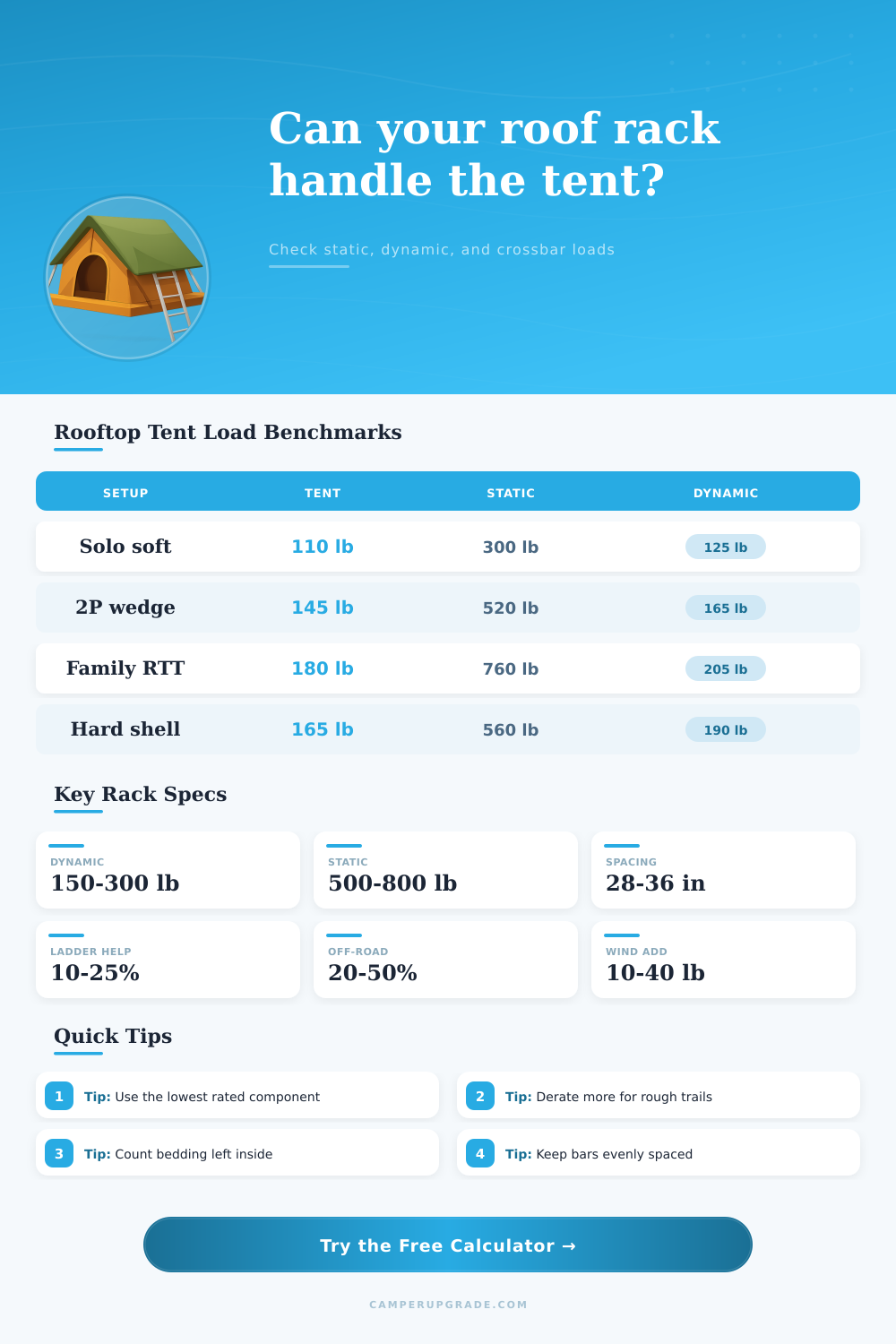
Rooftop Tent Weight Calculator
Estimate static roof load, dynamic travel load, rack safety margin, and per-crossbar load before mounting a rooftop tent.
| Preset | Tent Weight | Occupants | Bedding | Typical Support |
|---|---|---|---|---|
| Solo soft shell | 105 to 125 lb | 1 | 15 to 25 lb | 2 bars, 28 to 32 in spacing |
| Two-person soft shell | 130 to 160 lb | 2 | 25 to 40 lb | 2 bars, 30 to 36 in spacing |
| Wedge hard shell | 145 to 175 lb | 2 | 20 to 35 lb | 2 bars or short platform |
| Family fold-out | 165 to 210 lb | 3 to 4 | 40 to 70 lb | 3 bars or full platform |
| Canvas expedition | 185 to 240 lb | 2 to 3 | 35 to 60 lb | platform rack, high static rating |
| Check | Load Used | Rating Used | Good Margin | Why It Matters |
|---|---|---|---|---|
| Parked static rack | Tent + bedding + roof-carried occupants | Rack static rating | 10% or more | Sleep load is much higher than driving load. |
| Driving rack | Tent + bedding + wind allowance | Rack dynamic after derate | 15% or more | Trail impacts multiply stress on bars and towers. |
| Vehicle roof | Dynamic travel load | Vehicle roof rating after derate | 0% or more | The vehicle roof limit can be lower than the rack. |
| Crossbar share | Travel load divided by support count | Single bar working rating | 10% or more | Uneven rails and clamps can concentrate load. |
| Spacing | Tent base span | Manufacturer mounting range | Within range | Too-close bars can bend rails or tent floors. |
| Support Layout | Spacing Range | Load Pattern | Best For | Watch Point |
|---|---|---|---|---|
| Two crossbars | 28 to 36 in | About 50% per bar | Most compact and 2-person tents | Confirm rail clamp positions. |
| Three crossbars | 24 to 34 in between bars | About 33% per bar | Long hard shells and family tents | Middle bar should actually contact support rails. |
| Platform rack slats | Slats under full rail length | Distributed load | Heavy tents and rough roads | Use rated mounting feet and towers. |
| Bed rack rails | Often 30 to 48 in | Lower vehicle roof stress | Pickup tents and overlanding racks | Check bed rack dynamic rating separately. |
| Factory crossbars | Varies widely | Usually lowest rating | Light tents only if approved | Many factory bars are not RTT rated. |
| Travel Condition | Wind Add-On | Off-Road Derate | Planning Use | Result Effect |
|---|---|---|---|---|
| Highway, calm weather | 10 to 20 lb | 0% to 10% | Paved travel with secure mounts | Small dynamic allowance |
| Crosswind or tall tent | 20 to 40 lb | 10% to 20% | Boxy soft shells and exposed routes | Higher travel load and lower margin |
| Graded gravel | 15 to 30 lb | 20% to 30% | Moderate corrugation or forest roads | Dynamic rating is reduced |
| Washboard trail | 20 to 40 lb | 30% to 50% | Repeated vibration and impacts | Rack margin can disappear quickly |
| Technical off-road | 30 to 60 lb | 40% to 60% | Slow trails, ruts, and side loads | Use conservative ratings only |
This calculator estimates vertical planning loads. It does not replace the tent, rack, crossbar, tower, vehicle, or mounting hardware manufacturer limits.
When mounting a rooftop tent to a vehicle, there are several factors to consider. Specifically, you must consider the weight of a rooftop tent and some of the vehicle component. The additional weight of the rooftop tent include the rooftop tents weight, the weight of the individuals that will sleep in the rooftop tent, and the gear that will be inside the rooftop tent.
These weight must be divided into the static load and the dynamic load of the vehicle. The static load are the total weight of the rooftop tent, the individuals, and the gear when the vehicle is stopped. The dynamic load is the force that the wind acting on the tent create.
Check Rooftop Tent Weight and Roof Limits
Beyond considering the weight of the rooftop tent and it’s components, it is also critical to consider the weight capacity of the vehicle roof. While many people believes that the weight capacity of the roof rack equals the weight capacity of the vehicle roof, the weight capacity of the vehicle roof is often lower than the roof rack. If the vehicle has a panoramic roof or is unibody, the roof capacity will be lower than other vehicles.
You must compare the dynamic load of the rooftop tent to both the roof rack and roof capacity of the vehicle. The lowest weight capacity is the maximum weight that the tent and vehicle will carry. The type of road that is driven also impacts the dynamic load of the rooftop tent.
If the roads driven on have washboard roads or forest roads, the vibration that are created will impact the rooftop tents mounting points. Using an off-road derate factor will account for these vibrations. The dynamic load specification of the rooftop tent is only a starting point when estimating the dynamic load that will be placed on the rooftop tent because the type of road driven on can change.
The number of crossbar that are used to mount the tent will impact how the weight of the tent is distributed to the vehicle. If two crossbars are used, the weight will be distributed to each crossbar equally. Using three crossbars will spread the weight of the tent to each of the three crossbars.
The crossbar spacing must be set to allow for the tents rails to allow for even weight distribution. The crossbars cant be too narrow or too wide. Additionally, the weight of the individuals can be distributed to a ladder that is placed on solid ground.
By placing the individuals on the ladder, you will reduce the weight that is applied to the roof of the vehicle. The force of the wind will also impact the roof and the rooftop tent. The wind will create a dynamic load on the tent and the vehicle.
This dynamic load must be accounted for in the weight calculation of the tent. In areas where the wind is strong, or in vehicles with high rooftop tents, you must account for the dynamic load of the wind in the calculations by increasing the allowance for the dynamic load of the wind. Using the calculator will allow you to calculate the safety margin for the rooftop tent.
A positive safety margin will indicate that there is extra capacity for additional gear or for driving on rough road. A small safety margin will indicate that additional crossbars or gear need to be removed from the rooftop tent. The tent, rooftop mounting hardware, crossbars, and the vehicle roof can be viewed as one single system.
Calculations should of been performed before the purchase of the rooftop tent and after the tent has been used for one season.