Quilt Fill Weight Calculator
Estimate fill ounces, loft target, overstuff weight, and finished camping quilt weight from dimensions, taper, fill power, baffle height, and warmth profile.
Quilt fill estimate
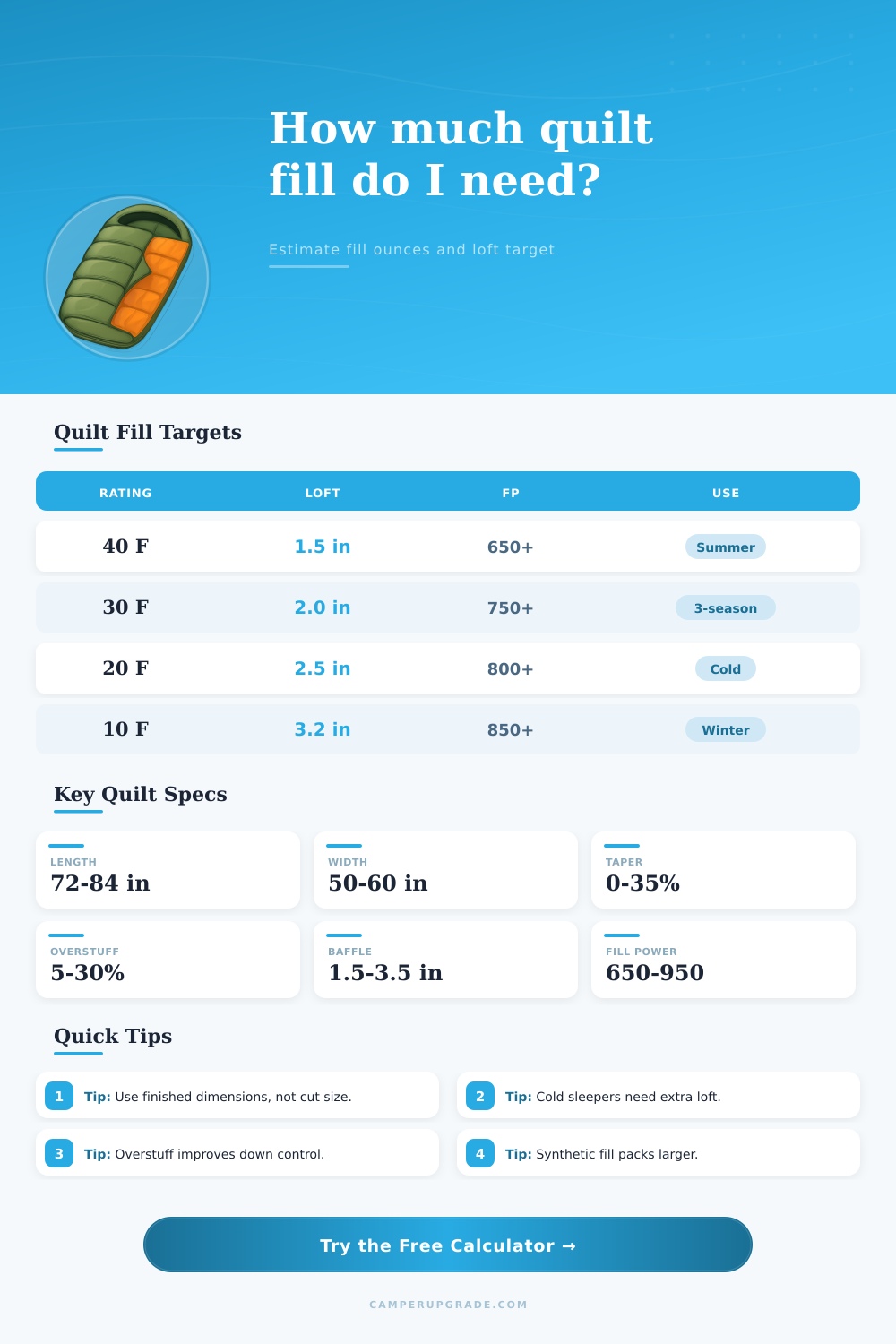
| Target rating | Typical loft | Baffle height | Best use |
|---|---|---|---|
| 50°F | 1.0 to 1.2 in | 1.0 to 1.5 in | Warm summer trips |
| 40°F | 1.4 to 1.7 in | 1.5 to 2.0 in | Summer and mild shoulder |
| 30°F | 1.9 to 2.2 in | 2.0 to 2.5 in | Three-season camping |
| 20°F | 2.4 to 2.8 in | 2.5 to 3.0 in | Cold shoulder season |
| 10°F | 3.1 to 3.5 in | 3.0 to 3.8 in | Winter sleeping systems |
| Fill type | Efficiency used | Overstuff norm | Planning note |
|---|---|---|---|
| 900 to 950 fp goose | 96% to 98% | 8% to 15% | Best warmth-to-weight |
| 800 to 850 fp down | 92% to 95% | 10% to 18% | Most quilt builds |
| 650 to 750 fp down | 86% to 90% | 12% to 22% | More fill weight needed |
| Synthetic sheet | 76% to 82% | 0% to 8% | Volume estimate only |
| Loose synthetic | 70% to 78% | 5% to 15% | Bulkier for same loft |
| Shell allowance | Typical fabric | Finished effect | Use case |
|---|---|---|---|
| 0.8 to 1.0 oz/yd² | Very light nylon | Lowest shell weight | Careful ultralight use |
| 1.1 to 1.3 oz/yd² | Common calendared nylon | Balanced durability | Backpacking quilts |
| 1.4 to 1.7 oz/yd² | Robust shell fabric | Higher total weight | Camp and dog use |
| 1.8 to 2.5 oz/yd² | Heavy liner or trim | Large shell penalty | Car camping builds |
| Preset | Size | Rating | Fill spec |
|---|---|---|---|
| Summer top quilt | 72 x 50 in | 40°F | 800 fp, 8% OS |
| Three-season top | 78 x 54 in | 20°F | 850 fp, 15% OS |
| Wide cold sleeper | 80 x 58 in | 15°F | 900 fp, 20% OS |
| Hammock underquilt | 76 x 48 in | 20°F | 850 fp, 18% OS |
| Synthetic Apex | 74 x 52 in | 35°F | 500 fp eq, 4% OS |
To design a good camping quilt, one must first determine how much insulation are required for that camping quilt. The temperature rating of the camping quilt, the sleep tendencies of the person who will be sleeping within the sleeping bag, and the physical shape of the camping quilt can influence the amount of insulation that is required. Once you have determined these three variables, you can begin to consider the weight of the camping quilt.
Fill weight is a critical value to determine for the camping quilt, and will determine how much loft that camping quilt will provide. If the camping quilt contains sufficient fill weight, it will feel lofty during it intended use in a 25-degree night. However, if the camping quilt dont have the correct amount of fill weight, the insulation may collapse when the sleeping person reaches for sleep.
How to Design a Camping Quilt
Thus, before using the calculator, the sleeping person must make a decision as to the temperature of the sleeping area for which the sleeping person is designing the camping quilt. Further, it is also necessary to decide how much loft is required in addition to the sleeping persons body. This will influence the total amount of fill that is required for the camping quilt.
Many people use the advertised comfort rating to determine the fill weight that they will use in their sleeping bag. However, the comfort ratings may not accurately describe the sleeping capabilities of each individual person. For instance, some people may feel that they tend to run cold, while other people has issues with feeling too warm within their sleeping bags.
Thus, it is helpful to incorporate the warmth factor adjustment within the calculator to adjust for either cold sleepers or warm sleepers. The dimensions of the camping quilt are also important to take into consideration. For example, a camping quilt with dimensions of 78 inches by 54 inches may have a different amount of required insulation than a camping quilt with different dimension.
The calculator will determine the area of the camping quilt based off the average of the shoulder and foot widths of the camping quilt. Additionally, different multiplier are applied according to the function of the camping quilt (underquilt, ground quilt, or sleeping bag top layer). Thus, any change in the width or taper of the sleeping bag will change the amount of insulation that is required in several ounces.
For this reason, it is necessary to measure the camping quilt when it is finished being constructed. Baffle height and fill power will have an impact upon how much loft the camping quilt provides. If the camping quilt has baffle heights that are too short for the desired loft for the sleeping area, the insulation will compress to the height of the baffles.
Thus, should the baffle heights and the loft not match within the calculator, a note will be provided that states such a change. Additionally, using large baffles with low loft values can allow the insulation to shift within the sleeping bag, which can lead to the formation of cold spots within that sleeping bag. Overstuff is another variable in the equation that will impact sleeping bags.
Adding extra fill to the sleeping bag increases the internal pressure within each chamber of the sleeping bag. This internal pressure is what enables the down within the sleeping bag to resist shifting from one area to another. Thus, overstuffing sleeping bags ensures that down will remain lofty.
However, overstuffing also increases the weight of the sleeping bag. Therefore, a decision must be made as to if the sleeping bag will accept the additional weight. Most people choose an overstuff percentage of between 10 and 20 percent for sleeping bags.
The weight of the shell fabric for the sleeping bag and the hardware for the sleeping bag will impact the total weight of the sleeping bag. The calculator includes the allowances for shell weight, baffle mesh, and trim. For instance, changing from a 1.1 ounce nylon shell weight to a 1.6 ounce nylon shell will impact the total weight of the sleeping bag, even if the amount of insulation within the sleeping bag does not change.
Thus, if there are any specific limit to the total weight of the sleep system, it is important to consider the weight of the shell and its components. Synthetic insulation will have a different efficiency compared to down insulation. Synthetic insulation has lower efficiency percentages compared to down insulation, and synthetic insulation does not take advantage of the same percentages of overstuff with which down insulation can be overstuffed to create resistance within the sleeping bag.
Thus, if synthetic sleeping bags are chosen, the sleeping bag will be bulkier. However, individuals who wish to have a sleeping bag with wet weather performance that is more above that of down insulation may choose synthetic insulation. Thus, the choice of synthetic versus down will influence the total weight of the sleeping bag if the sleeping person desires the lowest possible weight for camping trips.
There are four specific figures that will result from utilizing the camping sleeping bag weight calculator. The first is the fill ounces, which will show how much insulation is required for the sleeping bag. The second is the loft target, which will reconfirm the temperature and warmth settings for the sleeping bag.
The third is the overstuff that is to be added to the sleeping bag, which will indicate the weight of the sleeping bag that will be taken. Finally, the fourth figure is the finished sleeping bag weight, which will encompass the weight of all the individual components. These figures will allow the sleeping bag designer to avoid mistakes in buying and insulating the sleeping bag for camping trips.
When designing camping sleeping bags, compromises must be made. For instance, it is impossible to create a sleeping bag with the lowest possible weight, the highest possible loft, and the simplest construction possible. Each variable within the calculator will allow a designer to make trade-offs between these different variable in the sleeping bag.
Each designer must make a decision as to whether they wish to have the sleeping bag with the lowest possible weight, or whether consistency of loft is more important than having a sleeping bag that may be heavier in weight. Thus, the sleeping bag must be designed in a manner that matches the conditions of the trips that the sleeping person will take.