Camper Van Water Tank Size Calculator
Estimate fresh tank size, gray tank size, full water weight, and practical off-grid autonomy from van crew size, daily water habits, reserve margin, tank shape, and payload limit.
📌Van Water-Use Presets
⚙Trip Water Inputs
Water Use Breakdown
📊Tank and Payload Spec Grid
📘Van Water Reference Tables
Daily Van Water Use Styles
| Use Style | Per Person | Shared Use | Notes |
|---|---|---|---|
| Ultra conservative | 1-2 gal | 1-2 gal | Gym showers, basin dishes |
| Moderate van life | 2-3 gal | 3-6 gal | Sink, cooking, light cleaning |
| Navy shower routine | 3-5 gal | 4-8 gal | Short showers, careful rinsing |
| High comfort | 5-8 gal | 6-12 gal | Indoor showers and frequent dishes |
Fresh Tank Sizing Examples
| Scenario | Daily Use | Days | Fresh Tank |
|---|---|---|---|
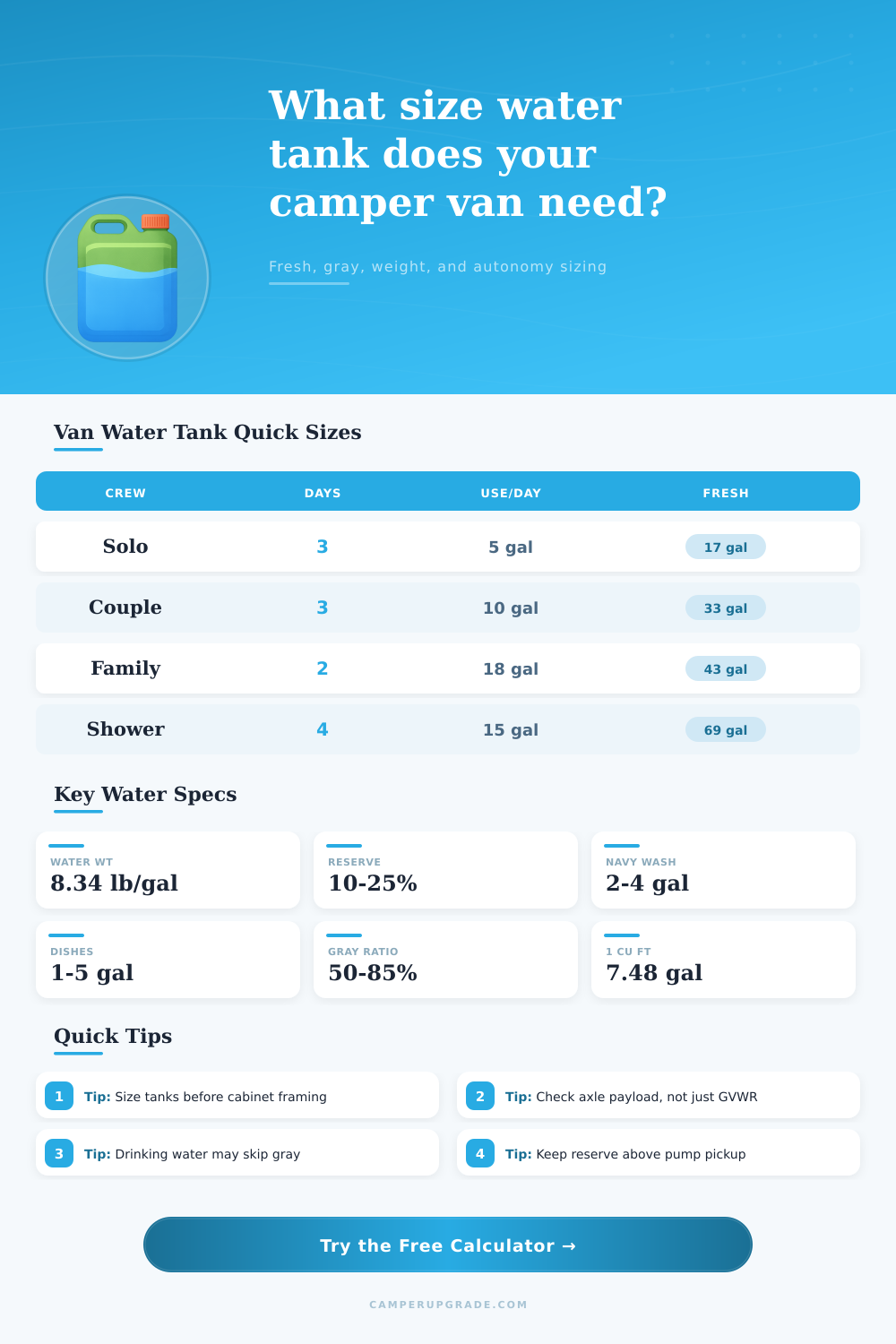
| Solo dry camper | 5 gal | 3 | 18 gal at 20% |
| Couple weekend | 10 gal | 3 | 35 gal at 15% |
| Family compact | 18 gal | 2 | 44 gal at 20% |
| Remote couple | 14 gal | 5 | 88 gal at 25% |
Gray Tank Ratio Guide
| Ratio | Best For | Includes | Watch Point |
|---|---|---|---|
| 45-55% | Outdoor shower users | Dishes, sink | Some water leaves the van |
| 60-70% | Typical galley vans | Sink and some shower | Good default range |
| 75-85% | Indoor wet bath vans | Sink, shower, cleaning | Gray may fill first |
| Custom | Split systems | Separate jugs or drains | Track actual captures |
Shape Capacity Notes
| Shape | Capacity Formula | Fit Use | Loss Factor |
|---|---|---|---|
| Rectangular | L x W x H / 231 | Under bed, cabinets | Usable fill only |
| Notched | Box x 0.82 / 231 | Wheel well spaces | About 18% shape loss |
| Cylinder | Pi x r2 x L / 231 | Round marine tanks | Usable fill only |
| Low profile | Box x 0.92 / 231 | Floor cavities | About 8% shape loss |
💡Calculation Tips
Planning a camper van trip involve considering various factors. One of the primary factors that will determine your comfort on the trip will be the management of water. You can choose to carry a small amount of water for your trip, or you can choose the size of the water system to accommodate your daily use of the water.
If you dont have enough water for your trip, you will have to ration the amount of water you use, which will make certain task more difficult. The amount of water that is used while camping in a camper van can vary depending on the numbers of individuals that are traveling within the camper van. For instance, if one person is traveling, who will be using the gym for there showers, but only using a small sink for there dishes, then they will use less water than a group of individuals who might have similar needs.
Choose the Right Water Tank Size for Your Camper Van
The addition of a second individual to the camper van will increase the amount of water that the camper van will use. Various activities will use the water while traveling in a camper van, and the amount of water that is used for drinking, cooking, and rinsing will eventually go into a gray water tank on the camper van. While the reserve capacity for the water system in the camper van is a critical component to include, many individual underestimate this component.
Including a reserve capacity for the water system, such as providing a fifteen percent reserve, will protect the water system from unexpected situations. There are situations in which it may be difficult to reach all of the water that is in the tank. The reserve capacity will additionally protect the water pump from damage caused by the pump running dry.
The calculator can be used to adjust for this reserve capacity to determine the total size of the water tank that would be required for the camper van with this reserve capacity. The payload that the camper van can carry will limit the amount of water that can be carried within the camper van. Because water weigh eight pounds per gallon, this will add to the payload of the camper van.
The payload also includes the weight of the passengers, the batteries, the camping tools, and the food that will be carried within the camper van. The weight of the water will impact the payload of the camper van, so if the total weight of the water is too great for the camper vans payload, then the camper van will change in how it handles on the road. The remaining payload that the camper van can use must be determined to ensure that the size of the water tank that is to be used is realistic for the camper van.
The shape in which the water tank is formed will impact the amount of water that the tank can hold. If the water tank is in the shape of a rectangle, it will be more easier to measure the amount of water that the tank can hold. However, a tank that has curves or notches in the tank will lose some of the volume of the tank.
Additionally, the volume of water that can be stored within a cylindrical tank will vary depending on the position of the tank and the height of the pickup tube that is used to fill the tank with water. These factors are accounted for in the calculator to determine the actual volume of the water tank that the camper van can use rather than the volume of the tank that is represented in the tank itself. The sizing of the gray water tank in the camper van is separate from the sizing of the fresh water tank, but the size of the gray water tank is related to the amount of water that the individuals in the camper van use.
Not all of the fresh water that is used will become gray water. For instance, if an individual uses the water for drinking, then that water will not become gray water. Furthermore, if an individual takes a shower outside of the camper van, then that water will not enter the gray water tank.
However, if the individual uses a wet bath within the camper van, then most of the water that is used will become gray water. Many individuals make mistake when they try to determine the size of the water tanks in their camper vans. For instance, they may correctly calculate the size of the fresh water tank but not the size of the gray water tank.
In this instance, the gray water tank may have to be emptied more often then they have calculated during their trip. Another mistake occurs when the size of the water tank is established based on the available space within the camper van. In this situation, the individual may not take into account the payload of the camper van.
By using the calculator a variety of different settings, it is possible to avoid these potential mistakes. Various environmental factors will impact the amount of water that is used in the camper van. For instance, hot weather will impact the amount of water that is needed for drinking water and for rinsing the body.
Cold weather will lead to an increase in the amount of water that is used within the camper van for cooking within the camper van. This impact on the amount of water will impact the amount of gray water that the camper van creates. By using the water tank calculator, an individual will be able to establish the amount of each type of water tank that will be needed.
Additionally, by logging the actual amount of water that is used during these trips, an individual will be able to adjust the settings within the calculator for their future trips. The goal in establishing water tanks in a camper van is to ensure that the water tanks are of a size that correctly matches the individuals habits while traveling in a camper van. The size of the water tanks do not necessarily have to be the largest tanks that are available, but they should be large enough to accommodate the individuals needs.
By correctly calculating the size of both the fresh and gray water tanks, by calculating the weight of the water, by calculating the size of the tanks, and ensuring that the total weight of the water tanks does not exceed the payload of the camper van, the water system will function correctly within the camper van. Additionally, by using the water tank calculator to determine how large each water tank should be, the individual can create a plan for their camper van that they can trust for their upcoming trips.