Camper Van Insulation R Value Calculator
Estimate effective R value, BTU heat loss, target thickness, and condensation risk from van surfaces, material choice, bridging, windows, ventilation, and climate.
🚙Van Insulation Presets
⚙Calculator Inputs
🧱Insulation Material Spec Grid
📊Reference Tables
| Material | R per inch | Moisture behavior | Van fit note |
|---|---|---|---|
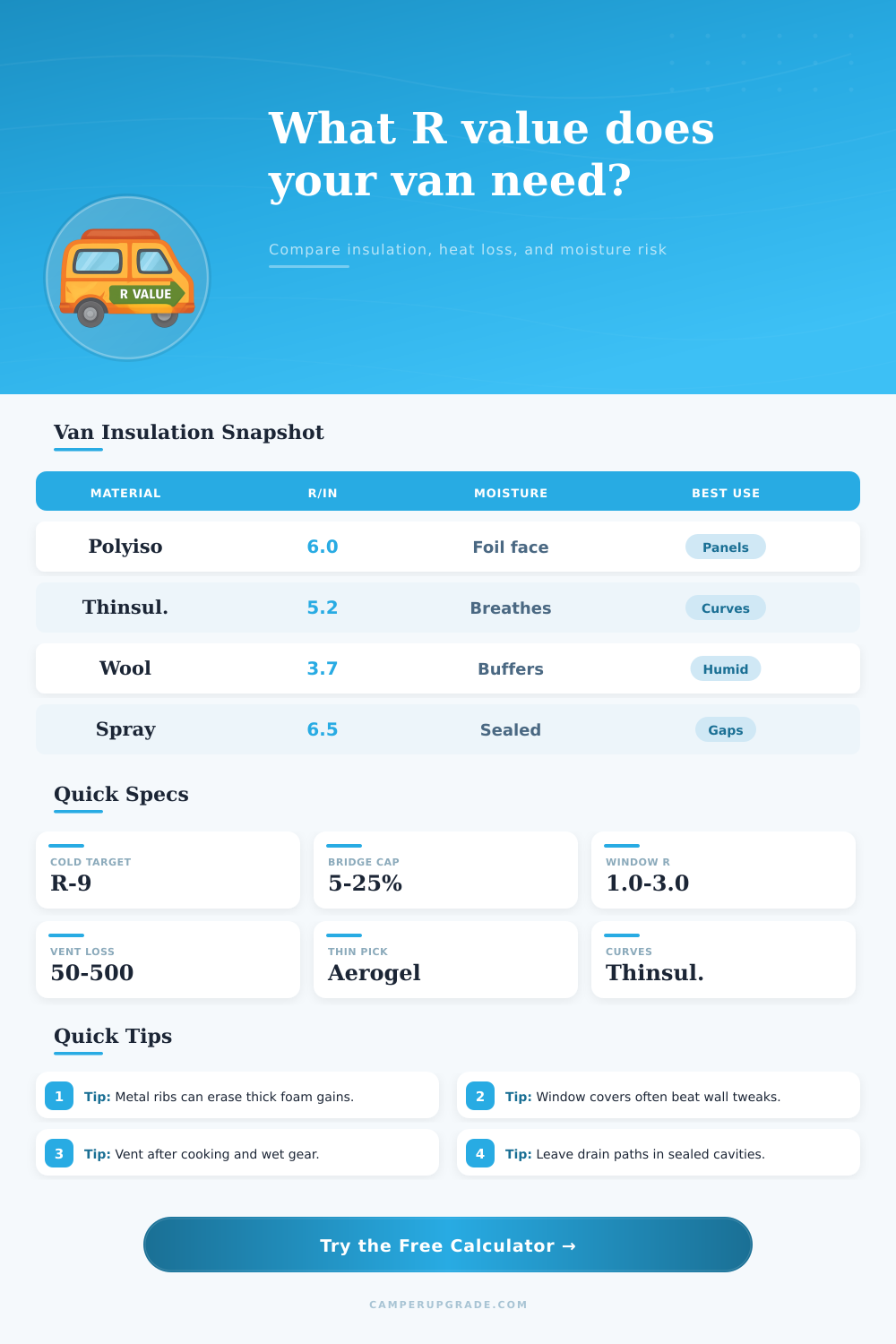
| Thinsulate-style mat | 5.2 | Dries through fibers | Curved panels and ribs |
| Foil-faced polyiso | 6.0 | Foil facer blocks vapor | Flat wall and ceiling bays |
| XPS foam board | 5.0 | Low water absorption | Floors and simple panels |
| EPS foam board | 3.8 | Needs protected seams | Budget flat cavities |
| Sheep wool batt | 3.7 | Buffers moisture swings | Humid mixed climates |
| Fiberglass batt | 3.2 | Loses value when damp | Only with careful air control |
| Closed-cell spray foam | 6.5 | Air and vapor resistant | Complex ribs and gaps |
| Aerogel blanket | 10.0 | Hydrophobic grades vary | Thin high-R details |
| Minicell foam | 4.0 | Closed-cell cushion | Floor strips and pads |
| Recycled denim batt | 3.5 | Must stay dry | Quiet dry-weather cavities |
| Climate zone | Target effective R | Moisture priority | Planning note |
|---|---|---|---|
| Mild marine | R-5 | Drying path | Windows often dominate loss |
| Mixed cool nights | R-7 | Vent after sleep | Good target for most touring vans |
| Cold mountain winter | R-9 | Bridge control | Cover ribs and door metal |
| Severe winter | R-11 | Condensation control | Thin metal paths become limiting |
| Hot dry sun | R-6 | Radiant roof control | Ceiling and window shade matter |
| Hot humid coastal | R-6 | Air sealing balance | Dry interior moisture promptly |
| Bridge share | Example path | Effect on thick insulation | Best correction |
|---|---|---|---|
| 5% | Few exposed ribs | Small R penalty | Continuous liner strips |
| 12% | Typical panel ribs | Noticeable R penalty | Cover pillars and fasteners |
| 20% | Many metal paths | Can cap effective R | Thermal break furring |
| 30% | Exposed cargo metal | Major heat shortcut | Add continuous interior layer |
| Condition | Dew point gap | Risk band | Calculator response |
|---|---|---|---|
| Surface 10 F above dew point | Wide | Low | Monitor windows first |
| Surface 4-10 F above dew point | Moderate | Guarded | Vent after sleeping |
| Surface 0-4 F above dew point | Narrow | High | Reduce humidity or bridge paths |
| Surface below dew point | Negative | Severe | Expect wet metal or hidden damp |
When making decisions about insulation in a camper van, there is several factors to consider. The spaces within camper vans tend to be small, and the surfaces of camper vans tend to be irregular. In addition, the temperature swings within camper vans can be dramatic.
As such, you have to consider how much heat will leak out of the camper van once the insulation is install in areas like the ribs, the windows, and the vents. There is often a gap between the performance of insulation as labeled by the manufacturer and the actual performance of the insulation. This difference in performance can lead to condensation within the camper van.
How to Choose Insulation for Your Camper Van
The performance of insulation change in response to a few different factors. First, the performance changes when there is metal within the camper van. Second, the type of window coverings you use on the camper van can change the performance of the insulation while you sleep on the sleeping areas of the camper van.
Materials with a high R-value per inch of thickness may lose that advantage if metal ribs of the camper van is bridging the insulation on the interior of the camper vans walls. These metal ribs will allow heat to escape from the camper van. The windows of the camper van will also allow heat to escape.
The amount of heat that will escape through the windows may be more greater than that which will escape through thin layers of insulation. People often find that the cost of insulating the walls of the camper van has a smaller impact on the comfort within the camper van than they had originally considered because heat escape through the windows. In order to make sound decisions regarding insulation, you must understand the relationship between insulation thickness, area, and your climate.
Using a calculator can allow you to enter the thickness of the insulation that you will use on your camper van, the area of each part of the camper van that will be insulated, and the climate in which you will use your camper van. Based on these variables, the calculator will provide information regarding the effective R-value of the insulation within your camper van after accounting for bridging of the insulation by the metal ribs of the camper van, the total heat loss of the camper van in BTU per hour, and the thickness of the insulation that you will need to achieve your target R-value for your climate. Each of these variables will help you understand how hard the heating or air conditioning system within your camper van will have to work.
The heat loss of your camper van will not be limited to the walls of the camper van. Other areas of the camper van that can lead to heat loss include the roof vents, the gaps of the windows of the camper van, and the door seal of the camper van. Using the camper vans fan to allow fresh air into the camper van or leaving a vent open while cooking within the camper van will also increase the loss of heat from the camper van.
Each of these variables can be entered into the calculator. In addition, the amount of moisture within the camper van is another variable that will impact the environment within the camper van. If you increase the humidity within the camper van, the dew point of the air within the camper van will change.
The new dew point will determine how close the interior surfaces of the camper van come to reaching the dew point at which condensation of water will form on those surfaces. The risk of condensation of water within the camper van can be entered into the calculator along with the other variables so that the calculator can show you if you are within a comfortable range of moisture levels or if the moisture within the camper van will lead to condensation on the metal surfaces of the camper van. The factor of bridging deserves some special consideration.
Bridging can often be underestimated when building insulation for a camper van. The R-value of the insulation can be limited by bridging even if the percentage of the surfaces of the camper van that is bridged is small. This is why it is important to include the bridging percentage of your camper van within the calculator.
Continuous coverage of the surfaces of the campervan is more important than the depth of the insulation. A few methods to avoid bridging include adding furring strip to the camper van or covering the pillars of the camper van. Using window covers or adding extra insulation to the ceiling of the camper van are other methods to avoid bridging.
Different climates will require different insulation levels within a camper van. For instance, the climate that camper van travelers in areas with mild coastal climates are likely to experience will have smaller swings in temperature then those in areas with winter climates within the mountains. Because of the difference in temperature swings, a person in a coastal climate may require different levels of insulation than a person who is traveling to one of the mountains within the country.
The calculator will calculate the R-value of the insulation within the camper van based off the climate zone in which you plan to use the camper van so that you dont have to guess at how thick the insulation should be in order to reach an R-value of 7, 9, or 11. The type of insulation materials that are used can interact with the R-value of the insulation, the thickness of the insulation, the potential for bridging, and the climate in which the camper van is to be used. For instance, closed cell spray foam insulation can deliver a high R-value per inch of thickness of insulation and will seal any gap in the camper van.
However, it will also lock in the moisture that is within the camper van. Wool insulation batts has a lower R-value than spray foam insulation, but it will help to buffer the moisture levels within the camper van. Thinsulate-style mats are helpful in that they will conform to the curves of the camper van without creating air pocket within the insulation.
One benefit of this type of insulation is that the curves of the metal ribs of the camper van do not need to be bridged as the insulation will conform to the curves of those ribs. While the calculator will not provide information about what type of insulation materials to purchase, it will provide information regarding how each of these types of insulation will perform once the thickness, bridging, and climate variables are entered into the calculator. There are other factors related to insulation of a camper van besides those that can be entered into a calculator.
The type of adhesive that you will use to install the insulation, how much the insulation will compress when installed into the camper van, and how often the doors of the camper van will be opened are just a few of the factors that may influence the efficiency of the insulation that is installed into the camper van. You should consider each of these other factors in addition to the information that the calculator will provide. However, the calculator will give you an idea of how well the camper van will perform with the insulation that you plan to purchase.
It is best to run the calculations within the calculator prior to purchasing any insulation for your camper van. Furthermore, you might notice that changing the percentages for bridging or the treatment of the windows within the camper van may reveal to you that buying covers or furring strips is the best decision rather than purchasing additional insulation for your camper van. Using this calculator will allow you to focus on the actual performance of the camper van rather than becoming focused on theoretical calculation of the R-values of different types of insulation.