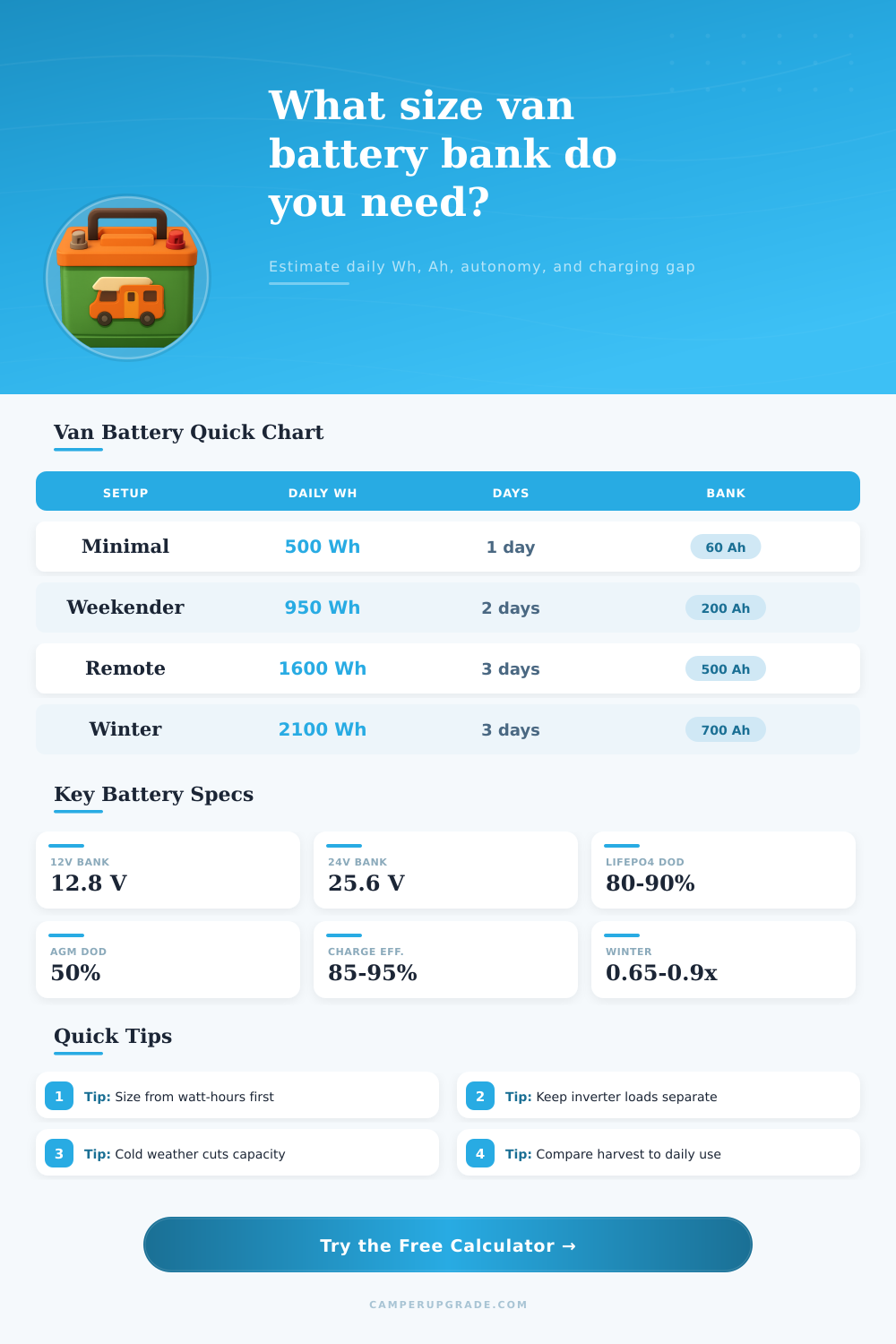
Camper Van Conversion Battery Calculator
Estimate daily watt-hours, recommended amp-hours, usable autonomy, and charging deficit from fridge, fan, lights, laptop, USB, inverter, chemistry, voltage, efficiency, and winter derate.
Battery bank estimate
| Load category | Typical draw | Typical use | Daily energy |
|---|---|---|---|
| 12V compressor fridge | 35-60 W running | 6-14 hr/day | 250-750 Wh |
| Roof vent fan | 8-35 W | 4-16 hr/day | 50-450 Wh |
| LED lights | 5-25 W total | 2-8 hr/day | 15-180 Wh |
| Laptop and monitor | 45-120 W | 2-8 hr/day | 120-900 Wh |
| USB and small DC | 10-45 W | 2-24 hr/day | 30-500 Wh |
| Short inverter load | 300-1500 W | 5-30 min/day | 25-750 Wh |
| Chemistry | Planning DoD | Efficiency note | Van use note |
|---|---|---|---|
| LiFePO4 high-use | 90% | High round-trip efficiency | Best for deep daily cycling |
| LiFePO4 daily-use | 80% | Good buffer for long life | Common modern van choice |
| AGM deep-cycle | 50% | Lower usable capacity | Simple, but heavier per Wh |
| Gel lead-acid | 50% | Charge settings matter | Conservative current limits |
| Flooded lead-acid | 50% | Ventilation and upkeep needed | Works when maintenance is acceptable |
| Scenario | Harvest factor | Capacity factor | Planning action |
|---|---|---|---|
| Clear summer travel | 0.90-1.00x | 0.95-1.00x | Daily solar may cover loads |
| Forest shade | 0.35-0.70x | 0.90-1.00x | Add alternator or shore buffer |
| Rainy multi-day stay | 0.15-0.45x | 0.85-0.95x | Increase autonomy days |
| Cold winter parking | 0.10-0.45x | 0.65-0.90x | Derate capacity and harvest |
| Alternator drive day | 0.70-0.95x | 0.85-1.00x | Use measured charger output |
| Nominal bank | Rated Wh | Usable LiFePO4 | Usable AGM |
|---|---|---|---|
| 12V 100 Ah | 1,280 Wh lithium / 1,200 Wh lead | 1,024 Wh at 80% | 600 Wh at 50% |
| 12V 200 Ah | 2,560 Wh lithium / 2,400 Wh lead | 2,048 Wh at 80% | 1,200 Wh at 50% |
| 12V 400 Ah | 5,120 Wh lithium / 4,800 Wh lead | 4,096 Wh at 80% | 2,400 Wh at 50% |
| 24V 200 Ah | 5,120 Wh lithium / 4,800 Wh lead | 4,096 Wh at 80% | 2,400 Wh at 50% |
| 48V 100 Ah | 5,120 Wh lithium / 4,800 Wh lead | 4,096 Wh at 80% | 2,400 Wh at 50% |
When you begin to thinks about camper van conversions, you must make decisions about the battery bank that will be used in the camper trailer. The battery bank will provide power to many of the item that is in the camper trailer. For instance, the refrigerator will require power from the battery bank, the vent fan will require power from the battery bank, and a laptop will require power from the battery bank.
If the battery bank becomes depleted of it energy, then the camper will not be able to use the battery bank to perform these different function. Furthermore, you must calculate how much energy the battery bank will need in order to last for the intended use of the camper trailer. The amount of energy that is required will depend upon the way in which you intend to use the energy and how you will recharge the battery bank.
How to choose the right battery bank for your camper trailer
To calculate the energy use that is required for the camper trailer, you must begin to calculate how many watt will be used each day. However, many people does not adequately account for the energy that will be used each day. For instance, a compressor refrigerator may only use 40 or 50 watt at any one time, but the refrigerator will cycle on and off throughout the day.
Likewise, the vent fan will use some of the energy throughout each day, as will the laptop, USB device, and interior lights. You can use the calculator to enter the wattage of each of these device and the number of hours that they will be used each day to calculate the total energy that will be used. Another factor to consider is the chemistry of the batteries that will be used in the trailer.
For instance, lithium iron phosphate batteries allow people to use the majority of the battery bank capacity. Lead-acid and AGM batteries, however, should not be discharged to more than 50% of their capacity; discharging these batteries to 100% can shorten their lifespan. Thus, the chemistry of the batteries will affect the amount of usable energy from the battery bank.
You can use the calculator to change the battery chemistry to see the impact on the total amp-hour requirement. Another factor to consider is the impact of winter upon the battery bank and the solar panels. In the winter months, both the battery bank and the solar panels will have reduced function; the battery bank will have less available capacity and the solar panels will create lesser energy.
You can use the winter factor in the calculator to determine the impact of winter upon the energy use of the camper trailer. The winter factor will impact how much energy the battery bank and solar panels generate; it may lead to a change in the autonomy requirement for the camper. Finally, you must consider the charging source for the camper.
There are a variety of charging sources, including solar panels, an alternator, and shore power. The amount of charging sources will affect the energy that can be provided to the camper trailer. Furthermore, there may be energy losses due to the efficiency of the charging systems.
In the situation where there is less energy that is generated in the camper trailer than is being used, the battery bank will continue to deplete. The calculator can help to provide an estimate of this energy deficit between the charging and energy use of the camper. Another factor to consider in the building of the camper is the autonomy of the camper trailer.
Autonomy is a measurement of how many day the camper trailer will be able to remain in the same location without using a charging source. Many camper trailers have an autonomy of two days; this allow for bad weather days, or days when the camper trailer is not driven. You can use the autonomy parameter in the calculator to size the battery bank, and the calculator will also show how many days of autonomy the camper will actualy be able to experience with the autonomy that is set up.
These two numbers will help to ensure that the autonomy of the camper trailer is accurate to the description of the camper trailer. An additional factor to consider is the use of an inverter. The use of an inverter will increase the energy use of the camper trailer.
Inverters allow travelers to use appliances that have high wattage rating; the higher wattage of these appliances will increase the energy that is used by the camper trailer. Furthermore, some energy is lost in the use of an inverter. Thus, the use of the inverter should be limited to certain days of the trip, such as those when the camper is utilizing the alternator to charge the battery bank.
These reference tables contain typical watt-hour measurement of the devices that can be located within a camper trailer. These tables can help to show the difference between battery chemistries. While the tables are not required to determine the size of the battery bank, they provide context for the energy that may be used within the trailer.
Many individuals use these tables to ensure that their energy use estimates are realistic. When building a camper trailer, one must always consider the factors and constraints upon the development of the camper trailer. The energy loads, energy sources, energy storage, battery chemistry, autonomy, inverter use, and the energy use of the devices all interact with one another in the building of the camper trailer.
It is best to run the calculator using the actual devices that will be incorporated into the trailer; this will allow individuals to determine whether or not the energy budget is appropriate for the device use that is to be experienced by travelers on the trip. Thus, using the calculator will allow individuals to create an appropriate plan for their battery bank for the camper trailer.