RV Awning Size Calculator
Estimate nominal awning length, fabric shade footprint, pitch clearance, and rail hardware margin before choosing a camper awning.
⛺Real Camper Awning Presets
📏Awning Rail, Projection, and Clearance Inputs
Measure only the straight section where awning hardware can mount. Curves, marker lights, ladders, slide flanges, and roof transitions should be excluded from usable rail length.
Your RV Awning Sizing Results
🧵Awning Fabric and Spec Comparison
📊Standard RV Awning Size Reference
| Nominal awning length | Typical fabric width | Common projection | Good fit when usable rail is |
|---|---|---|---|
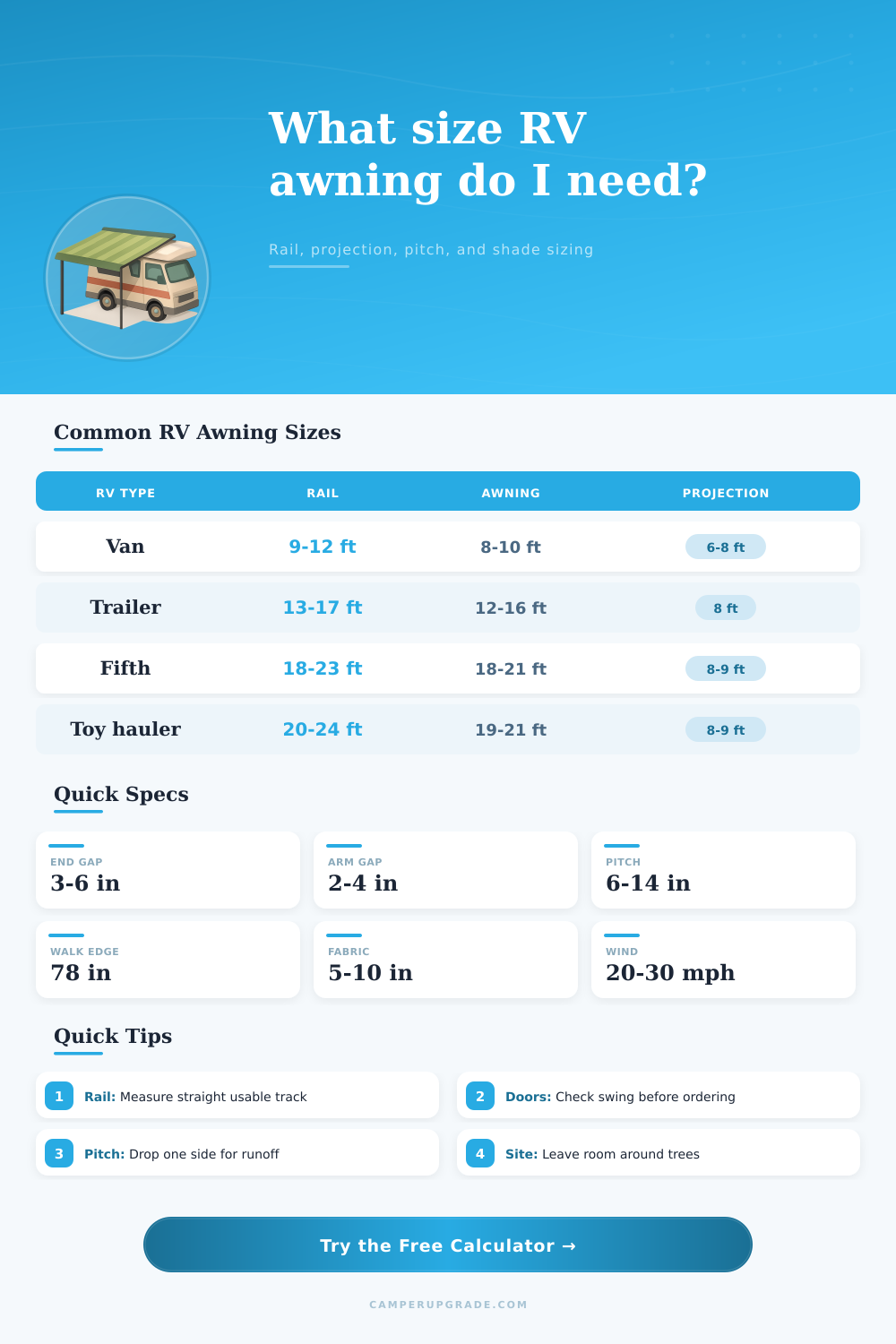
| 8 to 10 ft | About 7 ft 4 in to 9 ft 4 in | 6 to 8 ft | Compact vans, teardrops, narrow entry shade |
| 11 to 13 ft | About 10 ft 4 in to 12 ft 4 in | 8 ft | Small travel trailers and Class B vans |
| 14 to 16 ft | About 13 ft 4 in to 15 ft 4 in | 8 ft | Mid-size travel trailers with one main entry |
| 17 to 19 ft | About 16 ft 4 in to 18 ft 4 in | 8 to 9 ft | Bunkhouse trailers, Class C side walls, patio zones |
| 20 to 21 ft | About 19 ft 4 in to 20 ft 4 in | 8 to 9 ft | Fifth wheels, toy haulers, long uninterrupted walls |
⚙Clearance Targets for Arms, Doors, and Ends
| Clearance item | Calculator input | Typical target | Why it matters |
|---|---|---|---|
| Rail end gap | Front and rear end gap | 3 to 6 in each end | Keeps arms away from curved caps, ladders, lights, and wall seams |
| Arm bracket allowance | Bracket allowance per side | 2 to 4 in each side | Allows room for arm pivots, motor heads, and mounting plates |
| Slide-out or wall obstruction | Side clearance per end | 2 to 8 in where needed | Prevents the awning arm path from crowding slide flanges or windows |
| Door/window clearance below rail | Vertical clearance input | 4 in minimum, 6 in preferred | Leaves room for roller fabric, door swing, drip edge, and fabric sag |
| Front edge walking clearance | Mounting height minus pitch drop | 78 in or higher | Keeps the outer rail comfortable at the low side of the pitched awning |
💨Pitch Drop and Wind Planning Table
| Wind limit before retracting | Suggested pitch drop | Front edge note | Calculator interpretation |
|---|---|---|---|
| 20 mph calm-site use | 8 in or more | Mostly shade and runoff planning | Small pitch margin is acceptable for watched use |
| 25 mph typical powered awning | 10 in or more | Good balance for entry clearance | Default target used by many patio setups |
| 30 mph braced patio setup | 12 in or more | Check the low corner carefully | More drop helps runoff but reduces walking height |
| 35 mph high-caution manual setup | 14 in or more | Retraction discipline still matters | Calculator flags short pitch margins more aggressively |
🛖Common RV Patio Shade Footprints
| RV patio use | Usual awning size | Approx fabric footprint | Planning note |
|---|---|---|---|
| Entry step and two chairs | 8 to 10 ft by 6 to 8 ft | 45 to 70 sq ft | Prioritize door clearance over maximum length |
| Couple travel trailer patio | 12 to 15 ft by 8 ft | 85 to 115 sq ft | Often fits between front cap curve and rear window |
| Family dinette and camp chairs | 16 to 18 ft by 8 ft | 115 to 140 sq ft | Check slide room and window escape path clearance |
| Long fifth wheel patio | 19 to 21 ft by 8 to 9 ft | 145 to 180 sq ft | Site trees and hookups often limit usable side clearance |
| Screen room compatible setup | 12 to 20 ft by 8 ft | 90 to 155 sq ft | Squarer pitch helps room panels hang cleanly |
💡Awning Sizing Tips
Choosing the correct size for an awning for your RV require careful measurement of the RV and careful planning of how the awning will work within the RV and in the campsite. The best way to measure the RV is to measure the length of the rail on the side of the RV. You should not measure the entire length of the wall on the RV, the rail rarely continue in a straight line along the entire length of the wall.
Instead, you should only measure the straight section of the rail on the RV that will be use to mount the awning hardware. Any curves in the rail or hardware near a ladder or light on the RV should be ignored in the measurement of the length of the awning that you order for your RV. Beyond measuring the length of the rail on your RV, there are other factor that will influence the size of the awning that you order.
How to Measure and Choose the Right RV Awning Size
For example, one of the primary considerations of the size of the awning that you order is the depth of the projection of the awning from the RV. An eight-foot projection is the most common projection depth for awnings, as an eight-foot projection will provide shade for the RV without causing the front rail of the RV to hang too low when the awning is pitched to allow the awning to open. A nine-foot projection will provide more square footage of shade, but the outer edge of the awning will sit closer to the ground than if an eight-foot projection was chosen.
A deeper projection will allow RV owners to enjoy more shade on hot afternoon, but it will also allow the wind to catch the awning and reduce the walking height under the awning. These factors can be accounted for with an awning size calculator that takes into account these feature of the awnings. Another factor that you must consider is the pitch of the awning.
The pitch of the awning is the angle of the awning, and it is specifically constructed to allow water to run off of the awning. If the pitch of the awning is too low, water may pool on the awning; if the pitch is too high, the head room for individuals walking under the awning will be reduced. The intended wind conditions of the campsite will determine the required pitch of the awning; campsites with high winds will require a different pitch than a campsite that does not experience too much wind.
A calculator can help determine the best pitch of the awning according to the wind conditions at the campsite, but the owner will have to use there own judgment as to the weather at the campsite. Beyond the pitch of the awning, the length of the awning also requires that the owner account for the gap at the ends of the awning. Awnings are manufactured in such a way that their fabric is narrower than the length that it will appear on the RV; the awning roller and valance take up some of the length of the awning.
These areas at the end of the awning will also need to leave space for the awnings arms to clear any windows or end caps on the RV. Finally, the RV may also feature slide-outs that will require that the awning provide some clearance to those slide-outs. Each of these factors will mathematically reduce the length of the awning that the RV can receive, and each of these factors should be accounted for in determining the size of the awning that will best suit the RV.
The type of fabric that the awning will feature will also impact the size calculations for the RV. For instance, vinyl awnings are often some of the most durable to come into contact with the elements, but the vinyl often sits lower on the awning when it is pitched. Arylic awnings are often breathable to the individual camping trailers, but the acrylic fabric may sag more than vinyl.
These different types of fabrics will change the estimates of the width of the fabric and the height of the front edge of the awning that the awning size calculator will calculate. The fabric type should be chosen prior to calculating the size of the awning. Another constraint that can limit the size of the awning that may be use by an RV is the campsite itself.
For instance, even if there is enough length for the awning on the RV, the campsite may not be large enough for the awning to extend beyond the RV. Factors like trees, RV hookups, and other RVs may limit the space available at the campsite. These factors should be considered before purchasing an awning for the RV.
The size of the awning may also need to account for the door and windows on the RV. For instance, if the roller of the awning is too close to a door on the RV, the door may hit the awning when it opens. A solution to this problem is to either raise the height of the rail on the RV or to choose a shorter projection for the awning.
Finally, RV manufacturers often provide tables that show the common pairings of the length of the rail with the size of the awning that is manufactured for the model of RV. These tables often show the most common sizes of the awnings for each type of RV. They are not rules that the owner of an RV must follow.
For instance, travel trailers that are sixteen feet in length often have awnings that are between fourteen and sixteen feet in length. Fifth wheel trailers that have long walls often have awnings that are twenty feet or twenty-one feet in length. Using these tables allows the owner of an RV to compare the size of the awning that it has to other RV owner.
Wind is one more last factor that the RV owner must plan for when purchasing an awning for the RV. Every awning has a limit to the wind speed that it can endure. If the wind reaches that limit, the awning will need to be retracted.
For example, awnings that are powered will often need to be retracted if the wind reaches twenty-five miles per hour. Manual awnings may be able to remain extended in the wind, but only if someone is watching the weather. A calculator can be used to determine the pitch of the awning needed to accommodate the wind limit, but that calculator will not be able to provide any information about the wind that may occur at the campsite.
By calculating the size of the awnings that should be provided for an RV, the RV owner can gain an understanding of the constraints of the RV. Such calculations can help an RV owner to decide whether it wants larger patio space or more space to walk under the awning. The awning size calculator will show the impact that each measurement will have on the RV.
With each of these variables accounted for and the measurements calculated, the RV owner can match the size of the awning to the way in which the owner wants to use the campsite.