
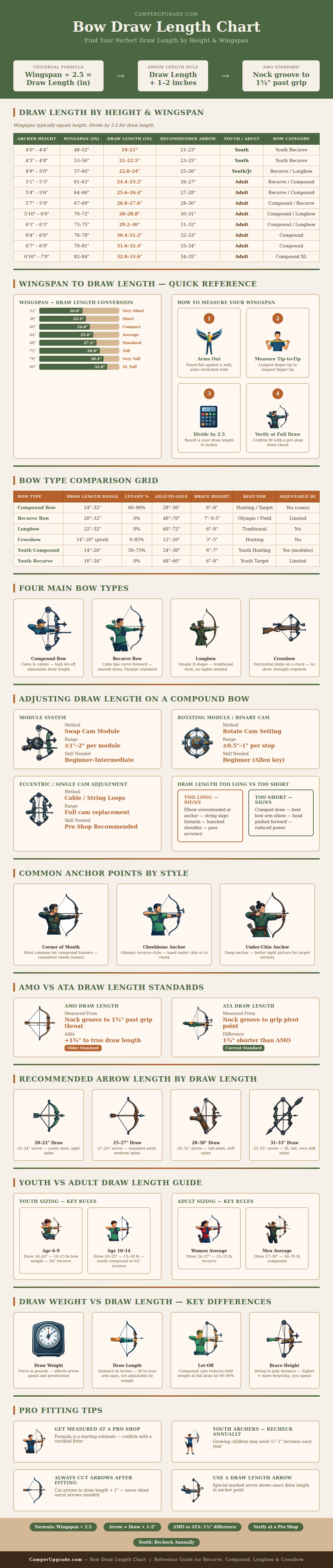
Finding the correct draw lengths for an archery bow is a necessary step for every archery sports participant. The draw length for an archery bow must be correct to ensure that an archery bow fit the individual archer. If an archery bow has the correct draw length, then the string will return to the same location on the archer from which the arrow was shot.
An incorrect draw length can lead to the archer’s elbow extending beyond its normal range of motion and the archer’s shoulder move upward. These physical motions reduce the archer’s accuracy with the bow. It is easy for new archery sports enthusiasts to guess at there draw length.
How to Measure Your Draw Length
Guessing at there draw length will result in inaccuracy for the archer. Instead, the archer should use a measurement chart to find the length of draw that will allow for the best accuracy in the archery field. A measurement chart use an archer’s wingspan to calculate the archer’s draw length.
An archer can determine their wingspan by measuring the distance from one fingertip to the fingertip of their opposite hand. This distance should then be divided by 2.5 to calculate the archer’s initial draw length. A persons arms are proportioned to the remainder of their body, so the wingspan calculation should provide an accurate measurement of the length of draw that an archery bow should have.
A measurement chart will include the archer’s height range to help an archer find their draw length. Additionally, many measurement charts will include recommendations of arrow lengths because arrows that are too short can be dangerous for an archer to shoot and arrows that are too long waste the archer’s energies. Many different type of bows allow for adjustments to the draw length.
For compound bows, an archer can make small adjustments to the draw length with an Allen key. However, recurve and longbows do not allow for adjustments to the draw length of the bow. The limbs of these bows cannot be adjusted.
This means that an archer must purchase a bow with the correct riser for their draw length. Crossbows does not require an archer to measure their draw length. The prod of the crossbow is preset to allow for an even draw length for each archer.
A measurement chart can help an archer to understand the different types of bows and their requirements for draw length adjustments. To measure an archer’s wingspan, the archer should stand against a wall. Another person can measure the distance from the tip of one of the archers middle fingers to the tip of the opposite middle finger.
Divide this distance by 2.5 to calculate the wingspan. This is only an estimation of the archer’s draw length. A professional archery shop should verify the draw length of the archer.
Youth archers should have their draw length verified more often than an adult archer. The bones of a youth archer is still growing. A youth archer can experience a half-inch change in wingspan each year.
Using an old bow that was fitted when they were younger can create issues for the youth archer with incorrect draw length. An archers anchor point is the spot where an archer’s drawing hand and arrow string touch the archers face. Hunters often choose the corner of their mouth as the archer’s anchor point for their bows.
This allow them to release the arrow from the bow without moving their drawing hand. On the other extreme, archers who aim at their target’s arrows may choose the archer’s chin as the anchor point for the arrow. There is no standard draw length for any of these choices.
The archer should choose the archer’s draw length so that their hand naturaly land on their face once they have reached their draw length for the bow. If an archer must stretch their face to reach the anchor point, then the archer likely has the wrong draw length for their bow. Arrows are sold of different lengths.
It is crucial for the archer to choose the correct length of arrow for the draw length of their bow. Many archers will choose an arrow that is between one and two inches longer than their draw length. This allow the arrow to ensure that the arrow tip does not hit the riser of the bow.
If the arrow is shorter than the draw length, the arrow may end behind the rest of the bow when the archer draws back against the string. This can be dangerous for the archer and their equipment. The archer should select the arrow length based off the archers draw length.
The relationship between these two measurement can be found on the measurement chart for bows. Archers must be aware of the difference between AMO draw length standards and ATA draw length standards. The AMO standard add 1.75 inches to the draw length of the archer.
The ATA standard does not add to the draw length but measures the draw length to the pivot point of the archer’s bow grip. These two method of measuring draw length can make an archers modern bow feel different than a vintage bow that may have been measured with the other standards. Using a measurement chart to find the archer’s draw length will prevent the archer from wasting their time and money.
Using the correct draw length for an archery bow will allow for an archer to focus on their shot rather than their equipment. The correct draw length will allow for a smooth draw and anchor point that becomes automatic with time and practice. An archer using the proper equipment and draw length will exhibit accuracy in their aimed arrows.
