Snow Shelter Size Calculator
Estimate interior sleeping volume, snow excavation, wall load, and ventilation area from occupants, pads, gear, wall thickness, tunnel size, stove space, and snow density.
Snow shelter estimate
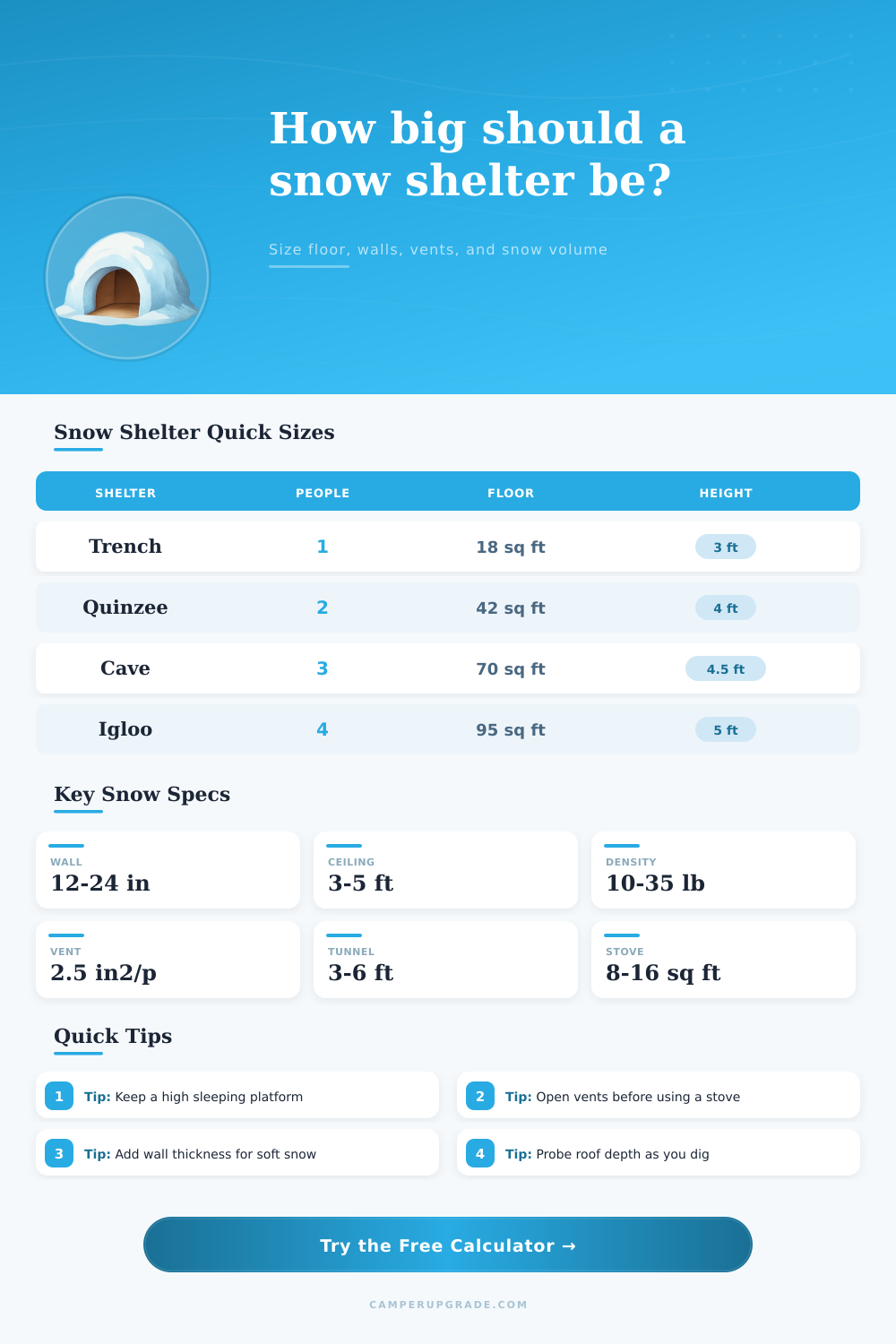
| Shelter | Occupants | Interior floor area | Ceiling target |
|---|---|---|---|
| Emergency trench | 1 | 14-22 sq ft | 2.5-3.5 ft |
| Sleep trench | 1-2 | 18-38 sq ft | 3-4 ft |
| Quinzee mound | 2-3 | 40-70 sq ft | 3.5-4.5 ft |
| Snow cave | 2-4 | 45-95 sq ft | 4-5 ft |
| Igloo dome | 2-5 | 45-115 sq ft | 4-5.5 ft |
| Snow kitchen | 3-8 | 70-160 sq ft | 4.5-6 ft |
| Snow condition | Density lb/ft³ | Density kg/m³ | Planning note |
|---|---|---|---|
| Fresh dry snow | 8-12 | 128-192 | Light to dig, weak for roofs |
| Settled powder | 12-18 | 192-288 | Good for small shelters |
| Compacted shelter snow | 18-22 | 288-352 | Useful planning baseline |
| Wind-packed snow | 22-28 | 352-448 | Strong but harder digging |
| Consolidated hard snow | 28-32 | 448-513 | High shell mass |
| Wet dense snow | 32-40 | 513-641 | Heavy load and drainage risk |
| Round vent diameter | Area per opening | Two openings | Best use |
|---|---|---|---|
| 1 in | 0.8 in² | 1.6 in² | Backup marker hole |
| 1.5 in | 1.8 in² | 3.5 in² | Solo sleep shelter |
| 2 in | 3.1 in² | 6.3 in² | Two sleepers |
| 2.5 in | 4.9 in² | 9.8 in² | Group or stove standby |
| 3 in | 7.1 in² | 14.1 in² | Cooking ventilation |
| 4 in | 12.6 in² | 25.1 in² | Large kitchen room |
| Excavated snow | Cubic yards | Cubic meters | Digging note |
|---|---|---|---|
| 40 ft³ | 1.5 yd³ | 1.1 m³ | Small trench or emergency pit |
| 80 ft³ | 3.0 yd³ | 2.3 m³ | Compact two-person shelter |
| 140 ft³ | 5.2 yd³ | 4.0 m³ | Comfortable quinzee or cave |
| 220 ft³ | 8.1 yd³ | 6.2 m³ | Group cave or kitchen |
| 320 ft³ | 11.9 yd³ | 9.1 m³ | Large basecamp room |
| 450 ft³ | 16.7 yd³ | 12.7 m³ | Major project with crew rotation |
To design a snow shelter, you must calculate the specific dimension of the snow shelter that will be constructed. The dimension must be calculated in order to ensure that the snow shelter will provide enough room for the person and their gear. Furthermore, determining the size of the snow shelter is also important in that the size of the snow shelter will determine the amount of snow that must be moved in order to create such a shelter, as well as the amount of space that will be created within the shelter.
The floor area of the snow shelter is one of the first measurements that must be made for the snow shelter. The floor area is important in that the area of the floor must provide enough space for each persons sleeping pad and gear. Each sleeping pad requires some area within the snow shelter, but each sleeping person also requires additional area within the shelter for there bulky winter sleeping bag, as well as for movement while sleeping.
How to Work Out the Size of a Snow Shelter
If two people will use the snow shelter, then it will require more area within the shelter for the sleeping pads of each person and their sleeping packs. Thus, it is important to include the dimension of the sleeping pads within the snow shelter when calculating the area of the floor of that shelter. The thickness of the walls of the snow shelter is the second measurement that should be considered in the construction of that shelter.
The thickness of the walls is important in that the thickness will determine the stability of the snow shelter. For instance, if you are to construct the snow shelter within soft snow, the walls will have to be thicker to ensure that the shelter is stable due to the weakness of the soft snow. In contrast, if the snow shelter is to be constructed within areas of wind packed snow, the walls can be thinner due to the strength of the wind-packed snow.
Furthermore, the thickness of the walls will determine how much snow must be excavated to construct the shelter. The weight of the walls will also play a critical role in determining if the shelter will collapse under the weight of the snow above it. The height of the ceiling within the snow shelter is the third measurement that should be considered in the construction of a snow shelter.
Such a height is important in that low ceilings will help to retain the body heat of the individuals within the shelter. However, low ceilings may make it difficult for individuals to sit up within the shelter. If you use a stove within the shelter, the height of the ceiling will have to be increased to allow for the stove to be placed within the shelter.
Furthermore, the height of the ceiling will also impact the total volume of the snow shelter, which will impact the amount of snow that must be dug out of the snow. In addition to the height of the ceiling within the shelter, another consideration in the construction of the snow shelter is the entrance tunnel of the shelter. Such an entrance tunnel is necessary for allowing individuals to enter and exit the shelter.
However, the size of such a tunnel is important to ensure that it is not a bottleneck within the shelter. Short entrance tunnels are easy to dig out of the snow, but may not provide protection from the wind. Long entrance tunnels offer more protection from the wind, but require more snow to be excavated to create such a tunnel.
The entrance tunnel should be included in the total volume of the snow shelter to be constructed. Snow shelter designs must also include provision for ventilation for the individuals that will utilize the snow shelter. Ventilation helps to prevent headaches for the sleeping individuals, as well as prevents condensation within the snow shelter from dripping onto the sleeping sleeping bags.
The openings for ventilation must be large enough to allow for proper ventilation for each sleeping individual. However, if using a stove within the snow shelter, the size of such ventilation openings will have to be increased to allow for the stove to consume enough air, as well as to permit the stovetop to produce water vapor. Thus, calculating the area of the snow shelter that will be used for ventilation is essential in determining if such openings will be large enough to accommodate the number of sleeping individuals.
The density of the snow that will be utilized to construct the snow shelter is a factor that will impact each of the measurement of the snow shelter. For instance, if utilizing light snow, it will be easier to move the snow to construct the shelter. However, light snow is not as strong as other forms of snow, such as dense snow.
Dense snow is strong enough to form a roof for the shelter, but is more difficult to move due to the weight of the dense snow. The density of snow can be used to calculate the total weight of the walls of the shelter, which will determine the stability of the snow shelter. Each of these calculations will help to make tradeoffs between the different measurements of the snow shelter.
For instance, increasing the ceiling height of the snow shelter will increase the total volume of the snow shelter more than adding an extra sleeping individual will increase the volume of the shelter. Similarly, increasing the thickness of the walls will increase the total weight of the walls of the shelter more than increasing the thickness of the walls will increase the insulation of the shelter. Thus, utilizing these calculations will allow an individual to create the smallest snow shelter necessary to keep themselves and their gear warm and dry.