Wetsuit Thickness Calculator
Estimate wetsuit thickness, hood, booties, gloves, chill risk, and comfort window from water, weather, session, and fit conditions.
Your wetsuit recommendation
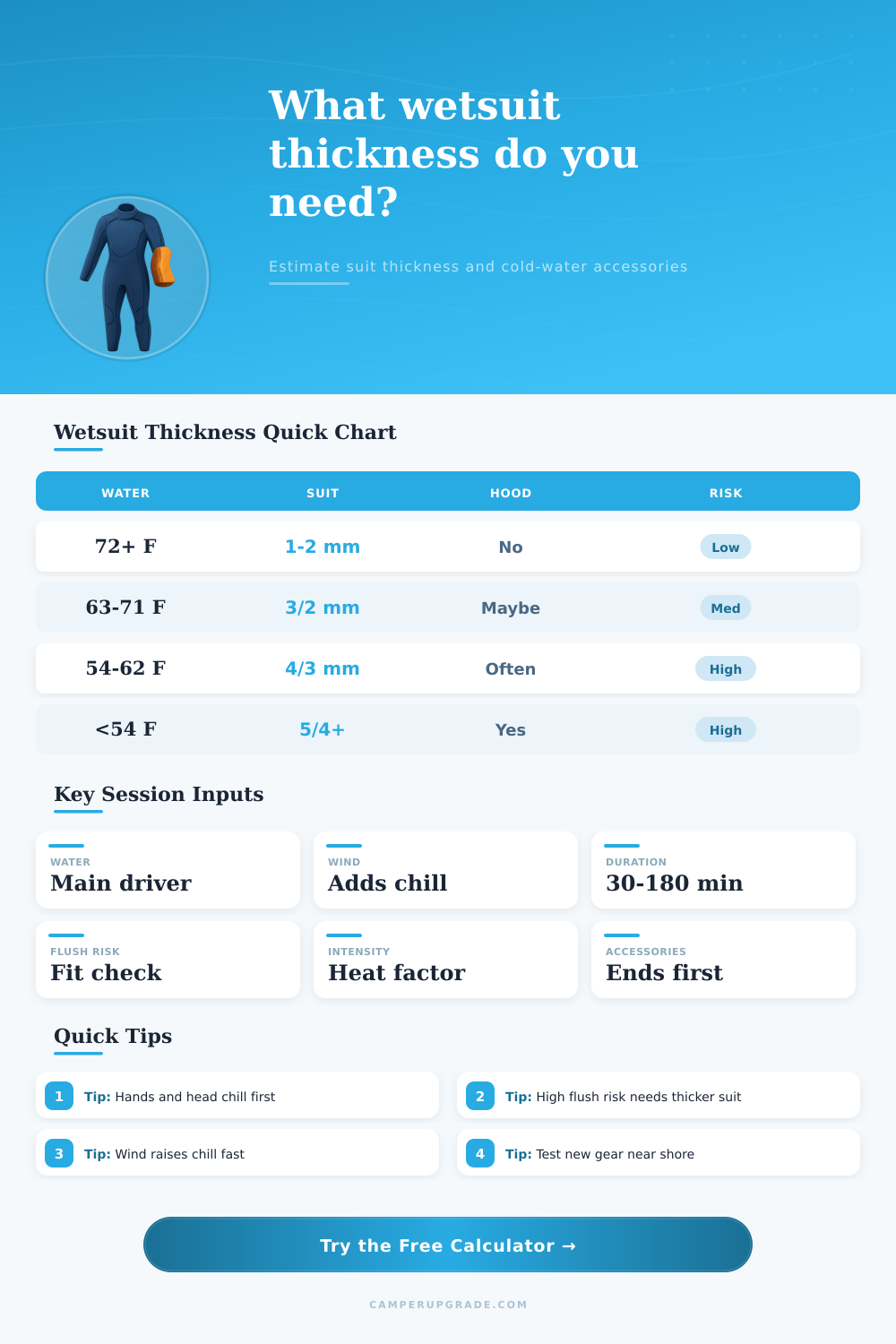
| Water temperature | Baseline suit | Typical accessories | Use note |
|---|---|---|---|
| 76 F / 24 C and warmer | Rash guard to 1 mm | Sun layer only | Wind and jellyfish may still matter |
| 72-75 F / 22-24 C | 1.5-2 mm top or spring suit | Usually none | Short active sessions stay comfortable |
| 68-71 F / 20-22 C | 2 mm spring or 3/2 full | Booties optional | Choose full suit for longer rests |
| 63-67 F / 17-19 C | 3/2 full suit | Booties in wind or rock | Moderate chill risk for long sessions |
| 58-62 F / 14-17 C | 4/3 full suit | Booties often useful | Hood becomes helpful with wind |
| 53-57 F / 12-14 C | 5/4 full suit | Hood and booties | Gloves for longer or windy sessions |
| 48-52 F / 9-11 C | 6/5 full suit | Full cold kit | Keep sessions conservative |
| Below 48 F / 9 C | 6/5+, 7 mm, or drysuit | Full cold kit required | Cold-water safety margin is critical |
| Accessory | Usually starts near | Stronger trigger | Comfort role |
|---|---|---|---|
| Hood | 58 F / 14 C water | Cold air, wind, duck-diving, waiting | Reduces heat loss from head and neck |
| Booties | 60 F / 16 C water | Rocky entries, long waits, cold board decks | Protects feet and extends comfort |
| Gloves | 55 F / 13 C water | Wind above 18 mph or low activity | Keeps grip and hand function longer |
| Sealed seams | 62 F / 17 C water | High flush risk or frequent immersion | Limits cold pulses inside suit |
| Factor | Warmer direction | Colder direction | Calculator effect |
|---|---|---|---|
| Activity intensity | High-output swimming or surfing | Still fishing, waiting, drift dives | Shifts 0.5-1.0 mm |
| Session duration | Under 45 minutes | Over 120 minutes | Raises chill score with time |
| Wind speed | Under 8 mph | Over 18 mph | Adds accessory need |
| Flush risk | Snug neck, wrists, ankles | Loose cuffs or worn seals | Can add a thickness step |
| Cold sensitivity | Runs warm | Gets cold easily | Changes personal margin |
This calculator is a planning aid. Cold water, fatigue, distance from shore, medical conditions, and local hazards can require more conservative gear choices.
Choosing the correct wetsuit thickness is important because the correct wetsuit thickness will ensure that you remain warm while you are in the water. Many people makes mistakes when choosing a wetsuit as they often dont consider that air temperature and water temperatures have different effect upon the human body. If the wetsuit is too thin for the water temperatures you will be in, the water will make you feel cold.
If the wetsuit is too thick, however, the wetsuit will make it difficult for you to moving while in the water. The wetsuit thickness calculator use several different input variables to determine the thickness of the wetsuit that you should use. These variables include the temperature of the water that you will be in, the temperature of the air, the wind speed, the length of your session in the water, your activity level while in the water, and the fit of the wetsuit.
How to Choose the Right Wetsuit Thickness
Each of these variables can affect the amount of heat that your body lose while you are in the water. For instance, wind will remove heat from the wetsuit and from the parts of your body that are not cover by the wetsuit. For this reason, you may feel more cold while in the water on a windy day then on a calm day, even if the water temperatures are the same.
One of the most important variables for the wetsuit thickness calculator is the temperature of the water that you will be in. Water temperature is a constant that cannot change. The length of your session in the water is also a variable for the calculator.
While a wetsuit may allow you to remain warm in the water for forty-five minutes, the same wetsuit may not allow you to remain warm for two hour. Water may gradually flush into the neck and cuffs of the wetsuit over a longer period of time. Your activity level while you are in the water is another important variable to consider.
If you will be performing activities that cause you to generate more heat, such as swimming or surfing, you can wear a thinner wetsuit. If, on the other hand, you will be performing activities that cause you to generate less heat, such as floating or standing still while waiting for wave to roll in, you will need to wear a thicker wetsuit to retain your body heat. Additionally, variables like cold sensitivity may have different value for each individual.
If you are a body that often feels cold, you may need to wear a thicker wetsuit. The fit of your wetsuit is just as important as the thickness of the wetsuit. If your wetsuit is too loose in the neck or the ankles, water may move in and out of the wetsuit.
This movement of water will erase the insulation quality that the neoprene of the wetsuit offers. A snug wetsuit is often a better option than a loose wetsuit. A snug wetsuit will prevent water from moving in and out of the wetsuit.
Thus, a snug 4/3 wetsuit may offer more warmth then a loose 5/4 wetsuit. The type of neoprene that goes into the wetsuit can also affect the warmth that it provide. If the wetsuit contains standard sealed neoprene, it will provide warmth.
If, however, the wetsuit contains thermal lined neoprene, it will provide more warmth than the sealed neoprene. Open cell neoprene allows for more water to move in and out of the wetsuit. This type of neoprene is often used for freediving.
Open cell neoprene, then, requires a very careful fit to the individual. Finally, if the wetsuit is relatively old it may not provide the same level of warmth and flexibility as a new wetsuit of the same thickness. Accessories for the wetsuit, such as hoods, booties, and gloves, can also provide warmth for those who wear them.
The head and the feet are the parts of the body that lose the most heat, and protecting these body parts with accessories can provide more comfort to the wearer than increasing the thickness of their wetsuit. The wetsuit thickness calculator will show if accessories will be necessary to wear with the wetsuit. These accessories will help the individual to remain warm while in the water for longer period of time.
The wetsuit thickness calculator is a baseline upon which to base your wetsuit purchase. However, the conditions of your session may change. For instance, you may plan to be in the water for two hours, but you may spend three hours in the water.
The weather may change while you are in the water. Thus, it is a good idea to bring extra accessories with you when you enter the water. These extra accessories will ensure that you stay warm while in the water for longer than you had plan.
The goal in using a wetsuit thickness calculator is to find a balance between warmth and mobility. A wetsuit that is too thick will keep you warm, but it will also limit your mobility in the water. You want a wetsuit that will keep you warm enough to remain comfortable while in the water, yet allow you to move easy in your chosen water activity.
By considering each of the factors mentioned above, you can remove the guesswork from choosing a wetsuit and finding the thickness that is appropriate for you and your plan water activity.