Boat Motor Size Calculator
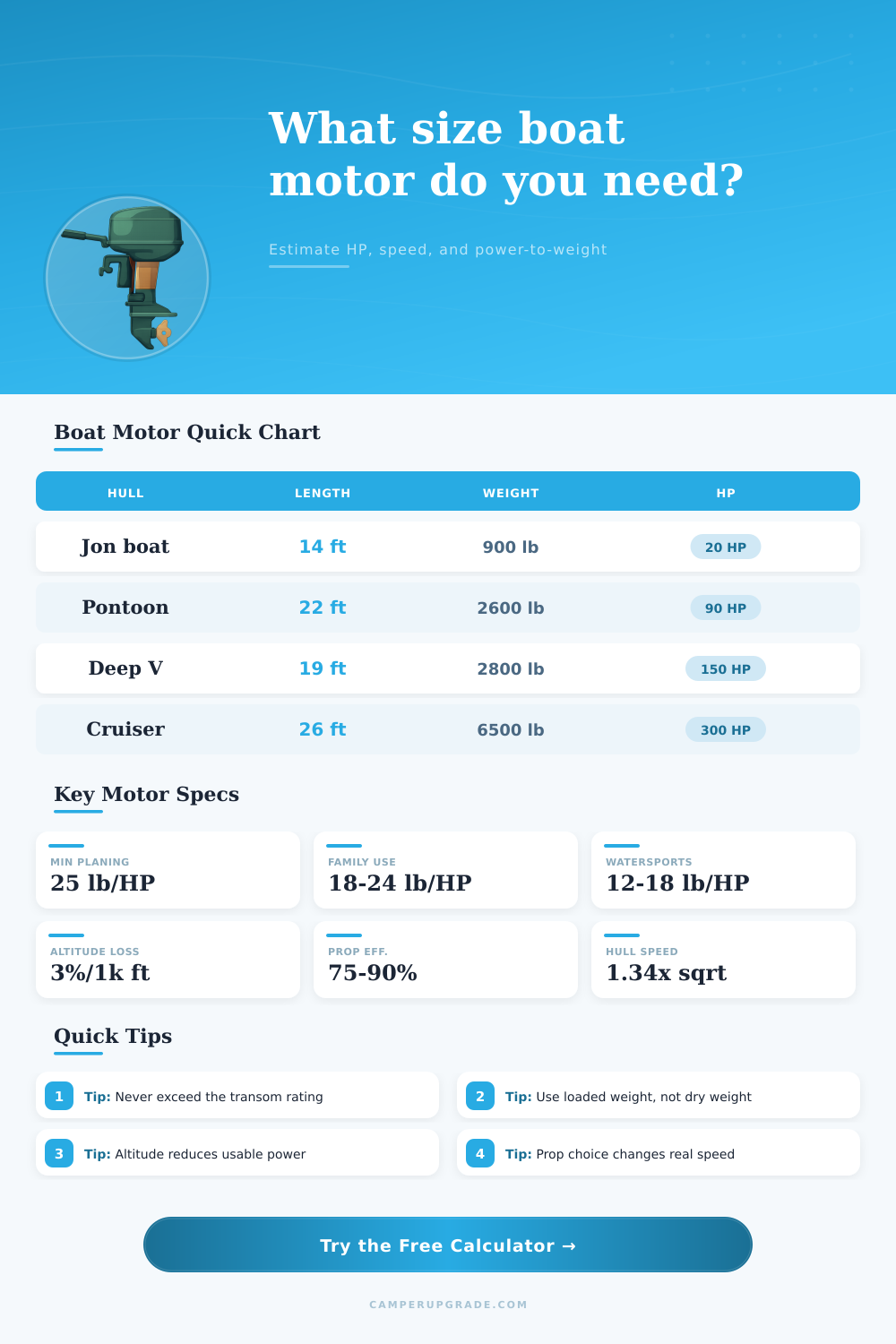
Estimate recommended horsepower, minimum horsepower, expected speed, and power-to-weight ratio from boat length, loaded weight, hull type, use case, target speed, load conditions, transom rating, prop efficiency, and altitude.
Boat motor size estimate
| Boat type | Common length | Loaded weight | Typical motor range |
|---|---|---|---|
| Flat-bottom jon boat | 12-16 ft | 500-1,200 lb | 9.9-35 HP |
| Aluminum utility V | 14-18 ft | 900-1,800 lb | 25-90 HP |
| Bass / flats boat | 17-21 ft | 1,900-3,200 lb | 115-250 HP |
| Pontoon twin tube | 18-24 ft | 2,000-3,800 lb | 60-150 HP |
| Deep V fishing boat | 17-22 ft | 2,200-4,000 lb | 115-250 HP |
| Cabin cruiser | 24-30 ft | 5,500-10,000 lb | 250-600 HP |
| Hull type | Speed behavior | Constant | Planning note |
|---|---|---|---|
| Flat-bottom jon / skiff | Quick planing, rough in chop | 180 | Light loads matter most |
| Modified V aluminum | Efficient small planing hull | 190 | Good all-around estimate |
| Pad hull bass / flats | Fast, efficient running pad | 220 | Setup and prop are critical |
| Pontoon twin tube | High drag, modest top speed | 150 | Windage needs margin |
| Deep V planing hull | More chop comfort, more drag | 195 | Likes adequate torque |
| Displacement sail / trawler | Limited by hull speed | Hull cap | Extra HP helps control, not speed |
| Loaded lb per HP | Feel on water | Best use | Watch item |
|---|---|---|---|
| 30+ lb/HP | Slow acceleration | Displacement or no-wake use | May not plane |
| 24-30 lb/HP | Marginal planing | Light cruising | Sensitive to load |
| 18-24 lb/HP | Normal family cruise | General use | Prop correctly |
| 12-18 lb/HP | Strong acceleration | Watersports and offshore | Trim and handling |
| Under 12 lb/HP | High performance | Fast hulls only | Rating and insurance |
| Condition | Approx effect | Calculator input | Practical note |
|---|---|---|---|
| Sea level | Full rated power | 0 ft | Baseline rating |
| 2,000 ft lake | About 6% loss | 2000 ft | May need pitch change |
| 5,000 ft lake | About 15% loss | 5000 ft | Expect lower speed |
| Average prop match | 75-82% effective | 75-82% | Check WOT RPM |
| Good prop match | 83-90% effective | 83-90% | Clean bottom and trim |
When choosing a motor for a boat, there are several factors that interacts with one another to determine the best motors for that boat. The first of these factor is the power that is required to move the boat through the water. Factors like the weight of the boat and the shape of its hull influence how much power is required to move that boat forward.
If you chooses a motor that does not have enough horsepower to move the boat with the required power, then the boat will struggle to reach the plane or to maintain its speed with a heavy load. Some of the inputs for the calculator include the hull type of the boat, the loaded weight of the boat, the target speed of the boat, and the environmental condition under which the boat will be used. The loaded weight is the weight of the boat when it is fully load, including the weight of the fuel, batteries, passenger, and gear.
How to Choose the Right Boat Motor
This figure is different than the dry weight of the boat, which is the weight of the boat without any passengers or gear. Choosing a motor that does not have enough horsepower for the loaded weight will not effectively move the boat. The hull type impacts the way in which the boat move through the water.
A boat with a flat hull will move quick on flat waters but will be susceptible to rough waters. A deep V-hull will move more easily through rough waters but will create more drag than a flat hull. The calculator take these variables into consideration when providing the estimate of the horsepower that is required to push the boat at the targeted speed.
Another of the factors to consider when choosing a boat motor is the use of the boat. A boat that is to be used only for trolling may not require as much horsepower as a boat that will be used for various watersports. Choosing a motor that has an extra reserve of horsepower allow the boat to accelerate to its target speed with a heavy load of passengers and gear and to hold a plane on rough waters.
Factors like altitude and propeller efficiency will impact the performance of the boat motor. The power of the engine will decrease at higher altitude due to the thinness of the air. A boat motor that is strong at sea level may not perform at the same rate in a mountain lake.
Propeller efficiency will impact how effective the motor’s power is translated into forward motion of the boat. If the propeller does not match the motor, power will be wasted. This can reduce the efficiency of the motor by ten or fifteen percent.
Another helpful measurement of the power of the motor is the power-to-weight ratio. This value will provide information as to how many pound of weight each horsepower must move to move the boat forward. If the power-to-weight ratio is below twenty pounds per horsepower, the boat will likely move quick.
If the ratio is above twenty-five pounds per horsepower, the boat may be able to reach the plane, but it will likely feel slow while traveling through difficult waters. The calculator calculates this ratio directly to help you compare it to the expectations of your boat. There is a difference between the minimum horsepower and the recommended horsepower.
The minimum horsepower is the lowest amount of horsepower required to allow the boat to reach the plane with its current load. The recommended horsepower is a higher number that will allow the boat to better perform and have more power in rough waters. Many people selects the minimum horsepower when purchasing a motor, but this can lead to dissatisfaction when the boat and load are heavy.
You must always ensure that the motor that you select for your boat will not contain more horsepower than the transom rating for the boat. The transom is the back of the boat, and the manufacturer provide a maximum amount of horsepower that the boat can have to ensure its stability and structure remains sound. If the horsepower calculated for your boat exceeds the transom rating, you must purchase a different motor for your boat.
The transom has a capacity plate that will provide you with the transom rating for your boat. The estimated speeds provided by the calculator are targets for the speed of the boat. The target speed is calculated assuming that the boat’s hull is clean and that the propeller is properly match to the motor.
Variables like algae on the hull or improper trim can impact the speed at which the boat can travel. The target speed is provided as a goal that you can use to compare your boat’s actual speed to while operating it. Common mistakes with the calculator include using the dry weight instead of the loaded weight of the boat.
People also often ignore the altitude setting on the calculator when they live near the ocean but may encounter mountains in other parts of the country. To avoid these mistakes, use the real number for your boat’s specifications. In order to find the correct motor for your boat, run the motor calculator with the actual specifications of your boat and use that value to compare to your budget and transom rating.
If the horsepower recommended by the calculator is within the transom rating and within the acceptable power-to-weight ratio, then the motor is likely the best choice for your boat. If the recommended horsepower is above the transom rating, you have recognized a potential problem with your boat that you can avoid purchasing a motor for that boat that could be dangerous to operate.