Guyline Length Calculator
Estimate shelter guyline cut length, total cord, stake radius, and planning tension from shelter height, stake distance, line angle, wind class, adjuster tail, knots, and cord stretch.
Guyline estimate
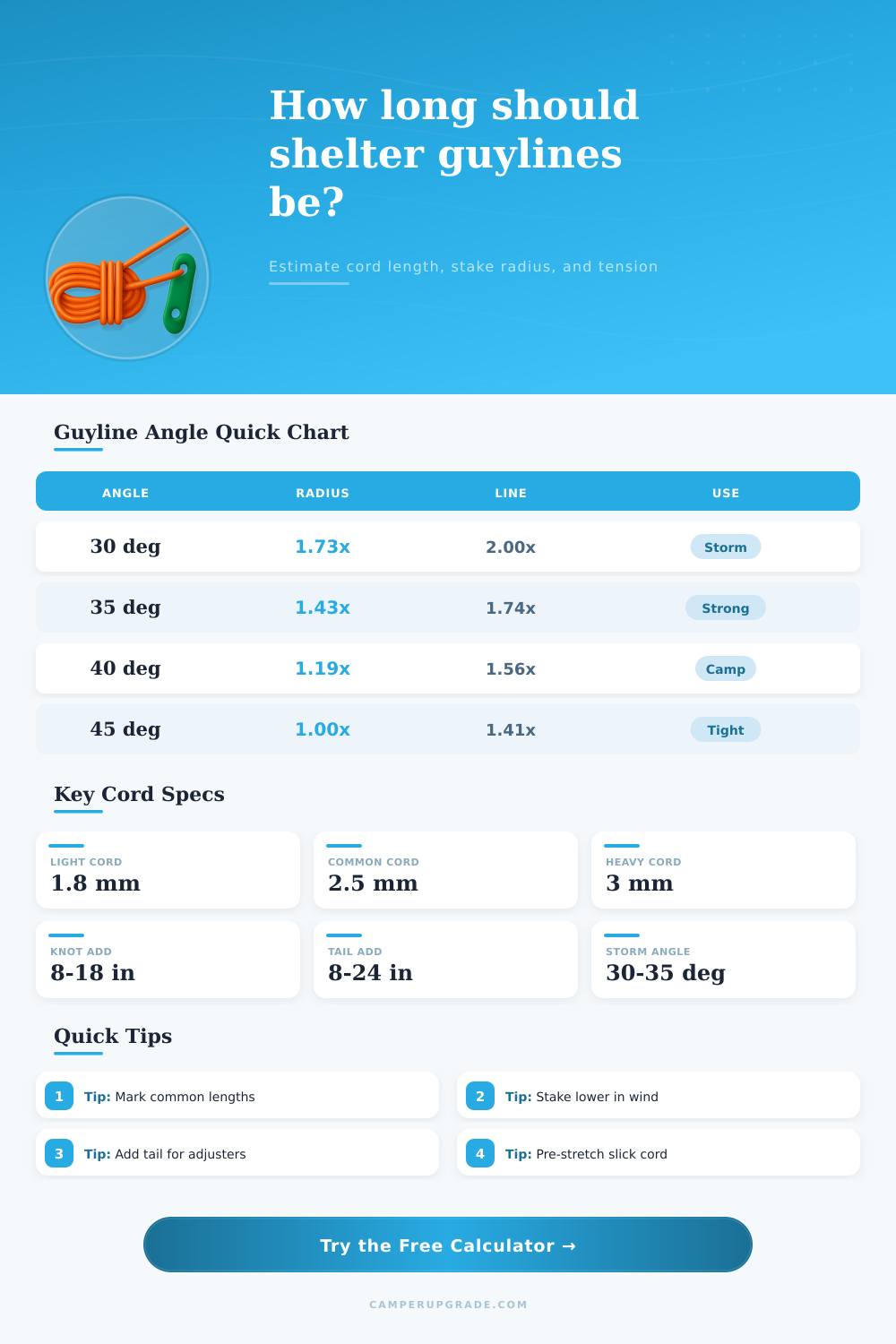
| Guy angle | Stake radius vs height | Line span vs height | Best use |
|---|---|---|---|
| 25° | 2.14 x height | 2.37 x height | Very wide storm staking |
| 30° | 1.73 x height | 2.00 x height | Strong exposed pitches |
| 35° | 1.43 x height | 1.74 x height | Windy camp setups |
| 40° | 1.19 x height | 1.56 x height | Balanced campsite pitch |
| 45° | 1.00 x height | 1.41 x height | Compact fair-weather pitch |
| 50° | 0.84 x height | 1.31 x height | Tight site, less outward pull |
| Shelter type | Typical height | Common guy count | Starting cut length |
|---|---|---|---|
| Flat tarp corner | 3.0-4.5 ft | 4-6 lines | 5-7 ft each |
| A-frame tarp ridge | 4.0-5.5 ft | 6-8 lines | 6-9 ft each |
| Pyramid shelter | 4.5-6.5 ft | 4-8 lines | 6-9 ft each |
| Dome tent fly | 3.0-5.0 ft | 4-8 lines | 5-8 ft each |
| Tunnel tent storm line | 4.0-5.5 ft | 8-12 lines | 7-10 ft each |
| RV awning tie-out | 6.5-8.5 ft | 2-4 lines | 9-13 ft each |
| Wind class | Planning tension | Stake radius note | Cord guidance |
|---|---|---|---|
| Calm camp | 12-20 lb per line | Compact radius is usually fine | Light cord works if not abrasive |
| Breezy exposed site | 22-35 lb per line | Add a little radius reserve | Reflective 2-3 mm cord is common |
| Windy ridge or coast | 38-55 lb per line | Lower angle and wider stake set | Low-stretch cord reduces flapping |
| Storm pitch | 60-85 lb per line | Wide radius with strong anchors | Use stronger cord and more lines |
| Cord type | Typical diameter | Stretch behavior | Use note |
|---|---|---|---|
| Dyneema-core cord | 1.5-2.0 mm | Very low stretch | Ultralight, slippery, needs compatible adjusters |
| Polyester guyline | 2.0-3.0 mm | Low stretch | Reliable tarp and tent line choice |
| Nylon accessory cord | 2.0-4.0 mm | Moderate stretch | Absorbs load but may sag when wet |
| 550 paracord | 4.0 mm | Moderate-high stretch | Bulky and handy, less crisp for tarps |
| Reflective tent cord | 2.0-3.5 mm | Low-moderate stretch | Good visibility around camp |
| Shock-cord assisted line | 3.0-5.0 mm | Elastic section | Useful for flapping panels, not main anchors |
Securing a tarp or an tent to the ground in the wind requires knowledge of the relationship between the height of the shelter, the angle of the securing lines, and the length of the cord that is used to create those lines. Many individuals often try to secure their tarps or tents by simply cutting line and placing stakes into the ground in an area without calculating the relationship between these three variable; this lack of calculation by many people is often what causes their tarps to flap in the wind or their tents to have leaning pole. The angle that a line makes with the ground will have an impact upon the tension that is created within that line and the amount of outward pull that each stake will have to resist.
For example, shallow angle in relation to the ground allow for the stakes to have more leverage in relation to the line that will be created; however, the shallow angles will require more cord to be utilize to secure the tarp or tent. Steeper angles will allow for the shelter to be constructed in a more compact area; however, the steep angles will reduce the component of the line that act in the direction of pressing the stake into the ground, potentially allowing the wind to pull on the tarp or tent instead of the stake. The calculator will provide estimates for the tension that is created in each of the line based off the height of each side of the shelter and the angle that is to be used.
How to Secure a Tarp or Tent Using Cord Length and Angle
The calculator will help to avoid issues of creating lines that is too short or too long to effectively secure the tarp or tent. In addition to the height and angle of the lines, the material of the cord will impact how the tarp or tent is secured. For instance, polyester cord is often used in backpacking tarps because the cord does not stretch like nylon cord does.
Dyneema cord is another common cord that is lightweight and almost inelastic, but often slippery when in contact with soft adjusters. In the calculator, an individual can select cord type so that the tension estimates will reflect the actual load on the cord when created. In addition to the cord type, the placement of each stake is also critical in securing the tarp and the tent.
The radius that is calculated is the distance that the stake will be placed from the tarp’s fabric. If the stake is moved closer to the shelter, as may be necessary if the ground is rocky, the angle of the tarp’s lines will be more steeper. This will reduce the amount of outward pulling tension that can be created by each stake.
As a result, there may be the need to add more lines to the shelter to secure it from the wind. The calculator will show the changes in radius that may be necessary so that individuals can understand how the tarp will behave in the wind. The amount of tension that is placed upon the shelter will change with the changing conditions of the wind.
For example, an area that is exposed to the wind will experience more tension upon the tarp than an area that has trees or other natural covers to the wind. The calculator will adjust the tension and stake radius estimates according to the wind class that is selected. Even more extreme conditions will again increase both the tension and the stake radius.
While it is not necessary to use the widest radius for securing the tarp or tent, the calculator will alert an individual if the radius that is used under normal conditions is insufficient for the wind conditions. Many individuals will find that the lines for their tarps are too short when exposed to high winds because they have created those lines for fair weather conditions, but did not allow for enough extra length for the tarps to secure in storm condition. In addition to the variables that relate to the cord that will be used to secure a tarp or a tent, other variable will also impact the total length of cord.
For instance, the knots that are used will impact the total length of cord that is required. A bowline or a trucker’s hitch will consume some of the cord. Additionally, adjusters like a lineloc will also consume some of the cord.
The amount of cord that is used for tails for future adjustments will also need to be accounted for. These variables are accounted for in the calculator to ensure that each line will contain the necessary amount of cord for the tarp or tent setup. If these variables are neglected, the lines may appear to be the correct length, but may be too short once the knots is tied under tension.
Another variable that impacts the tension that is created in the lines is the stretch that each cord will experience. The stretch of cords will change once they become wet. For instance, nylon cord will stretch when it becomes wet, while polyester and Dyneema cord will not.
An individual can enter the percentage of stretch for each cord into the calculator so that an individual knows the length to which the cords should be cut to account for stretch once wet. While the calculator may not be exact in the amount of length of cord that will be required due to the potentially changing length of cord due to temperature or how long the cord will be under tension, using this calculator will prevent an individual from having lines that become slack once the cord becomes wet. One way in which this calculator can be used is to create one sample line prior to cutting all of the cord.
An individual can setup the shelter in which they will place their tarp or tent. The angle of the lines can be chosen, as can the placement of knots. Once the tarp or tent is tensioned, the length of the cord can be measured before all of the remaining cords are cut.
This ensures that each line will have the same length as each of the other. By utilizing the calculator, an individual can understand the relationship between the height of the shelter, the angle of the lines, and the length of the cord so that they can make decisions about the setup of their shelter. It’s important to realize that you’re setup could of failed if you dont account for everything.
A modern setup should of been more careful than that. It is also vital to recieve the right cord for the job. Many people thinks that any cord works but thats not true.
You should of checked the material first. It’s a common mistake that dissapears when you use the calculator.