Rappel Rope Length Calculator
Estimate minimum rope, recommended rope, pull-tail length, and reserve after rappel from drop height, anchor setback, rope stretch, knots, shrinkage, and contingency margin.
Rappel rope estimate
| Vertical drop | Anchor setback | Path before add-ons | Common round-up |
|---|---|---|---|
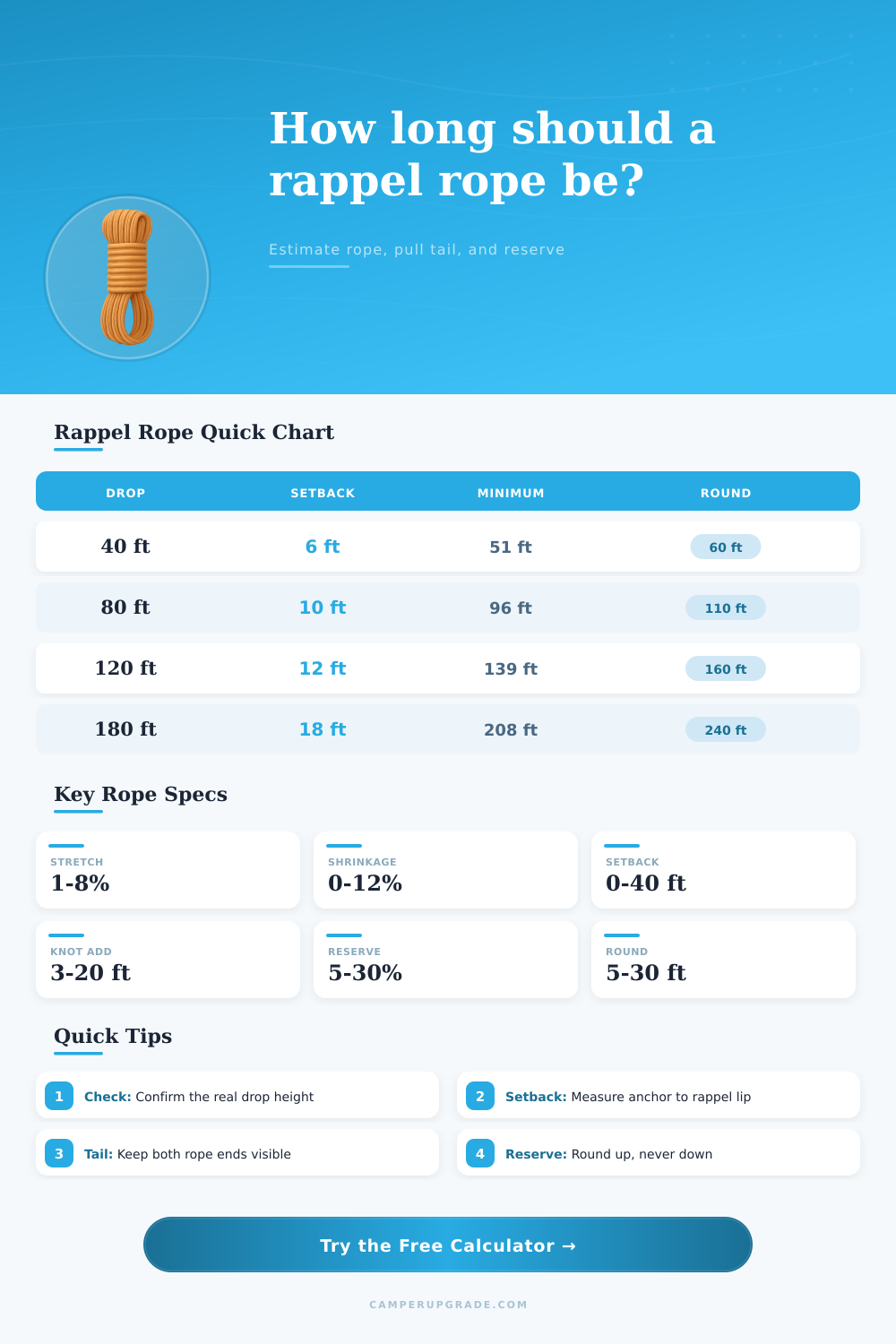
| 40 ft / 12.2 m | 6 ft / 1.8 m | 41.8 ft / 12.7 m | 60 ft / 18.3 m |
| 80 ft / 24.4 m | 10 ft / 3.0 m | 83.0 ft / 25.3 m | 110 ft / 33.5 m |
| 120 ft / 36.6 m | 12 ft / 3.7 m | 124.2 ft / 37.9 m | 160 ft / 48.8 m |
| 180 ft / 54.9 m | 18 ft / 5.5 m | 186.4 ft / 56.8 m | 240 ft / 73.2 m |
| 240 ft / 73.2 m | 25 ft / 7.6 m | 250.4 ft / 76.3 m | 320 ft / 97.5 m |
| Terrain type | Factor | Rope path effect | Use note |
|---|---|---|---|
| Direct free-hanging | 1.00x | No path add | Clean vertical line |
| Clean cliff lip | 1.03x | Small bend add | Typical simple rappel |
| Slab or ledge contact | 1.07x | Moderate add | Rope touches rock |
| Wandering rappel line | 1.12x | Large add | Route does not fall straight |
| Canyon or awkward start | 1.18x | Very large add | Complex lip and stance |
| Uncertain path | 1.25x | Exploratory add | Use conservative planning |
| Rope condition | Stretch planning | Shrinkage planning | Calculator setting |
|---|---|---|---|
| Low-stretch static | 1% to 2% | 0% to 3% | Measured rope |
| Standard static | 2% to 4% | 3% to 6% | Normal field use |
| Used wet rope | 3% to 5% | 6% to 10% | Water or canyon use |
| Unknown rope length | 3% to 6% | 8% to 12% | Measure before relying on it |
| Dynamic rope | 6% to 10% | 0% to 5% | Use only when appropriate |
| Scenario | Drop | Setback | Reserve | Starting rope class |
|---|---|---|---|---|
| Short practice wall | 35 ft | 4 ft | 10% | 60 ft / 18 m |
| Clean cliff rappel | 80 ft | 8 ft | 15% | 120 ft / 37 m |
| Wandering slab | 100 ft | 14 ft | 18% | 165 ft / 50 m |
| Canyon slot drop | 125 ft | 18 ft | 20% | 200 ft / 61 m |
| Free-hanging rappel | 180 ft | 12 ft | 15% | 240 ft / 73 m |
| Remote expedition | 220 ft | 25 ft | 30% | 300 ft / 91 m |
When planning a rappel, determining the total length of rope that are required for the rappel requires consideration of more than just the vertical distance of the rappel. In addition to the vertical distance of the rappel, the anchor setback and the terrain must be consider. The anchor setback is the horizontal distance between the anchor to which the rappeller will descend and the edge of the cliff.
An anchor that is set back from the edge of the cliff will require more rope than a rappel with an anchor that is close to the edge of the cliff due to the fact that the rope will travel along an angled path from the rappeller to the anchor. Many people will only consider the vertical distance that the rappeller will travel, but often, if only the vertical distance is consider, the rope may be too short to account for the anchor setback and terrain. The terrain in which the rappellant will descend also impact the amount of rope required for the rappel.
How to Calculate Rope Length for a Rappel
Terrain may force the rappel line to travel along a path that is not directly from the rappellant to the anchor. For instance, the rope may hang freely in the air between the rappellant and the anchor, but the terrain may necessitate that the rope touch a slab or a ledge. Additionally, terrain elements like trees or canyon slots may require the rappelling rope to follow those curve.
In these cases, the rope will require more length than if it were allowed to follow a direct path from the rappellant to the anchor. A multiplier can be entered into the calculator to account for these terrain element. Using this multiplier will ensure that the length of the rope calculated for the rappel accounts for such terrain elements.
The behavior of the rope when being rappelled can also impact the length of rope that is needed. Ropes will stretch when a rappellant puts there weight on the rope. Additionally, ropes may shrink when wet rappel ropes dry, and used ropes may have altered in length due to normal wear and tear on the rope.
These factors can be entered into the rappelling calculator to determine if the rope that will be used in the rappel is a new rope that is dry, or if the rope will be a wet rope. Accounting for the stretch and shrinkage of the rope will ensure the length of rope is enough for the rappel. Another factor to consider is the retrieval of the rappel rope.
The retrieval strand of the rope must be long enough to reach the stance of the rappellant after they have completed the rappel. The rappelling calculator will compare the length of the rope that is required to pull the rope back to the rappellant to the length of the retrieval strand. The rappelling calculator will indicate whether there is a surplus of rope or a shortage of rope relative to the rappellant’s retrieval of the rope.
If the rappellant plans on pulling the rope themself, the retrieval of the rope is something that must be considered at the same time as the planning of the rappel itself. Another last factor to consider is the inclusion of a contingency reserve into the length of rope that is calculated for the rappel. A contingency reserve is an amount of length of rope that is added to the total length that is calculated to provide an extra length of rope in case of moving the anchor or tying a different knot into the rappel rope.
A percentage can be selected for the contingency reserve in the rappelling calculator. A higher percentage will indicate a longer amount of reserve rope. While the rope will not become any safer as a result of this contingency reserve, it will provide more room for rappelling difficulties when the rappel is performed.
The rappelling calculator can display the length of rope that would of been required with the inclusion of a contingency reserve after the rope shrinkage is accounted for. The reference tables provide examples of rappels with specific distances for the drop and the setback. These tables can be used to compare the variables of the rappel that will be performed with the examples provided for different variables.
The tables demonstrate how the length of the rope increases with the addition of elements like terrain and rappel line allowances. These tables should not be used to replace the physical measurement of the rappels anchor, but instead they can provide examples of how the length of the rappels rope will change with those additional factors. Most problems with rappelling are the result of underestimating one variable and overestimating another.
Some people may find that their rope is long enough for the vertical distance of the rappel, but too short for the anchor setback and terrain. Other people may have ropes that are too long to rappel the distance that they intend for the rappel. A rappelman that brings a rope that is too long will find it difficult to carry and to pull the rope up the distance that they need to rappel.
In creating a rappel plan with the rappelling calculator, an individual can aim to find a rope that will meet the demand of the rappel. The rappelling calculator will calculate the length of rappel rope based off the measurements for the rappels drop, setback, terrain, rope type, retrieval of the rope, and the contingency reserve of rope.