Knot Strength Calculator
Estimate retained rope strength, knot loss, working load, and safety margin from MBS, knot choice, rope diameter, weather, wear, bend radius, and load type.
Knot strength estimate
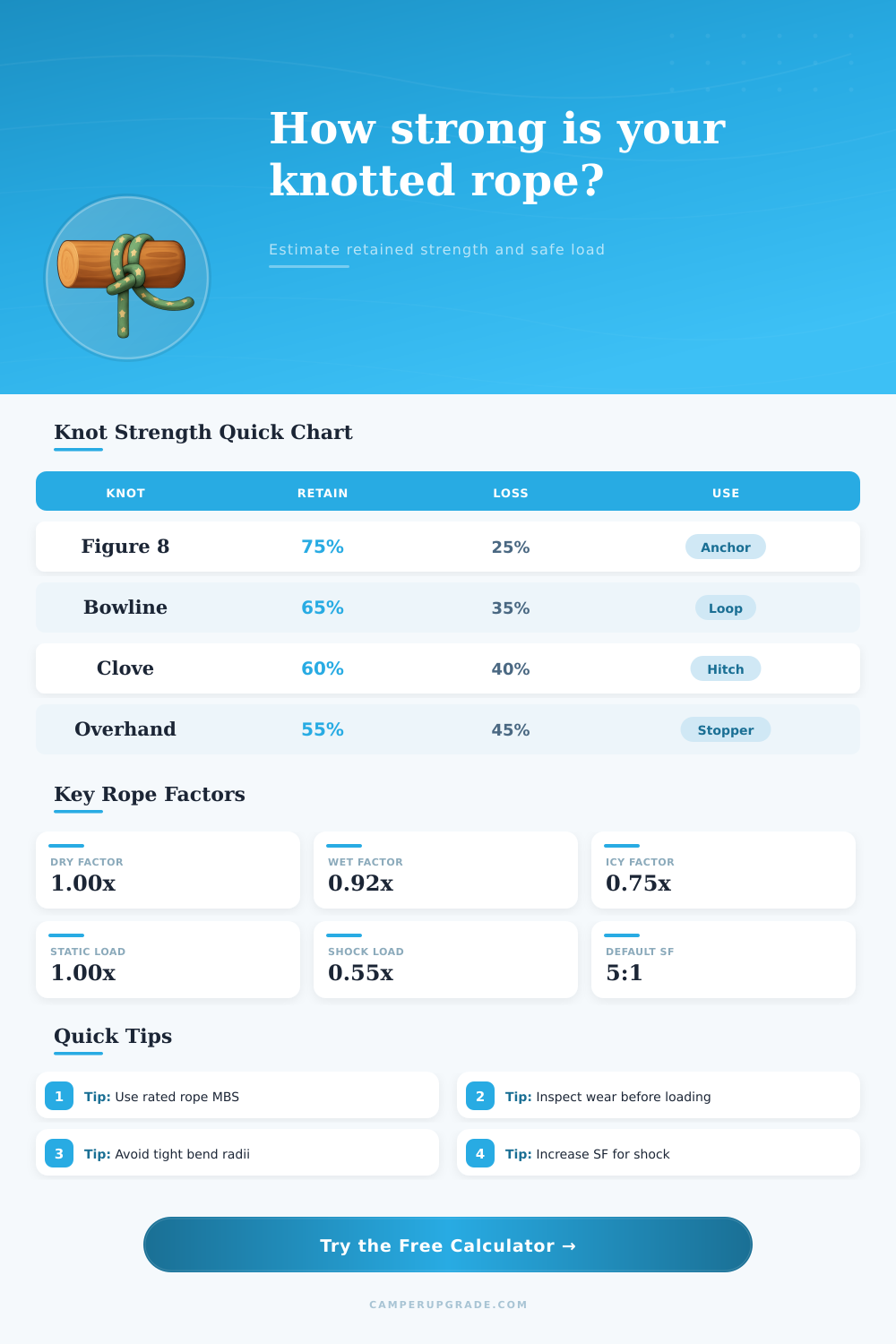
| Knot type | Retained strength | Knot loss | Planning note |
|---|---|---|---|
| Double fisherman bend | 80% | 20% | Strong bend when dressed and set |
| Figure eight follow-through | 75% | 25% | Common loop and anchor tie-in shape |
| Figure eight on a bight | 74% | 26% | Similar loss with a fixed loop |
| Water knot / tape knot | 68% | 32% | Common for flat webbing and tape |
| Bowline | 65% | 35% | Useful fixed loop, requires proper finish |
| Sheet bend | 62% | 38% | Best when rope sizes are compatible |
| Clove hitch | 60% | 40% | Convenient hitch, sensitive to loading angle |
| Truckers hitch system | 58% | 42% | Includes bends and concentrated tension |
| Overhand knot | 55% | 45% | Simple, compact, and usually high-loss |
| Nominal diameter | Metric diameter | Typical MBS range | Common field use |
|---|---|---|---|
| 1/4 in | 6 mm | 1,000-2,000 lb | Tarp, light utility, accessory cord |
| 5/16 in | 8 mm | 2,200-3,800 lb | Utility line, small boat line |
| 3/8 in | 10 mm | 3,500-6,500 lb | Static rope, dock line, work rope |
| 7/16 in | 11 mm | 5,000-9,000 lb | Rescue-style static rope screening |
| 1/2 in | 13 mm | 6,000-12,000 lb | Haul line, anchor line, heavier utility |
| 5/8 in | 16 mm | 10,000-18,000 lb | Large dock, mooring, and rigging line |
| Factor group | Input option | Multiplier | What it represents |
|---|---|---|---|
| Weather | Dry and clean | 1.00x | Baseline planning condition |
| Weather | Wet or rain-soaked | 0.92x | Water, lower friction, and handling uncertainty |
| Weather | Muddy / gritty sheath | 0.82x | Abrasion and grit around tight bends |
| Weather | Icy or frozen | 0.75x | Stiff rope, poor dressing, and reduced grip |
| Load type | Static hanging load | 1.00x | Slow load with little movement |
| Load type | Hauling / tensioned line | 0.85x | Friction, cyclic pulls, and uneven loading |
| Load type | Dynamic movement | 0.70x | Movement and short load spikes |
| Load type | Possible shock load | 0.55x | Sudden force can exceed static estimates |
| Preset | Rope and knot | Field factors | Planning result |
|---|---|---|---|
| Static rope figure eight | 6,000 lb, 7/16 in, figure eight | Dry, 10% wear, static | High utility margin at 700 lb |
| Wet dock clove hitch | 4,500 lb, 3/8 in, clove hitch | Wet, 18% wear, pulsing | Margin depends on low load |
| Truckers hitch haul line | 3,200 lb, 5/16 in, truckers hitch | Dry, 12% wear, hauling | Keep load modest |
| Icy alpine rope | 7,500 lb, 10.5 mm, figure eight | Icy, 15% wear, dynamic | Needs high safety factor |
| Aged camp utility line | 1,800 lb, 1/4 in, overhand | Muddy, 35% wear, pulsing | Light-duty only |
When you use the rope strength calculator, there is various factors that will impact the strength of the rope. The manufacturer publish a rating of the strength of the rope when it is new. However, when you tie a knot in the rope, the strength of the rope will decreases.
The knot will bend the fiber of the rope around each other, which will decrease the even distribution of the strength of the rope. The calculator will ask for the rated strength of the rope and the type of knot that you will use. The efficiency of the knot will impact the remaining strength of the rope.
What Affects Rope Strength
For instance, a double fisherman bend will retain 80% of the ropes strength, while an overhand knot may reduce the strength of the rope to 60% or less. The calculator will perform the efficiency of the knot calculation first. Following this calculation, the other factors will be apply to the results to determine the strength of the rope under the given condition.
Weather and surface will also impact the strength of the rope within the knot. For example, if the rope is wet, it will swell within the knot. Additionally, the strength of the rope will have less friction if it is wet.
Grit will act as an abrasive against the ropes fiber. Ice may make the rope stiff when incorporate into a knot. These factors will be accounted for in the calculator with a multiplier that takes into consideration the weather and the surface on which the rope is use.
The wear on the rope will also impact the strength of the rope. Ultraviolet light will break down the filaments within the rope. Additionally, the fiber of the rope may experience fatigue due to the load that it carry.
If the rope has fuzz or flat spot on the ropes fibers, it has strong sign of internal damage within the rope. The wear on the rope can be entered into the calculator as a percentage. A rope that is old will have less strength then one that is new.
Another factor that will impact the strength of the rope is the bend radius. The bend radius is the measurement of the sharpness of the turn that the rope make around an object or within a knot. As with other factors, the smaller the bend radius, the less strength the rope will exhibit.
For most ropes, the manufacturer will specify that the minimum bend radius should of be four times the diameter of the rope. If the bend radius of the application is smaller than this measurement, the strength of the rope will decrease. The calculator will account for this factor by compare the bend radius to the diameter of the rope.
The type of load that will be placed upon the rope will also have an impact upon the strength of the rope. With static loads, the evenness of the distribution of the ropes fibers allow for even distribution of the applied load. With dynamic loads, such as shock loads, the ropes fibers will not even out the load that is place upon the rope.
The shock load is more stressful upon the rope then a static load. When you choose dynamic or shock loads for the load type within the calculator, the calculator will automatically reduce the load to account for this factor. The last factor that will impact the strength of the rope is the safety factor.
This factor act as a margin of safety for the strength of the rope. You should incorporate this factor to ensure that you have a margin of safety for the rope. If the safety factor is too small, you should change the type of knot that you use, the rope that you use, or the load that you are placing upon the rope with this knot.
It is important to enter honest numbers within the parameters of the calculator to ensure that you maintain a safety factor that is reliable for your application.