Anchor Angle Force Calculator
Estimate force per anchor leg, total system tension, angle multiplier, and safety margin for campsite rigging, redirects, awnings, tarps, and recovery planning.
Anchor force estimate
| Anchor leg angle | Multiplier | 500 lb shared by 2 legs | Field note |
|---|---|---|---|
| 0 degrees | 1.00x | 250 lbf per leg | Best alignment |
| 15 degrees | 1.04x | 259 lbf per leg | Very efficient |
| 30 degrees | 1.15x | 289 lbf per leg | Good field target |
| 45 degrees | 1.41x | 354 lbf per leg | Watch ratings |
| 60 degrees | 2.00x | 500 lbf per leg | High tension |
| 70 degrees | 2.92x | 731 lbf per leg | Avoid if possible |
| Direction change | Anchor reaction | Example use | Planning note |
|---|---|---|---|
| Direct pull | 1.00x load | Straight guyline | Simplest case |
| 30 degrees | 1.04x load | Fairlead offset | Small change |
| 60 degrees | 1.15x load | Light redirect | Add margin |
| 90 degrees | 1.41x load | Corner pull | Common high load |
| 120 degrees | 1.73x load | Wide return | Near double |
| 180 degrees | 2.00x load | Return pulley | Doubles reaction |
| Component | Typical planning range | Best use | Check before use |
|---|---|---|---|
| Tent stake | 50-250 lbf | Light shelter tie-outs | Soil and pull angle |
| Sand screw | 150-600 lbf | Beach awnings | Depth and sand firmness |
| Tree strap | 1000-3000 lbf | Hammock or tarp anchors | Bark protection |
| Utility carabiner | 150-1200 lbf | Light camp rigging | Stamped rating |
| Recovery shackle | 4000+ lbf | Vehicle recovery planning | WLL and pin fit |
| Rated webbing sling | 2000+ lbf | Tree saver wrap | Cuts and abrasion |
| Condition | Multiplier | Use when | Result effect |
|---|---|---|---|
| Static hold | 1.0x | Load is steady | Base force only |
| Mild movement | 1.3-1.5x | Wind or sway | Moderate increase |
| Jerky pull | 2.0x | Vehicle or rope snaps | Large increase |
| Low friction | 1.05x | Pulley or smooth ring | Small allowance |
| Rough wrap | 1.12-1.20x | Bark, edge, or webbing | Higher hot leg |
| High drag | 1.30x | Sticky redirect | Use more margin |
When tensioning a line between two anchor, it is important to understand the relationship between the tension in that line, the angle of the line, and the force that is applied to that line. The tension that is felt at each of the anchors are not necessarily the same as the weight that is being applied to the line; in some cases, the tension at the anchor can be significantly higher than the weight that is being applied to the line. Furthermore, while you can estimate the tension at the anchors, such estimates can lead to failures in the anchor and line equipment; it is essential to account for each of these factors to ensure that the tension is within the strength of the anchors and line itself.
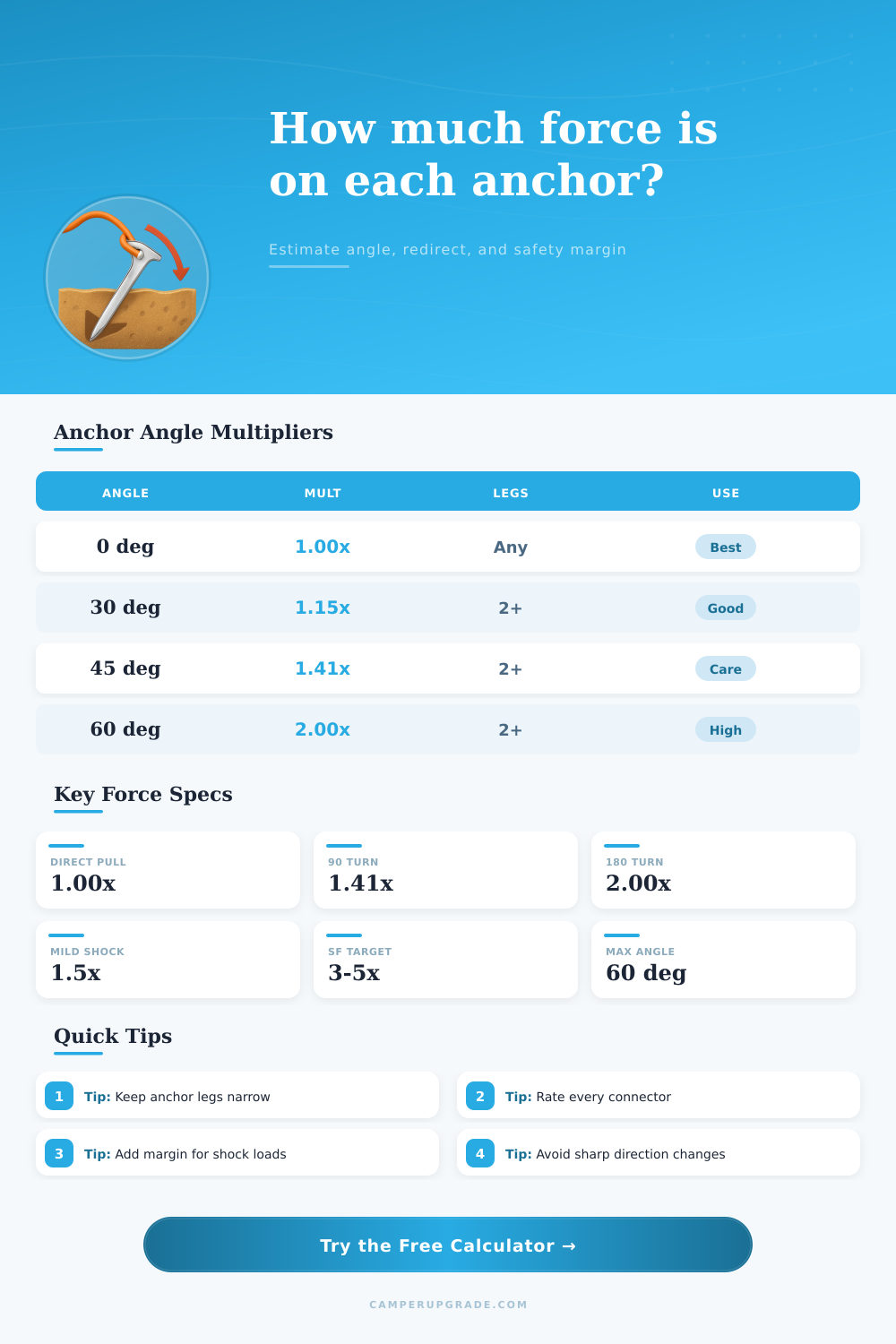
One of the factor that will increase the tension at the anchor is the angle of the line between the two anchors. As the angle between the line and the anchor increase, the tension that each of the anchors must apply to the line increases, as well. For instance, if the angle between each of the lines is forty-five degrees, the tension in each line will be forty percent higher than if the line was pulling in a straight direction.
What Affects the Tension in a Line Between Two Anchors
Furthermore, if the angle between each of the lines is sixty degrees, the tension in each of those lines will double. Thus, any increase in the angle between each of the lines will lead to an increase in the tension at each of the anchors; the wider of the angle will stress the anchor more than a narrower angle between the two anchors. The tension within each of the lines can be calculate by a calculator that takes into account the angle of the lines.
In addition to the angle of the lines, the setup of the anchors may lead to increased tension at only one of the two anchors. For instance, one of the anchors may be placed into softer ground than the other anchor, or one of the anchors may be placed at a different distance from the load than the other anchor. Because of these differences between the two anchors, the tension will not be evenly distributed to each anchor.
These differences can be accounted for in a calculation of the tension of the lines by using a symmetry feature on that calculation tool. Another factor that may lead to an increase of the tension at the anchors is the changes in the direction of the lines between the load and the anchor. For instance, if the lines change its direction by ninety degrees, the tension at the anchor will increase; a one-eighty degree change in the line’s direction will double the tension at that anchor.
Thus, any change in the line’s direction will increase the tension at the anchor; a line that changes in direction to a pulley will create more tension on that tree strap than a line that pulls the load in a straight direction. This factor can be accounted for with a calculation tool with a redirect coefficient feature. In addition to these factors, the tension within the line may also increase due to the friction between the line and another object.
For instance, if the line moves along the bark of a tree, friction will increase the tension that is being applied to one side of the line. Similarly, dynamic loads on a tarp due to the wind, or movement of an object within a hammock, will also increase the tension within the line. Typical camping setups will experience tensions that is between 1.3 times and 2 times of the static load when movement or wind is encountered.
To account for these dynamic loads, it is important to include a factor in the tension calculations that accounts for this potential increase in tension. Another factor that can be included in the calculation of the tension of the lines is the safety factor. A safety factor is the strength of the anchor or line divided by the tension that is applied to that line.
A three to one safety factor means that the line or anchor is three times as strong as the tension that will act upon it; a five to one safety factor means that the line or anchor will be five times as strong as the tension that will act upon it. A higher safety factor is desired if there is a chance that a heavy object will fall upon a person if that line fails; thus, when setting up an even three to one safety factor, it is important to include this calculation to ensure safety. The tension calculations can compare the strength of the line to the safety factor to ensure that each setup will remain within it’s desired safety factor.
Some of the mistakes that people may make when calculating the tension on the line and anchors include measuring the wrong portions of the line, or understanding the strength of the hardware. For instance, many individuals may measure the angle of the line at the load, rather than the angle at the anchor. Furthermore, individuals may believe that the average tension on the lines is the most important measurement of the system, when in fact, the tension at the most loaded anchor is the most important; that is the portion of the system that is most likely to fail.
Additionally, the strength of the hardware should never be measured as the working load; the working load should always be set to a value that is less than the maximum rated strength of that hardware. The type of ground on which the anchors are placed will affect the strength of the anchor; a stake may be able to hold three hundred pounds on firm soil, but may only be able to hold a few pounds in sand or clay. Similarly, the strength of the hardware may not be the portion of the system that fails; it is more likely that a knot or buckle will fail before the tree strap itself fails.
Thus, each setup should account for the weakest portion of the system; that is the portion that will fail. Prior to setting up the equipment, the tension within the lines should be calculated. For instance, if an anchor will be near the safety factor for its system while there is no wind, the tension at that anchor will likely reach the safety factor of that system when the wind arrives.
Furthermore, adjusting the angle at which the lines are placed can reduce the tension at each anchor; changing the angle to each of the anchors can reduce tension more effectively than simply replacing that anchor with a stronger hardware component. By adjusting these various factors, the safety of the entire system can be increased. People should of accounted for this to avoid accidents.
Youll need to be careful with the furnitures you use for setups too. The anchors location is vital, and sometimes people dont realize how much tension can build up. Its a common mistake to think the tension is constant, but it actually changes alot based off the angle.
Using a moddern calculator helps, but you still must double check your work to recieve accurate results. Its easy to miscalculate if you dont pay attention to the small details.