Backpack Torso Length Calculator
Match C7-to-iliac torso length, hipbelt size, shoulder strap range, pack volume, load weight, and frame adjustability to a cleaner pack fit.
Backpack fit estimate
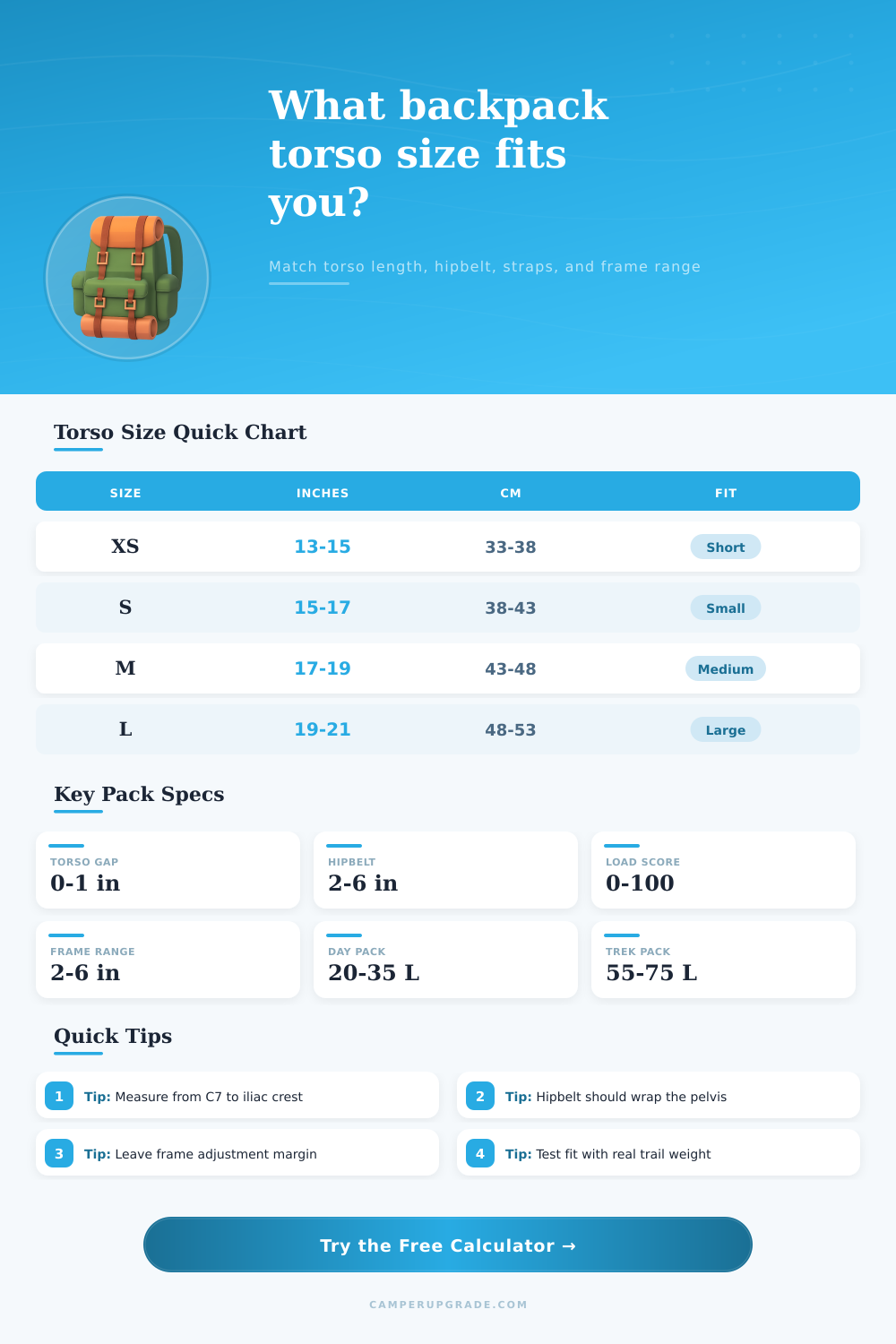
| Torso size | Torso range | Metric range | Typical pack label |
|---|---|---|---|
| Extra small | 13 to 15 in | 33 to 38 cm | XS or short |
| Small | 15 to 17 in | 38 to 43 cm | S or short |
| Medium | 17 to 19 in | 43 to 48 cm | M or regular |
| Large | 19 to 21 in | 48 to 53 cm | L or tall |
| Extra large | 21 to 23 in | 53 to 58 cm | XL or tall |
| Hipbelt label | Waist over hips | Padding wrap | Fit note |
|---|---|---|---|
| Small | 26 to 32 in | 2 to 5 in gap | Shorter padded wings |
| Medium | 32 to 38 in | 2 to 6 in gap | Common backpacking fit |
| Large | 38 to 46 in | 3 to 7 in gap | Longer wrap and webbing |
| XL | 46 to 54 in | 4 to 8 in gap | Extended belt needed |
| Pack profile | Volume | Load range | Frame expectation |
|---|---|---|---|
| Day hiking | 15 to 30 L | 5 to 18 lb | Simple or light frame |
| Overnight | 30 to 45 L | 15 to 28 lb | Light internal frame |
| Weekend | 45 to 60 L | 25 to 40 lb | Structured hip transfer |
| Long distance | 50 to 70 L | 20 to 35 lb | Stable, efficient frame |
| Winter or camera | 55 to 75 L | 35 to 55 lb | Stiff frame preferred |
| Expedition | 70 to 95 L | 45 to 70 lb | Heavy load frame |
| Frame style | Usable range | Good margin | Risk flag |
|---|---|---|---|
| Fixed torso | 0 to 1 in | Within 0.5 in | Exact size matters |
| Limited ladder | About 2 in | 0.5 in from edge | Little resale fit range |
| Standard ladder | About 4 in | 1 in from edge | Most common choice |
| Extended ladder | About 6 in | 1.5 in from edge | Good for shared packs |
| Custom system | Maker-specific | Centered setting | Verify with loaded test |
Finding the correct backpacks begins with a torso measurement, which is necessary to determine if a backpack will sit correctly on your body. The torso measurement will ask that you measure from the C7 vertebra at the base of your neck to the top of your hip bone. If you dont get the correct torso measurement, then the backpack will not work with your anatomy; it will fight against your anatomy.
Backpack frame are built for specific ranges of torso measurements, and if your measurement falls outside of that range, you will not have the necessary adjustments to your frame to allow for proper functioning of the backpack. Enter your torso length, your hip measurement, your expected load, and your frame style into the calculator. The calculator will use those measurements to make a mathematical calculation that will indicate whether you need to guess at whether or not a medium-sized backpack will allow for enough adjustments to your backpack to allow your weight to be distributed proper.
Measure Your Torso to Get the Right Backpack
Height does not have the same significance as torso length. While you may have the same height as another individual, your torso length might not be the same than that of another individual. The calculator will use height in the determination of the best backpack size for you, but it will not be the deciding number.
If your torso length is too short or too long in comparison to your height, your fit score will drop. The fit score will drop to indicate that the backpack will either sit too high on your back (if your torso is too short), or the backpack will sit too low on your back (if your torso is too long). This will affect how the weight of the backpack is distributed to your hips; it should be distributed to your hips because this is the part of your body that is design to carry weight.
Another important measurement is your hipbelt; however, you should not take your waist measurement. Your hipbelt should be measured from where the padded wings of the belt will wrap around the top of your pelvis. The calculator includes a means to compare your hipbelt to the typical range of hipbelts for backpacks, and it will tell you what your front gap will be for the backpack when you are properly fitted.
This will allow you to determine if your backpack will sit within the limits of your hipbelt or if your hipbelt will be pushed to its limit. The range of your shoulder straps and the adjustment of your frame are two features of your backpack that are difficult to explain without seeing the backpack. For instance, your frame may offer four inch of ladder adjustment, but the actual adjustment for your shoulder straps may be less.
The calculator will tell you how close your adjusted torso length is to the edge of the frame range. If you are within a half-inch or less of the edge of the range for your frame, your backpack may become uncomfortably when you are loaded with your intended weight. Backpacks with different volumes will carry different amounts of weight.
For instance, a 55-liter backpack will behave differently with twenty pounds of weight compared to forty-five pound of weight. The calculator will provide a transfer score based off your load and the backpack volume. The transfer score will tell you if the weight you are moving is within the normal range for that backpack.
If the load score is too high for your backpack, your score will drop unless you have a backpack with a stiff frame. Many individuals will make a mistake in sizing their backpacks based upon the size of the backpack rather than the recommendation of the calculator. A medium size on one manufacturer may differ from another manufacturer’s measurement of medium size.
The reference tables will show you each of these sizes, and you will be able to see how each size relates to the other sizes. Furthermore, these tables will also display your hipbelt specification in comparison to your waist-over-hips measurement. This information may be useful for those who are in the middle of backpack sizes, or who use interchangeable backpack belts.
Backpacks made for women and youth are different than those made for unisex individuals. For example, the yoke of the backpack may be shorter for those who are made for women, or the shoulder straps might be shaped differently. These differences are made for individuals who have narrower shoulders and whose center of gravity is lower.
The fit offset selector allows for those individuals to select a different measurement than their torso measurement; otherwise, their backpack may not distribute the weight proper to their shoulders and back. Even using the calculator for determining your backpack size, you should still test the backpacks. The calculator will never account for how a backpack will feel with your actual load, especially on terrain that may challenge the movement of your body.
Based on the calculator, you can begin to form a list of backpacks that may work for your body. Place each backpack in your load and walk for ten minutes with it. If you feel any pressure points while using the backpack for ten minutes, those pressure points will become worse while on the trail.
Finding the correct backpack begins with properly measuring your torso. To find your torso measurement, you will stand in the most natural position for your body. Ask a friend to find the bump at the base of your neck (C7 vertebra) by tilting your head.
Use this point to measure vertically down to the top of your hip bones. This torso measurement will, along with your hip measurement and the load you will be carrying, provide the calculator with the information it need to properly calculate the suitability of each backpack that is listed. Armed with this information, you can stop looking at features of backpacks that will not be able to accommodate your body, and you can begin to compare those that will properly accommodate your body.