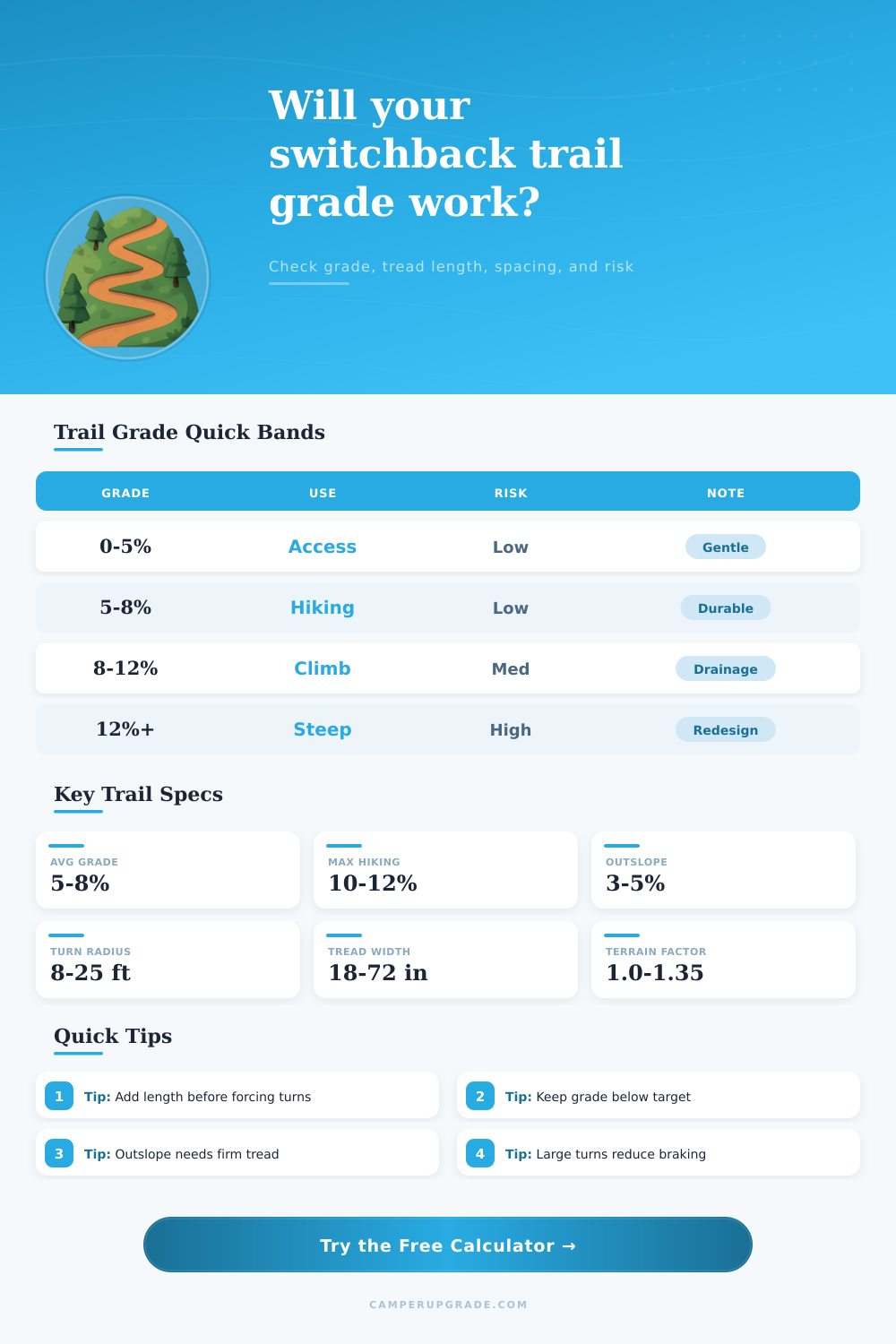
Switchback Grade Calculator
Estimate average trail grade, tread length, switchback spacing, and design risk from rise, run, turn count, tread width, turn radius, outslope, correction, and terrain factor.
Switchback layout estimate
| Average grade | Common use | Drainage concern | Design note |
|---|---|---|---|
| 0-5% | Accessible or family routes | Low if outslope is continuous | Check landings and cross drainage |
| 5-8% | Sustainable hiking trail | Low to moderate | Often durable with grade reversals |
| 8-10% | Climbing trail on stable soil | Moderate | Use frequent drainage features |
| 10-12% | Short steeper segments | Moderate to high | Keep runs short and armored if needed |
| 12-15% | Technical or constrained routes | High | Expect erosion and braking forces |
| 15% plus | Not ideal for sustained trail | Very high | Add tread length or relocate controls |
| Use case | Tread width | Turn radius | Layout note |
|---|---|---|---|
| Narrow hiking trail | 18-30 in | 6-12 ft | Use cribbing or full bench on steep side slopes |
| Standard hiking trail | 30-42 in | 10-18 ft | Keep approach grades modest before the turn |
| Shared-use climbing trail | 36-60 in | 18-35 ft | Larger radius reduces braking and rutting |
| Accessible interpretive trail | 48-72 in | 20-40 ft | Check running grade, landings, and cross slope |
| Pack animal or stock trail | 48-72 in | 25-50 ft | Avoid blind tight turns and abrupt grade breaks |
| Technical mountain route | 18-30 in | 5-10 ft | Use only where terrain forces a compact turn |
| Outslope | Best fit | Risk signal | Field check |
|---|---|---|---|
| 0-2% | Accessible or hardened surfaces | Water may stay on tread | Confirm drains and grade reversals |
| 3-5% | Most natural-surface hiking trails | Low when tread is firm | Water should sheet off the outside edge |
| 5-7% | Wet soils or durable bench | Moderate user comfort issue | Check slip risk and soil creep |
| 7-10% | Short armored areas only | High edge displacement risk | Use retaining, rock, or drainage refinement |
| 10% plus | Rare field constraint | Very high cross-slope risk | Regrade tread or narrow the exposed segment |
| Terrain factor | Terrain description | Effect on length | Design implication |
|---|---|---|---|
| 1.00-1.05 | Open, smooth corridor | Minimal extra tread | Layout closely matches map run |
| 1.06-1.15 | Moderate rocks or trees | 6-15% extra tread | Good default for hand-flagged contour trail |
| 1.16-1.25 | Broken hillside or constraints | 16-25% extra tread | Expect more bends and drainage details |
| 1.26-1.35 | Rocky, gullied, or tight corridor | 26-35% extra tread | Use conservative grades and larger buffers |
| 1.36-1.50 | Very constrained alignment | 36-50% extra tread | Field verification matters more than map math |
| Net rise | Minimum tread length | Example switchbacks | Spacing check |
|---|---|---|---|
| 40 ft / 12 m | 500 ft / 152 m | 0-1 turns | 250-500 ft traverses |
| 80 ft / 24 m | 1000 ft / 305 m | 1-2 turns | 330-500 ft traverses |
| 120 ft / 37 m | 1500 ft / 457 m | 2-3 turns | 375-500 ft traverses |
| 180 ft / 55 m | 2250 ft / 686 m | 3-5 turns | 375-560 ft traverses |
| 260 ft / 79 m | 3250 ft / 991 m | 5-7 turns | 405-540 ft traverses |
| 360 ft / 110 m | 4500 ft / 1372 m | 7-10 turns | 410-560 ft traverses |
A switchback grade calculator is a tool that take the measurements of your trail design and produces mathematical outcome. Additionally, a switchback grade calculator help you understand those outcomes. When you are designing a trail on a hillside, you must consider two main factors: how the trail’s walking surface will behave and how that same walking surface will handle water and erosion.
A switchback grade calculator allow you to view how these variable will play out before you construct the trail. There are many different input that must be entered into the switchback grade calculator. The vertical rise represent the net vertical climb between your two points along the trail, and this value is one that you need to measure.
How a switchback grade calculator helps you design a trail
The horizontal run is the distance you can travel on the slope between those two points, but this value does not include the distance that the trail’s turns will add to the trail. The turn count is the number of switchbacks that the trail will include, and this impact how the water will move along the trail. The tread width is the width of the trail’s walking surface, and this impact both the comfort of the trail’s users as well as the ability of the walking surface to shed water from the trail.
The target grade is the grade that you want to establish along the trail, and you must respect this value so that the trail will not experience erosion. The turn radius is the tightness of the turns along the trail, and this impact the experience of the individuals that are traveling the trail. Finally, the outslope is the angle of the trails walking surface, which impact the way that water drains from the trail’s tread.
Finally, the elevation correction account for any dips in the ground that you may encounter, and the terrain factor account for any obstacles that may impact the trail. Each of the inputs into the switchback grade calculator will impact the different outputs that the calculator provides. For instance, if you increase the terrain factor that you enter into the calculator, the length of the tread that must be constructed will increase, which will reduce the average grade that is established along the trail.
However, constructing a trail with a longer tread will require more drainage work to be performed on that trail. The switchback grade calculator allow you to view these different trade-offs between your various trail design elements. The switchback grade calculator will provide you with three main output.
The first is the average grade of the trail, which will help you understand whether or not the trail is likely to be sustainable, or whether it will suffer from erosion. The second output will be the length of the tread that will need to be constructed. Finally, the third output is the spacing between switchbacks along the trail, which will help you to understand if the traverses along the trail are long enough to allow the water to soak into the ground.
Additionally, the calculator will provide a risk band for each trail design element; this risk band will change if any of the design elements’ values are outside of the standard range for those elements to be functional. One of the mistake that many trail designers make is treating the grade of a trail as a single, fixed number. The grade is actualy a relationship between the trail’s vertical rise and the horizontal length of the trail.
The trail may appear to have an acceptable grade on a map, but that same trail may become too steep if rocky terrain and switchbacks are added to that trail. The switchback grade calculator force a designer to consider this relationship between vertical and horizontal measurements prior to construction of the trail. Furthermore, the switchback grade calculator make the outslope of a trail visible to the designer.
An outslope of 4% may be sufficient to ensure that water runs off of a firm trail’s tread, but 4% may be too steep for a trail on loose soil. Thus, the relationship between the grade and the outslope of a trail can help a designer to determine whether the tread needs to be widened or whether the trail needs to be constructed with more grade reversals. Depending upon the use case for the trail, the switchbacks calculator can be used in different ways.
For instance, if the trail is for pack stock, then the grade will be steeper than a trail that is designated for hiking individuals. Thus, the risk band will change according to the use case of the trail. However, there are still some factors that the switchback grade calculator does not account for; for instance, it does not account for the soil that will be used in constructing the trail.
Thus, you will need to use your own judgment when walking the trail. An error that many designers make is attempting to use the switchbacks to reduce the grade of a trail without ensuring that there is enough length along the hillside for the turns to be constructed. Additionally, while the spacing between the switchbacks will provide insight into whether or not that many traverses along that distance are acceptable, they will not change the fact that the hill itself is steep and the horizontal run that the trail will take is short.
Another error that designers often make is ignoring the outslope of a trail. While the switchback grade calculator will alert you if the outslope of the trail is outside of the normal range (3%-5%), you will still need to use a clinometer to determine the outslope of the trail. The tables that are provided within the calculator provide information that designers should know regarding trail design elements.
These tables can be used to understand the relationship between the different trail elements. While trail designers dont have to memorize the tables, they will help designers to understand if a trail layout will be durable. Finally, the switchback grade calculator provides designers with a means of converting their trail design choices into a list of the consequences of each of those choices.
In this way, the switchback grade calculator allow designers to see the trade-offs between different trail elements prior to beginning construction. The numbers that are provided from a switchback grade calculator will never completely replace the need for designers to walk the trail and inspect the soil that will be used for the trail, but the numbers will help designers to avoid constructing a trail that has the wrong grade. Thus, using a switchback grade calculator will provide clarity to trail designers prior to beginning construction of their trail.