Arrow Weight GPI Calculator
Total shaft grains and every arrow component, then compare finished GPI, FOC, kinetic energy, momentum, and grain tolerance for tuned bow setups.
Arrow build estimate
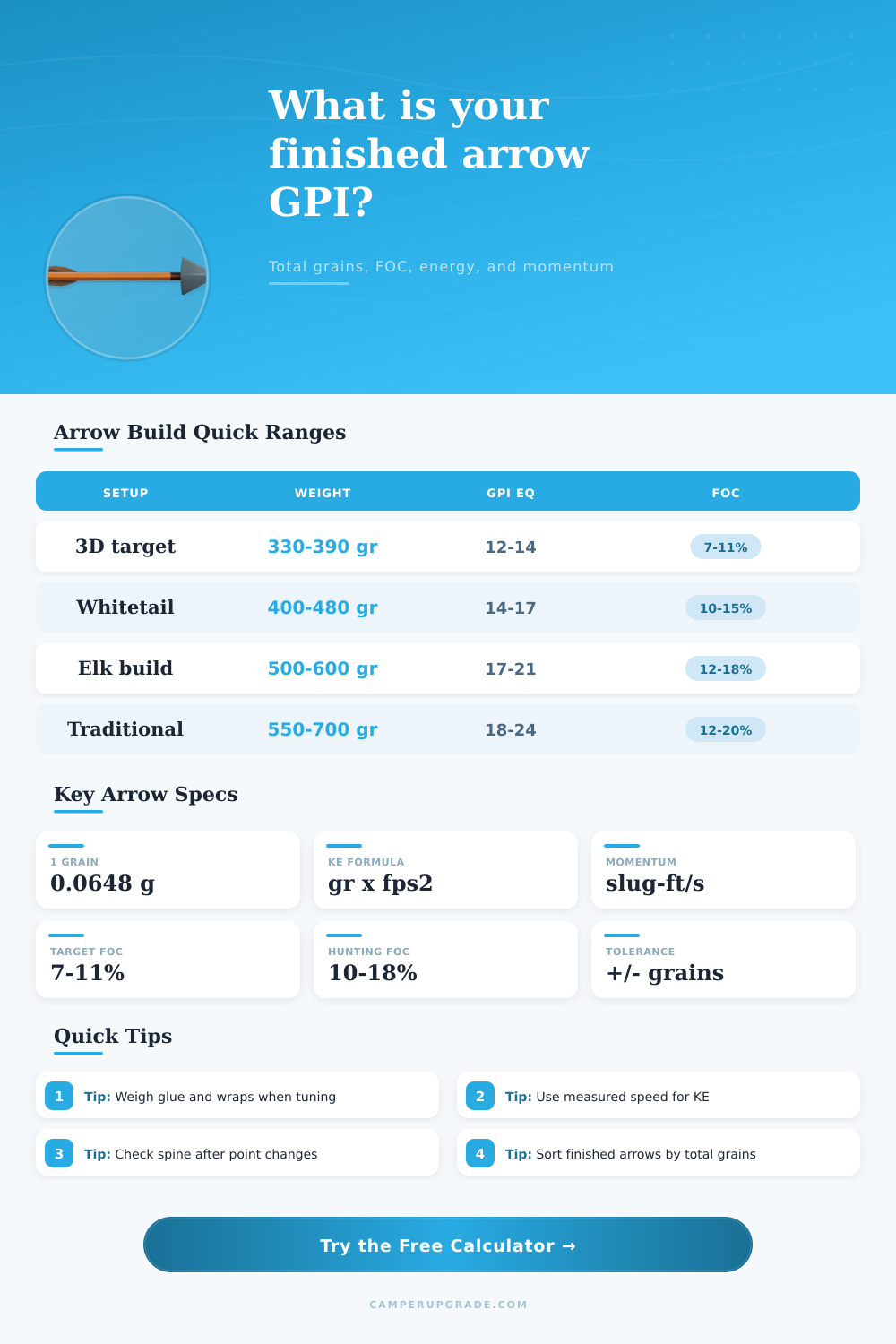
| Finished weight | Common use | Typical speed feel | Tuning note |
|---|---|---|---|
| 300-375 gr | 3D and target | Fastest sight marks | Watch minimum bow grain limits |
| 375-450 gr | Whitetail and mixed use | Balanced speed and carry | Common fixed or mechanical range |
| 450-550 gr | Heavy hunting | Quieter shot, more carry | Check broadhead tune and spine |
| 550-700 gr | Large game or traditional | Slower but high momentum | Verify sight clearance and drop |
| Component | Light range | Heavy range | Calculator impact |
|---|---|---|---|
| Point or broadhead | 75-100 gr | 125-200 gr | Raises total mass and FOC |
| Insert | 10-20 gr | 50-100 gr | Adds front weight inside shaft |
| Outsert or collar | 10-25 gr | 35-75 gr | Adds front weight outside shaft |
| Nock, wrap, vanes | 20-35 gr | 45-70 gr | Rear weight lowers FOC |
| Glue or epoxy | 1-3 gr | 4-8 gr | Small but useful for matching sets |
| FOC range | Classification | Common setup | What to watch |
|---|---|---|---|
| Below 7% | Rear heavy | Light points, heavy rear | May group poorly at distance |
| 7-11% | Target range | 3D and field points | Flat flight, modest front bias |
| 10-15% | General hunting | 100-125 gr heads | Good starting window |
| 15-20% | High FOC | Brass inserts or heavy heads | May need stiffer spine |
| Above 20% | Extreme FOC | Specialized heavy front builds | Confirm drop and tune carefully |
| Total weight | Speed | Kinetic energy | Momentum |
|---|---|---|---|
| 350 gr | 300 fps | 69.9 ft-lb | 0.47 slug-ft/s |
| 425 gr | 285 fps | 76.7 ft-lb | 0.54 slug-ft/s |
| 500 gr | 270 fps | 80.9 ft-lb | 0.60 slug-ft/s |
| 600 gr | 245 fps | 80.0 ft-lb | 0.65 slug-ft/s |
Building a serious hunting arrow requires making many small choice. Each of these choice contributes to the total weight that the arrow will have once completed. Arrows have many component to them, and each component add to the total weight of the arrow.
Many archers experience the gap between what they intended the arrow to weigh when they began building it and the actual weight of the finished arrow. That gap between intended and actual weight can cause inconsistencies in the arrow’s flight. Arrow weight tools help archers to account for all the components of the arrow so that they can have a single picture of the total weight of the arrow.
How to Find Arrow Weight and Balance
Because arrow weight has such an influence on arrows, it is critical for archers to understand how arrow weight work. Arrow weight influences how an arrow leave the bow. Arrow weight also influences the amount of energy that the arrow will have at the point of impact.
Additionally, arrow weight impacts how an arrow will behave when released from the bow with any imperfection. Though lighter arrows may have a flatter flight for 3D courses, lighter arrows may not have the momentum to effectively kill a heavy animal at a long distance. By using such a calculator, archers can more easily determine the weight of each component of the arrow.
To find the weight of an arrow shaft alone, the archer can use the grains per inch (GPI) of the shaft to calculate how much the arrow shaft alone will weigh. The manufacturer will provide the shaft GPI rating, but it will be for the bare shaft tube. By multiplying the GPI by the length of the shaft in inches, archers can find the weight of the arrow shaft alone.
Each component added to the shaft will add to that total weight. Inserts, outserts, and collars will add weight to the front of the arrow. Additionally, the weight of the broadheads and field points will add to the total weight.
However, nocks, wraps, and fletching will add to the total weight of the arrow’s rear. Arrow weight tools separate these calculations so that archers can understand if the arrow’s weight is front-heavy or rear-heavy. Arrows that are front-heavy will have a certain percentage of the length of the arrow that is ahead of the arrow’s balance point.
A modest amount of bias toward the front of the arrow will aid in the arrow’s stabilization after it leaves the bow. Too much or too little bias can cause the arrow to either wander at distance or change the arrow’s dynamic spine. A change to the dynamic spine of the arrow can require a change to the shaft of the arrow or the weight of the arrow’s point.
Arrow calculators can determine the distance from the nock groove to the balance point of the arrow and compare that distance to the midpoint of the shaft. Based off these two distances, the arrow weight calculator can show if an archer’s arrow has the FOC in the range required for target shooting or if the FOC is in a range preferred by hunters for penetration of game. Another critical factor in the shooting of arrows is the arrow’s kinetic energy and momentum.
Though a lighter arrow will have more kinetic energy than a heavier arrow shaft at the same speed, the arrow with the higher kinetic energy will lose it more rapidly downrange. An arrow with less kinetic energy and momentum may not be ideal for hunting game species that require a certain amount of energy to kill humanely. The archer can calculate the kinetic energy of an arrow by plugging the arrow’s speed into the calculator.
The archer can also estimate the momentum of an arrow with the same calculation of kinetic energy. These two values will help archers to understand if their arrow will have enough energy to hunt the species they plan on hunting. Additionally, there is a small amount of tolerance for the weights of each component of an arrow.
Glue, epoxy, and manufacturing difference will all play a small part in the total weight of an arrow. The weight tolerance for arrows is usually three grains of weight. When weighing a dozen arrows, the total weight should be within three grains of each other.
Arrow weight calculators will show the low and high value of this component, allowing archers to set a standard for all arrows they will build. Environmental factor such as temperature and humidity can play a major part in the arrow’s actual weight. Temperature can change the viscosity of the glue in the arrow, and humidity can play a part in the swelling of wraps.
Additionally, if the weight of the arrow’s point is more than the weight of the field point used to tune the arrow, the FOC will shift. Though arrow calculators cannot account for these factors, they will allow archers to account for these variables once the arrow is built. If the arrows fall outside of the tolerance established by the archer with the calculator, those arrows will need to be checked to ensure correct glue weight and vane consistency.
Archery instructors might tell archers that they need to change one component of the arrow to change another component of the arrow. For instance, archers might change the weight of the point of the arrow to increase the penetration of the point into the game species they are hunting. This will, however, cause the arrow groups to open up at long distances.
This is due to the change in the dynamic spine of the arrow that results from adding weight to the front of the arrow. This change in dynamic spine will change the way the arrow flexes around the arrow’s riser. By using the arrow weight calculator and plugging in the new weight of the point, archers can ensure that the FOC has not changed to a distance at which the arrow shaft was designed to perform.
The same is true of replacing target points on arrows with fixed-blade broadheads. Fixed-blade broadheads tend to weigh more than target points. This will shift the FOC of the arrow to the front of the arrow.
If the arrow’s FOC shifts to a point more than a few inches ahead of the center of the arrow, archers may have to change the spine of the arrow or the length of the arrow shaft to compensate. These changes might take an archer weeks of fiddling with the arrow shaft when they could of simply used the arrow weight calculator to determine that such changes to the arrow shaft were needed. Speed is an important factor in the arrow’s performance.
However, the faster an arrow leaves the bow, the less energy it has at its peak. Therefore, though lighter arrows will leave the bow at a higher speed, there will be a certain velocity at which the energy of the arrow begins to flatten out over distance. Though speed can be measured with a chronograph, that measurement can be plugged into the arrow weight calculator to determine the arrow’s energy and momentum at the speed that it will actualy travel.
This will allow archery instructors and archers to understand the cost of increasing the total weight of the arrow. Often, these calculators will reveal that increasing the arrow’s total weight will cost the arrow only a few feet per second of speed. Another advantage of using these calculators is the consistancy that can be gained from arrows that are built to have the same total weight.
Consistencies in total arrow weights allow archers to reliably strike the same marks on the target with every arrow. The tolerance field in the arrow weight calculator can help archers to establish a standard weight for all arrows they will build. Once the arrows have been built, the archer should weigh the arrows to ensure that they all fall within the standard established during the building process.
Outliers can then be sorted from the arrows that have been built to have the same weight. The best arrow configurations are the arrows that an archer understands completely. An archer should understand the reasons for the GPI of the shaft, the weight of the insert, and how each arrow will behave once it passes a certain distance from the archers bow.
Arrow calculators will help archers to make decisions about the arrows they will shoot based on these numbers. By understanding the numbers of each arrow component, archers will know how the arrow will perform once released from the bow.