Camp Shower Heating Time Calculator
Estimate how long it takes to warm shower water using propane, electric, engine heat, kettle mixing, or a solar bag, with flow and weather losses included.
Heating estimate
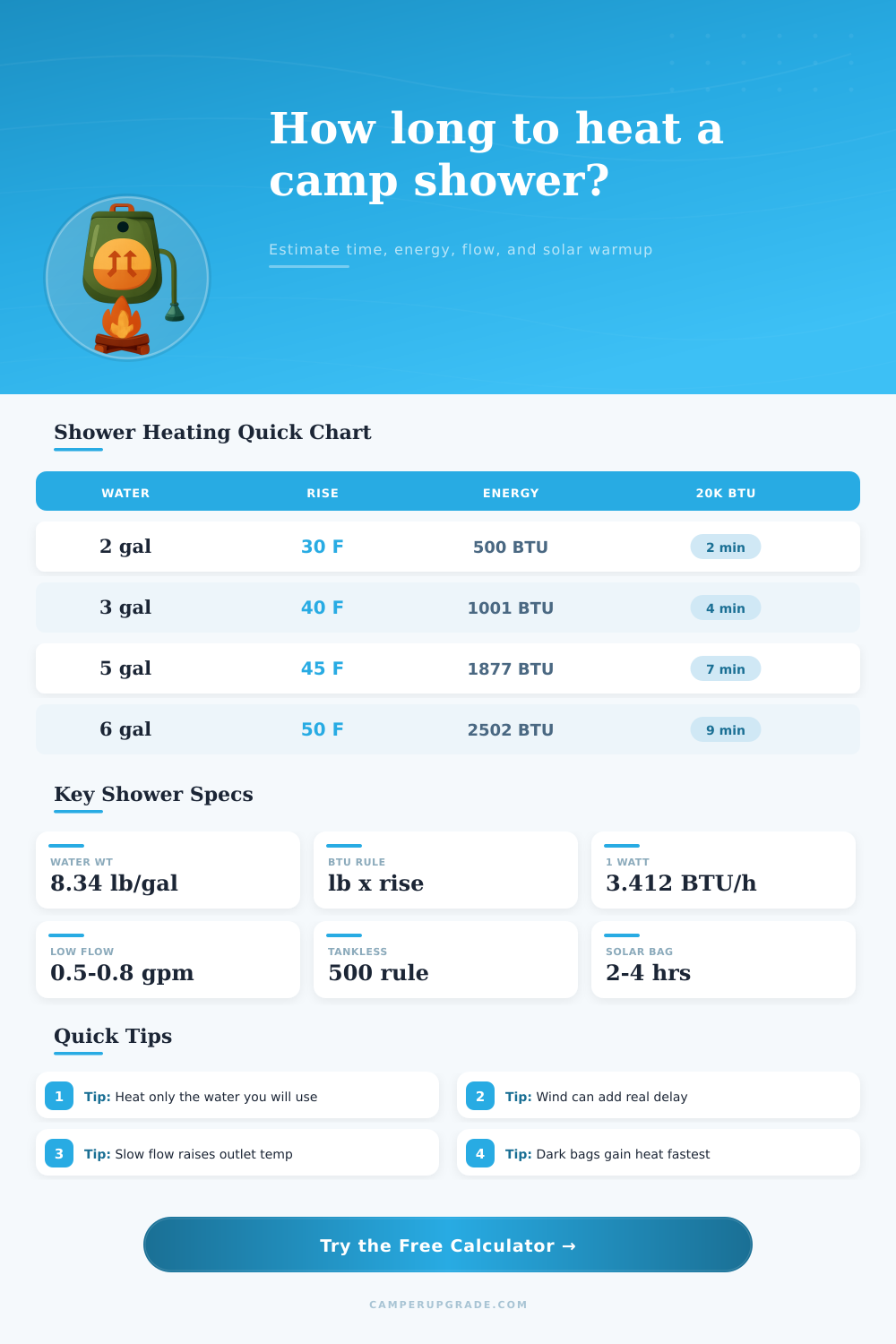
| Water amount | 30°F rise | 45°F rise | 60°F rise |
|---|---|---|---|
| 1 gallon / 3.8 L | 250 BTU | 375 BTU | 500 BTU |
| 2 gallons / 7.6 L | 500 BTU | 751 BTU | 1,001 BTU |
| 3 gallons / 11.4 L | 751 BTU | 1,126 BTU | 1,501 BTU |
| 5 gallons / 18.9 L | 1,251 BTU | 1,877 BTU | 2,502 BTU |
| 6 gallons / 22.7 L | 1,501 BTU | 2,252 BTU | 3,002 BTU |
| Heat source | Nominal output | Effective output | 5 gal, 45°F rise |
|---|---|---|---|
| Small 12V element | 120 W | 410 BTU/hr | 4 hr 35 min |
| Portable power station element | 600 W | 2,047 BTU/hr | 55 min |
| Camp kettle on stove | 8,000 BTU/hr | 4,800 BTU/hr | 23 min |
| Compact tankless propane | 37,500 BTU/hr | 29,250 BTU/hr | 4 min |
| Solar bag, strong sun | 4 sq ft sun area | 800–1,000 BTU/hr | 2–3 hr |
| Effective output | 0.6 gpm | 1.0 gpm | 1.5 gpm |
|---|---|---|---|
| 15,000 BTU/hr | 50°F rise | 30°F rise | 20°F rise |
| 22,000 BTU/hr | 73°F rise | 44°F rise | 29°F rise |
| 29,000 BTU/hr | 97°F rise | 58°F rise | 39°F rise |
| 37,500 BTU/hr | 125°F rise | 75°F rise | 50°F rise |
| Condition | Sun intensity | Wind factor | Practical note |
|---|---|---|---|
| Clear midday, sheltered | 800–1000 W/m² | 95–100% | Best solar bag case |
| Hazy afternoon | 500–700 W/m² | 85–92% | Add an hour or more |
| Cool windy site | 400–650 W/m² | 72–82% | Shield the bag and hose |
| Cloudy shade | 100–300 W/m² | 70–90% | Solar alone may not finish |
| Preset | Typical water | Heating basis | Flow / use case |
|---|---|---|---|
| Joolca HOTTAP V2 | 3–6 gal | Propane tankless, about 37.5k BTU/hr | 0.6–1.5 gpm camp shower |
| Eccotemp L5 | 3–6 gal | Propane tankless, about 37.5k BTU/hr | Up to about 1.5 gpm |
| Camplux 5L | 3–5 gal | Propane tankless, about 34k BTU/hr | About 1.3 gpm |
| Coleman solar bag | 5 gal | Solar gain through dark bag | Gravity low-flow rinse |
| NEMO Helio LX | 5.8 gal | Sun-warmed or preheated water | Pressure rinse, 7–10 min class |
| Sea to Summit Pocket | 10 L / 2.6 gal | Sun-warmed gravity bag | Ultralight low-flow rinse |
| Geyser-style 12V rinse | 0.8–1 gal | Low watt electric or preheated mix | Sponge-assisted low water use |
| Zodi-style 3 gal | 3 gal | Stove coil or propane recirculation | Small camp shower bucket |
Planning a camp shower requires consideration of a few different factors. The factor to consider include the amount of water that will be used for the shower, the temperature of the water that will be used, and the type of heater that will be used to heat the water to the desired temperature. Each of these factors must be considered in relation to the environmental condition at the location where the shower will be held; if the factors of the shower are not matched to the environmental conditions, its possible that the water will not reach the desired temperature.
Furthermore, planning a shower will ensure that there is enough warm water to last the entire shower, rather than deplete the warm water prior to the end of the shower. The amount of water that will be heated can be calculated by determining the weight of the water that will be used. One gallon of water weigh eight and a third pounds, so the total weight of the water is equal to the number of gallon of water to be heated multiplied by eight and a third pounds.
How to Plan a Camp Shower
Furthermore, the starting temperature of the water must also be considered. For instance, the starting temperature of water that is taken directly from a creek may be lower than the starting temperature of water that has been stored in a vehicle. Because of this, the water that is taken from these different source will require different amounts of energy to heat the water to the target temperature.
Many different heating method can be utilized for the water prior to the shower. For instance, propane tankless heater provide heat to the water through the combustion of propane. The temperature of the water that emerges from a propane tankless heater may be increased by decreasing the flow rate of the water, and the temperature of the water may be decreased by increasing the flow rate of the water.
Furthermore, electric element and 12-volt heaters provide heat to the water through the use of electricity. The electric elements and the 12-volt heaters may require a specific amount of watt-hours to heat the water to the desired temperature. Finally, solar bag may be used to heat the water using the sun as the energy source.
The sun may heat the water in the solar bags, but the efficiency of the solar bags may be reduced if the bags are not light colored, if the bags are not positioned towards the sun, or if the area is covered by clouds. The calculator provide estimates for the warm-up time of the water and the amount of energy that will be required to heat the water to the target temperature. To calculate these estimates, the calculator utilizes information from the individual to create a plan to heat the water.
For instance, the individual may enter the volume of the water to be heated into the calculator, the starting and target temperatures of the water may be entered into the calculator, and the environmental factor (such as the temperature of the air and the wind) may be entered into the calculator. These parameters will allow the calculator to provide an estimate of the warm-up time and the energy requirement for heating the water. Furthermore, besides calculating the amount of energy that will be required, the calculator may also determine the flow rate of the water.
For instance, a low flow rate will allow the warm water to last for a longer period of time than a high flow rate. However, using flow rates that are too low may lead to tankless heaters cycling on and off. A reference table may be used to determine the flow rate of the water that will allow for the best heating of the water, as well as to determine the type of shower head that should be used in conjunction with the tankless heater.
Finally, the sun can heat the solar heaters. The intensity of the sun falling upon the solar bag will determine the amount of energy provide to the water by the sun. Cloud cover over the area will reduce the amount of energy provided to the water by the sun.
To increase the heating of the water using a solar bag, the bag can be filled with the water in the morning, and the bag can be positioned to ensure that the sun falls direct upon the bag. Should the strength of the sun be not sufficient to heat the water to the desired temperature, a kettle could of been used to provide additional heat to the water. Many campers may make some mistakes when attempting to plan a camp shower.
For instance, many people may not recognize that the starting temperature of the water will be lower than the desired temperature, and many people may not account for the wind stripping heat from the water. Furthermore, many people may heat more water than the number of individual that will be using the water. Heating more water than will be used will require the individual to carry more water.
Thus, an individual should only heat the amount of water that they plan to use. Furthermore, if the individual plans in advance for the camp shower, they will know if they have enough propane to heat the water to the desired temperature, if they have enough electricity to heat the water using electric elements or 12-volt heaters, and if the solar bag will reach the apropriate temperature by the time that they plan to take the shower.