Propane Hose Pressure Drop Calculator
Estimate propane vapor pressure drop from BTU/hr load, hose length, inside diameter, inlet pressure, appliance target pressure, fittings, elevation, and temperature.
Propane hose pressure estimate
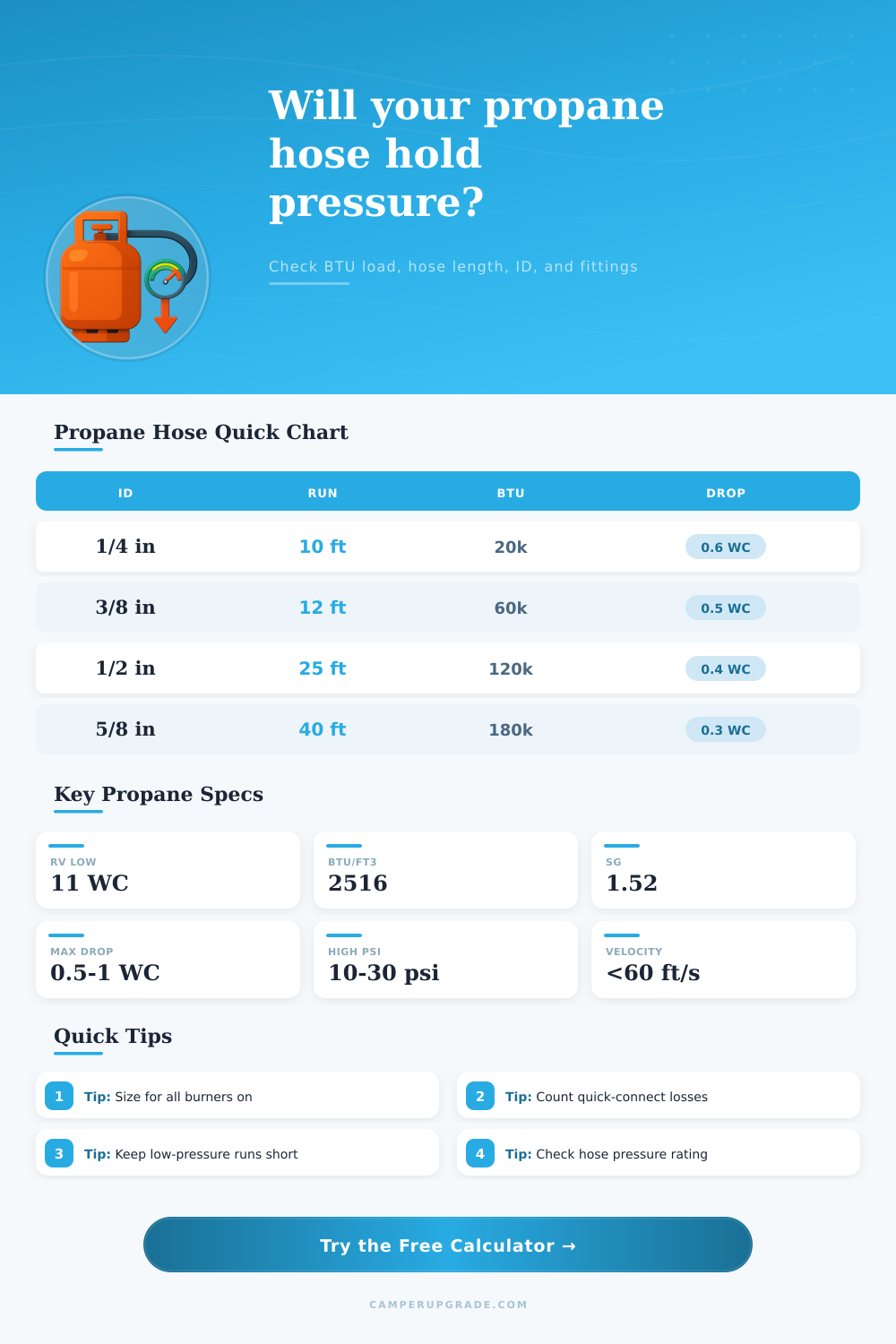
| Inside diameter | Best RV use | Typical 10 ft capacity | Watch point |
|---|---|---|---|
| 3/16 in | Small adapters, pilot loads | 8,000-15,000 BTU/hr | Pressure drop rises quickly |
| 1/4 in | Small grills, camp stoves | 15,000-35,000 BTU/hr | Long runs limit burners |
| 5/16 in | Medium appliance hose | 35,000-60,000 BTU/hr | Check fitting bore |
| 3/8 in | RV quick-connect hoses | 60,000-100,000 BTU/hr | Good all-around size |
| 1/2 in | Generator or manifold branch | 100,000-180,000 BTU/hr | Bulky but low drop |
| 5/8 in | Long high-flow branch | 180,000+ BTU/hr | Confirm connector ratings |
| Fitting type | Calculator setting | Equivalent ft each | Use when |
|---|---|---|---|
| Straight flare adapter | Mostly straight adapters | 0.5 ft | Open bore, few turns |
| 90 degree elbow | Mixed quick-connects and elbows | 1.2 ft | Typical RV appliance branch |
| Quick-connect coupler | Small-bore quick-connects | 2.5 ft | Spring valve or narrow plug |
| Shutoff plus regulator body | Regulator body plus shutoff | 4.0 ft | Compact pigtail assembly |
| Condition | Actual vapor flow | Pressure-drop effect | Calculator input |
|---|---|---|---|
| Sea level, 60°F | 1.00x baseline | Baseline | 0 ft, 60°F |
| 5,000 ft, 60°F | About 1.18x volume | Higher velocity | 5000 ft, 60°F |
| 9,000 ft, 60°F | About 1.36x volume | Long hoses need more ID | 9000 ft, 60°F |
| Sea level, 95°F | About 1.07x volume | Slightly higher velocity | 0 ft, 95°F |
| Sea level, 20°F | About 0.92x volume | Lower hose drop | 0 ft, 20°F |
| Supply setup | Pressure range | Common hose ID | Best calculation target |
|---|---|---|---|
| RV two-stage outlet | 10.5-11.5 in WC | 3/8 in or 1/2 in | Keep drop under 0.5-1 in WC |
| Low-pressure quick-connect | About 11 in WC | 1/4 in to 3/8 in | Outlet above appliance minimum |
| Adjustable high-pressure hose | 0-30 psi | 1/4 in to 3/8 in | Confirm hose and appliance rating |
| Cylinder pigtail before regulator | Tank pressure to regulator | 1/4 in or 5/16 in | Leave regulator inlet headroom |
| Low-pressure manifold branch | 10.5-11.5 in WC | 3/8 in to 5/8 in | Size for combined BTU load |
| RV propane load | Typical input | Common target | Calculator note |
|---|---|---|---|
| RV furnace | 20,000-40,000 BTU/hr | 10.5-11 in WC | Fan cycling may mask low pressure |
| Water heater | 8,000-12,000 BTU/hr | 10.5-11 in WC | Add furnace if both run |
| Absorption refrigerator | 1,200-2,200 BTU/hr | 10.5-11 in WC | Small load, sensitive flame |
| Range burner | 6,500-9,000 BTU/hr each | 10-11 in WC | Add all lit burners |
| Outdoor griddle | 15,000-30,000 BTU/hr | 10-11 in WC | Quick-connect bore matters |
| Portable fire pit | 50,000-90,000 BTU/hr | 10-11 in WC | Use larger ID on long hoses |
A pressure drop occurs in propane vapor as propane move through a hose. The propane loses energy due to friction in the hose, the propane loses energy due to fittings in the hose, and the propane also loses energy due to changes in elevation and changes in temperature within the propane hose. The pressure that leaves a propane regulator is not the same than the pressure that arrives at a propane appliance.
Too large of a drop in the pressure of propane within the propane hose will not allow the propane appliance to perform its function. For these reasons, it is important to calculate the pressure drop in the propane hose before the propane appliance begins to fail to function proper. Because propane vapor behaves different than liquid fuel, the density of propane vapor can change with changes in both temperature and pressure.
How to Use a Propane Pressure Drop Calculator
When the air is thinner, as at high elevations, the propane vapor will carry fewer BTU. Additionally, the colder the temperature of the propane vapor, the denser the vapor will be, and more slow it will travel through the propane hose. These changes in density are small when the propane hose is being used in warm weather at low elevations.
However, the changes in density become more pronounced at high elevations and in cold weather. To account for these changes, many use a propane pressure drop calculator. The first number to enter into a propane pressure drop calculator is the total BTU load of all propane appliances that might be running at the same time.
You must account for the BTU load of each appliance. The BTU load of only one appliance might seem like the correct number to enter into the calculator; however, that single appliance does not represent the total BTU load of all propane appliances that is used in an RV. Should the RV have a furnace, water heater, and stove, you should account for the BTU load of each appliance and add to calculate the total BTU load of the RV.
This will provide a realistic BTU load that the propane hose will need to move within the RV. Additionally, it is also possible to use the calculator to enter a safety margin to the BTU load of the appliances so that the propane system will not fail if other propane appliances are added to the RV. Another factor to consider is the inside diameter of the propane hose.
The larger the diameter of the propane hose, the greater the amount of propane vapor that can pass through the hose. For instance, changing from a quarter-inch inside diameter propane hose to a three-eighths inch inside diameter propane hose will allow the propane vapor to travel through the hose at a rate that roughly doubles the amount of propane vapor that can pass through that section of propane hose. Using a propane pressure drop calculator allow individuals to compare different inside diameters for propane hoses to determine the best method of controlling the propane pressure within the RV.
A third factor to consider is the number of fittings in the propane hose run. Each fitting in the propane hose creates a pressure drop for the propane vapor. Such fittings may include quick-connect couplers, shutoff valves, and elbows in the propane hose run.
Each of these element of a propane system will act as a length of propane hose. Additionally, the longer the propane hose run with these fittings, the greater the effect they will have on the pressure drop of the propane system. Thus, individuals should consider the number of fittings when calculating the pressure drop in their propane system.
The fourth factor to adjust for is the elevation and the temperature of the propane system. Changes in both of these factor will affect the expansion and contraction of the propane vapor that is transported through the propane hose. For instance, if the propane system is located at a high elevation, its atmospheric pressure will be lower than at sea level.
Thus, a 60,000 BTU propane load at sea level will move less propane through the propane hose than a 60,000 BTU load located at a high elevation. Additionally, if the propane load is very cold in the morning, more propane will be vaporized to provide the same BTUs as when the propane is warmer. Individuals dont have to memorize these correction factors; rather, they are only necessary to enter the number of the actual elevation and the actual temperature within the propane system.
The fifth and final factor to calculate with a propane pressure drop calculator is the margin between the calculated outlet pressure from the regulator and the target outlet pressure to the propane appliance. If the difference between these two pressures is small, there is a risk in the propane system that additional drop in propane pressure will occur due to drops in temperature or the addition of additional appliance. Additionally, the propane pressure drop calculator calculates the capacity of the propane system to provide BTUs to the RV.
If the capacity result of the calculation is much higher than the BTU load of the appliances that is used in the RV, then there is a significant margin for error. However, if the two number are close, the propane system will have to be changed. Common mistakes with propane systems include only considering the BTU load of the most commonly used appliance.
Additionally, many individuals do not consider the effect that the fittings will have on the propane system; they have zero resistance to the flow of propane vapor; the addition of each fitting will increase the length of the propane hose. Another common mistake is to assume that if a propane system has a high pressure rating, that it will provide high flow rates for the propane vapor within the system; the two are not necessarily related. To avoid these common mistakes and ensure the reliability of the propane system, individuals should use the calculator with realistic input for the parameter of the system.
Hose sizing involves matching the flow of propane vapor through the system to the BTUs that are required by the appliances within the RV. To size the propane hose properly, it is necessary to consider the elevation of the site, the temperature within the RV, the number of propane appliance, and to calculate the margin of error and the capacity of the propane system. Additionally, using a propane pressure drop calculator allow an individual to determine if adjustments should be made to the propane system, such as shortening the propane hose run, increasing the inside diameter of the propane hose, or reducing the number of appliances that are running at the same time.
Thus, using the calculator will allow for an individual decision to be made based off the data that the calculator gathers, as opposed to a decision made based upon guesswork.