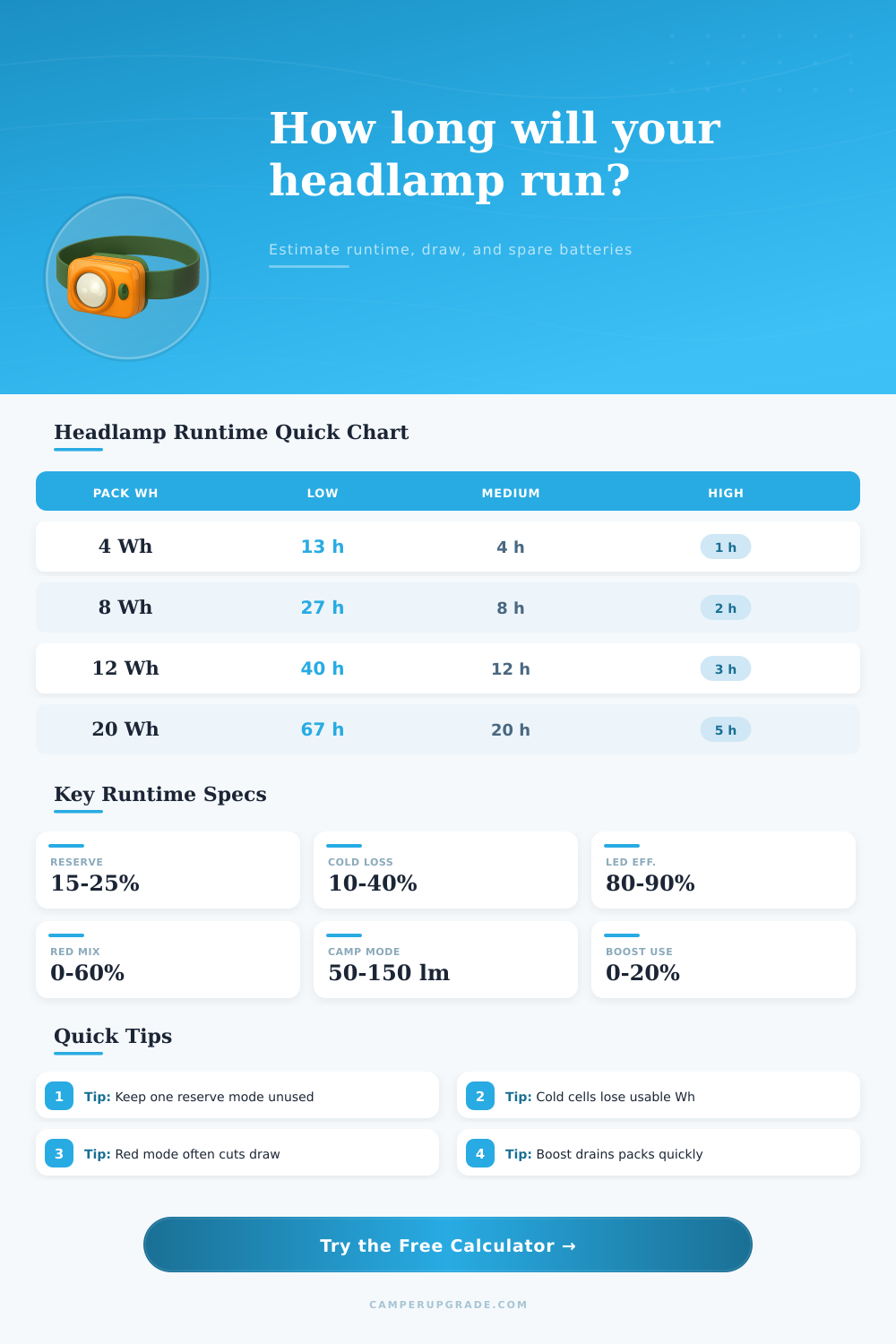
Headlamp Runtime Calculator
Estimate safe lighting time from battery watt-hours, selected mode draw, driver efficiency, cold-weather derate, reserve margin, and red-light mix.
Runtime estimate
| Usable battery | 0.3 W moonlight | 1.0 W camp | 2.0 W trail | 4.0 W high |
|---|---|---|---|---|
| 3 Wh usable | 10 hours | 3 hours | 1.5 hours | 0.8 hours |
| 5 Wh usable | 16.7 hours | 5 hours | 2.5 hours | 1.3 hours |
| 8 Wh usable | 26.7 hours | 8 hours | 4 hours | 2 hours |
| 12 Wh usable | 40 hours | 12 hours | 6 hours | 3 hours |
| 18 Wh usable | 60 hours | 18 hours | 9 hours | 4.5 hours |
| Chemistry | Usable factor | Cold behavior | Runtime note |
|---|---|---|---|
| Rechargeable lithium-ion | 0.92 | Moderate cold loss | Best all-around headlamp pack estimate |
| NiMH AAA or AA | 0.86 | Good in cold | Stable voltage under moderate loads |
| Alkaline AAA or AA | 0.62 | Heavy cold loss | Capacity falls at higher current draw |
| Lithium primary cells | 0.95 | Excellent in cold | Strong choice for emergency spare sets |
| LiFePO4 pack | 0.90 | Good cycle life | Lower voltage packs need proper electronics |
| USB power bank output | 0.82 | Depends on bank | Includes conversion losses at 5 V output |
| Lighting use | Typical lumens | Typical LED watts | Best use |
|---|---|---|---|
| Moonlight / tent | 5-15 lm | 0.1-0.3 W | Reading, tent sorting, late camp checks |
| Red camp light | 5-30 lm | 0.1-0.6 W | Preserve night vision and save energy |
| Camp chores | 50-150 lm | 0.6-1.6 W | Cooking, bear bag, campsite walking |
| Trail hiking | 150-300 lm | 1.6-3.0 W | Moving over uneven ground |
| High / search | 400-1000 lm | 4.0-9.0 W | Short scans and route finding |
| Headlamp preset | Battery basis | Mode entered | Runtime planning note |
|---|---|---|---|
| Black Diamond Spot 400 medium | 3xAAA or lithium pack | 150 lm / 1.6 W | Good mixed campsite and trail setting |
| Petzl Actik Core camp | CORE rechargeable pack | 100 lm / 1.1 W | Efficient camp chore baseline |
| Nitecore NU25 UL mixed | Built-in lithium pack | 65 lm / 0.7 W | Lightweight overnight estimate |
| BioLite HeadLamp 425 medium | Built-in lithium pack | 200 lm / 2.2 W | Useful moving-light planning mode |
| Fenix HM50R trail | 16340 lithium cell | 130 lm / 1.4 W | Compact rechargeable trail setting |
| Ledlenser MH10 search | 18650 lithium cell | 600 lm / 6.0 W | High-output bursts need spare energy |
Headlamp runtime planning is an important part of headlamp operation because headlamp runtime isnt an unchanging property of headlamps. Headlamp runtime can change based off battery state, the chosen output of the headlamp, environmental conditions, and the way in which you use your headlamp. If you dont plan for the runtime of your headlamp, you may find yourself without enough light to perform some of the most essential task for camping or hiking.
The energy contained in a battery is often less than the amount advertised for that battery. Many factor that reduce the overall usable energy that may be drawn from the battery affects the energy contained in a battery. Batteries lose energy when exposed to cold temperatures, old batteries lose power more quick than new batteries of the same make and model, and headlamps use some of the battery’s energy to power the light before it turn on.
How to Plan Headlamp Run Time
Each of these factors reduces the energy that is available to the headlamp, so the runtime of that headlamp. Each of these variables can be accounted for in the calculator to remove guesswork from planning headlamp runtime. The chemistry of the battery is one of the major factor that can influence the runtime of a headlamp.
For instance, rechargeable lithium-ion battery maintain a steady voltage. Furthermore, lithium-ion batteries work well with regulated headlamps due to the consistent output that they provide. However, alkaline batteries lose their capacity quick if they are drawing a high current or if the temperature at which the battery is used is low.
Finally, although lithium primary batteries are more expensive than alkaline batteries, they are more reliable in cold temperatures. Temperature is another factor that can impact the capacity of the battery. Batteries work well at the temperatures at which they are manufactured, but batteries that work well at room temperatures may lose their capacity if the temperature of the batteries drop.
Furthermore, the loss of capacity of alkaline batteries in cold temperatures is far greater than the loss of capacity of lithium-ion batteries or lithium primary batteries. However, the headlamp runtime calculator can incorporate the temperature derate into the calculation. The reserve margin for a battery is the amount of energy that is reserved in the battery for the headlamp to utilize for emergencies or unexpected tasks.
However, a reserve margin is typically set aside for trips that last multiple nights in order to provide some protection in case something come up that requires the use of the headlamp while camping. Furthermore, the calculator applies the reserve margin after the battery chemistry and temperature derate has been applied to calculate the energy that the headlamp can utilize. The way in which you use your headlamp will impact the length of time that the headlamp remains lit.
For instance, using moonlight or red-light mode will draw less power from the battery than headlamps that use the bright white beam of light. However, using the maximum lumen mode for short periods of time will increase the average rate at which the battery drains. The regulation style of the headlamp will impact the way in which the headlamp beam its light.
For example, headlamps with fully-regulated lights will maintain their brightness until the battery is depleted. However, semi-regulated and direct-drive headlamps may continue to glow even after the brightness is too low to be useful for performing task. However, the calculator can account for the efficiency factor of the headlamp in the calculation that the calculator performs.
Tables are provided that display the typical watt draw that are required for certain tasks. For instance, moonlight mode is typically used for tasks inside the tent, camp level is used for tasks like cooking, and trail level is used for walking along a camping path. However, these tables are not meant to replace the headlamp runtime calculator, but they do provide additional information regarding the watt draws that are required for different tasks.
Many people make mistakes when calculating headlamp runtime. For instance, many people assume that the maximum lumens output of a headlamp is the output that they will use the majority of the time. However, most people use their headlamp at a lower output than the maximum lumens that the headlamp can achieve.
Furthermore, people often ignore the difference between the nominal capacity of the battery and the usable capacity. The usable capacity will be less than the nominal capacity due to the factor described above. Finally, because the calculator determine how many batteries are required for a trip, it is also possible to use the calculator to plan for spare capacity of batteries.
For instance, the calculator will determine the number of spare batteries that are required in addition to the battery that will be carried in the headlamp. Each of these variables will impact the number of spare battery that are required. For this reason, it is important to run the calculator in various scenario to determine the number of spare batteries that are required to accomplish a camping trip.
You should of used the calculator for alot of different situations.