Flashlight Beam Distance Calculator
Estimate ANSI throw, practical target range, beam width, and center brightness from lumens, candela, beam angle, lens transmission, battery mode, and visibility conditions.
Beam distance estimate
| Peak candela | ANSI 0.25 lux | 1 lux useful reach | 5 lux detail reach |
|---|---|---|---|
| 2,500 cd | 100 m / 328 ft | 50 m / 164 ft | 22 m / 73 ft |
| 10,000 cd | 200 m / 656 ft | 100 m / 328 ft | 45 m / 147 ft |
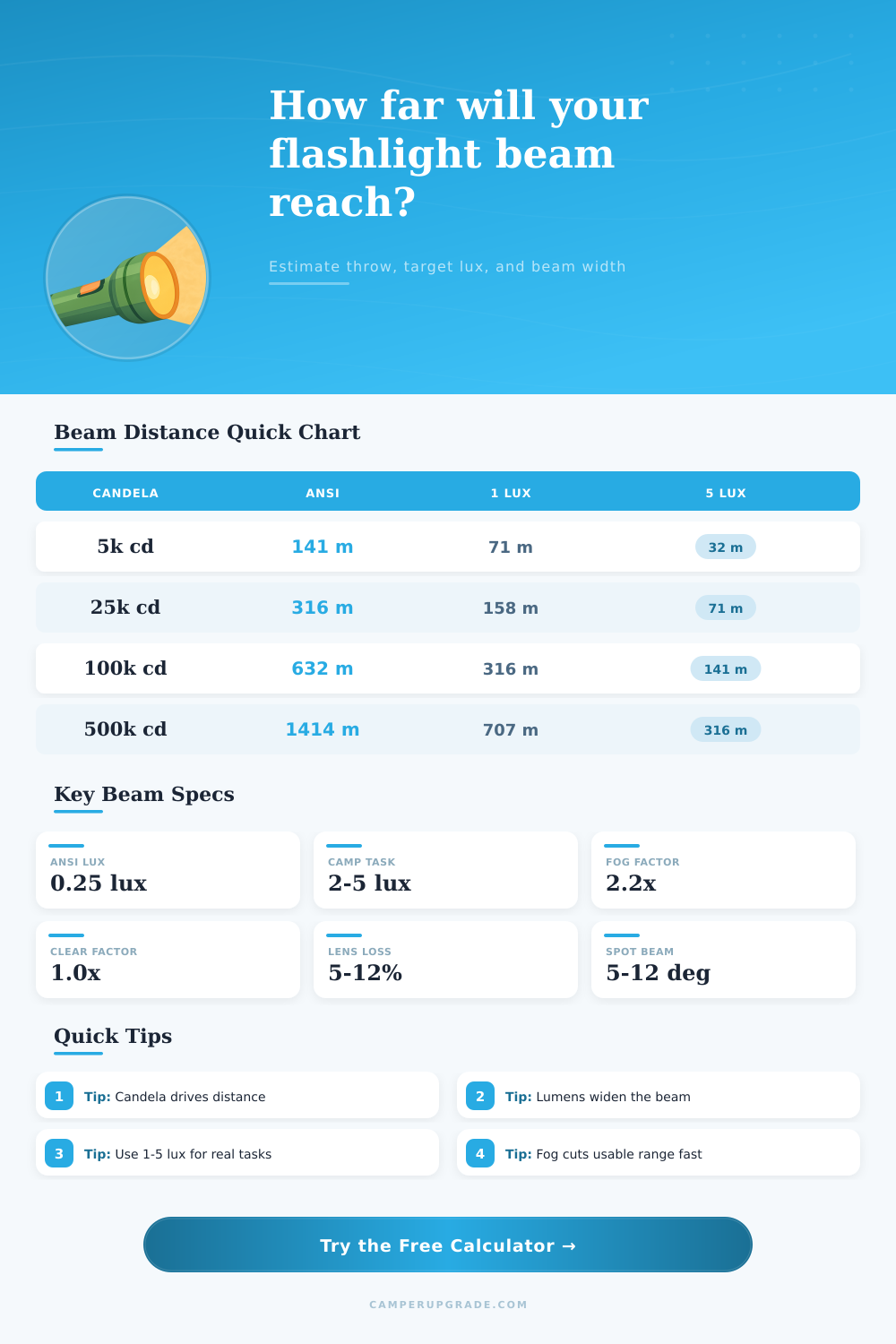
| 25,000 cd | 316 m / 1,037 ft | 158 m / 519 ft | 71 m / 232 ft |
| 100,000 cd | 632 m / 2,075 ft | 316 m / 1,037 ft | 141 m / 464 ft |
| 400,000 cd | 1,265 m / 4,150 ft | 632 m / 2,075 ft | 283 m / 928 ft |
| Condition or task | Suggested lux | Calculator use | Notes |
|---|---|---|---|
| ANSI beam distance | 0.25 lux | Rated throw comparison | Similar to bright moonlight on target |
| Spot a reflector or marker | 0.5-1 lux | Long trail checks | Works best with clear air |
| Identify campsite objects | 1-3 lux | Practical outdoor range | Good for gear and path edges |
| Walk rough ground | 3-5 lux | Detail-focused range | Shorter but more realistic |
| Fog, smoke, or dust | 2x or more | Ambient multiplier | Backscatter lowers useful contrast |
| Output state | Candela factor | Distance effect | When to use it |
|---|---|---|---|
| Turbo / rated peak | 1.00x | Full rated estimate | Fresh cell, short burst |
| High sustained | 0.75x | About 87% distance | Common after brief heat rise |
| Medium-high | 0.45x | About 67% distance | Longer searches or camp use |
| Moderate step-down | 0.65x | About 81% distance | Thermal regulation in small lights |
| Low battery reserve | 0.30x | About 55% distance | Late runtime planning |
| Preset model | Lumens | Candela used | Beam character |
|---|---|---|---|
| Fenix PD36R Pro | 2,800 | 36,600 cd | Compact tactical throw |
| Streamlight ProTac HL-X | 1,300 | 35,000 cd | Duty-style hotspot |
| Olight Warrior 3S | 2,300 | 23,256 cd | Balanced TIR beam |
| Acebeam L19 2.0 | 2,200 | 422,407 cd | Long-range thrower |
| ThruNite Catapult V6 | 2,836 | 119,716 cd | Large-reflector throw |
| Nitecore P20iX | 4,000 | 12,200 cd | High-lumen flood tactical |
| Sofirn SP36 BLF | 5,650 | 32,400 cd | Lantern-like flood with reach |
| Convoy C8+ Osram | 900 | 250,000 cd | Narrow budget thrower |
| Noctigon K1 W2 | 1,500 | 571,500 cd | Extreme pencil throw |
A flashlight beam distance calculator can tell you how far the beam of a flashlight will travel. Many individual look at the lumen ratings of the flashlight listed within the flashlight box. However, the lumen ratings does not tell the flashlight how far the light will go.
Several different input go into this flashlight beam distance calculator to account for the different variables that will impact the flashlight beam. These inputs include the rated lumens, the peak beam intensity in candela, the beam angle, the lens transmission, and an optic type. The rated lumens will tell you how much light the flashlight will output.
How to Use a Flashlight Beam Distance Calculator
However, the peak beam intensity in candela will tell you how focus the flashlight beam is. The higher the candela, the more distance the flashlight will travel. The beam angle tell you the spread of the flashlight beam and whether it will be narrow or broad.
The lens transmission is an amount of light that passes through the flashlight lens. The optic type tell you the shape and focus of the flashlight beam created by the reflector in the flashlight. These different variables all have an impact on how far the flashlight beam will travel.
Another variable is the battery mode and step down mode of the flashlight. Many flashlights can produce high lumens for a short period. However, when the flashlight runs for an extended period, the lumen output may fade to protect the battery.
Using the flashlight beam distance calculator, you can account for this and determine how far the flashlight will travel after running for many minute. This is important to account for to see the difference between a flashlight with high lumens for a short time compared to one that provides an extended amount of light. Another important variable to account for is the ambient visibility.
The standard is clear air. However, other variables such as mist, sand, and glare may affect the light output requirement for the flashlight beam. Using the flashlight beam distance calculator, you can account for these variables.
This is important to account for because the ANSI ratings for flashlights does not account for these variables. Using the flashlight beam distance calculator, you will recieve several different output. The ANSI distance will show the theoretical distance the flashlight will go at a light level of 0.25 lux.
The practical target range will use your selected lux value to show the amount of light needed to recognize an object. The center lux will show the brightness of the middle of the flashlight beam, and the hotspot width will show the diameter of the flashlight beam. Additionally, there are reference table on the website to show the relationship between the candela and the distance the flashlight beam will travel.
You can find a chart that demonstrates the relationship between candela and distance and a visibility guide to show the correct lux value for specific tasks. It is common for individuals to overestimate the distances that their flashlight will travel. This is due to the marketing of the flashlight with high lumens.
However, the peak lumens does not show how fast the light will fade. The distance that a flashlight will travel is not a fixed variable because it also relies on the environment and the visibility of the task for which the flashlight is being used. The flashlight beam distance calculator can help individuals account for these variables.
The relationship between lumens and candela is another important flashlight variable. This will become apparent when you realize that a high lumen flashlight could have a short distance if the beam is very wide. Alternatively, a flashlight with low lumens but a narrow beam will have a longer distance that the beam will travel.
The candela per lumen ratio will show you this for the flashlight that you are considering to purchase. Another important variable is the head diameter of the flashlight. Flashlights with a larger head have a larger reflector that will produce a tighter beam of light.
This is accounted for in the flashlight beam distance calculator as one of the input for the flashlight. The calculator will use this to show the intensity index of the flashlight. Finally, it is important to use the flashlight beam distance calculator when you are considering purchasing a flashlight.
By using the flashlight beam distance calculator, you can test the flashlight under different scenario. For instance, you can use the flashlight in the high sustained mode with clear air, and then you can compare that to using the flashlight in the moderate mode with light rain. This will allow you to decide the best mode or light setting for your flashlight.