Portable Toilet Duration Calculator
Estimate how many days a camping toilet will last from waste tank size, flush tank size, people, daily visits, flush volume, solids mix, deodorizer reserve, and your empty-at-full threshold.
Portable toilet duration estimate
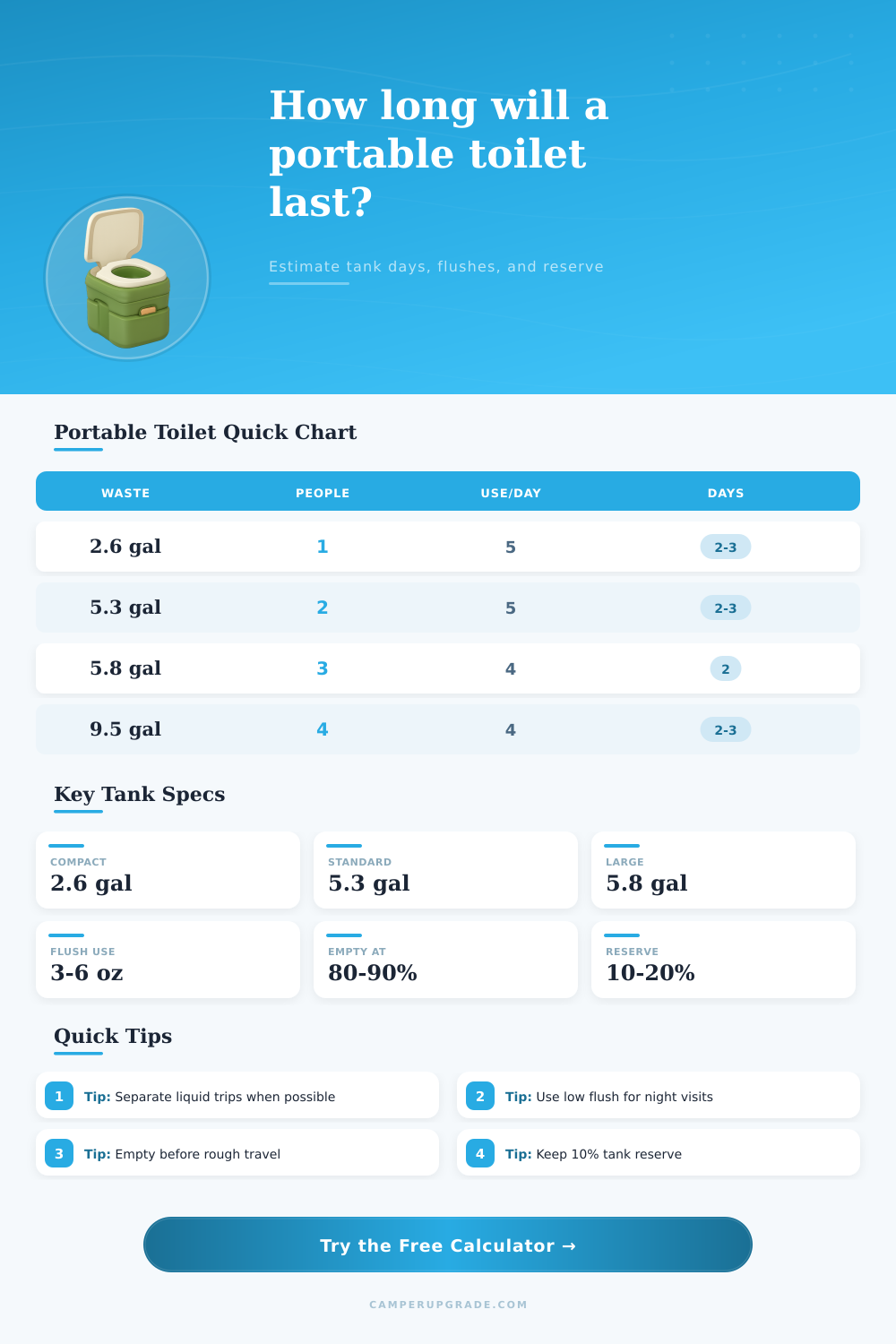
| Toilet class | Waste tank | Flush tank | Best fit |
|---|---|---|---|
| Compact overnight unit | 2.4-2.8 gal / 9-11 L | 2.0-2.6 gal / 8-10 L | Solo vans, tent nights |
| Standard cassette portable | 5.0-5.5 gal / 19-21 L | 3.2-4.2 gal / 12-16 L | Two adults for short trips |
| Large portable toilet | 5.6-6.0 gal / 21-23 L | 3.5-4.5 gal / 13-17 L | Families, longer weekends |
| RV cassette tank | 4.5-5.3 gal / 17-20 L | RV water supply | Built-in cassette bays |
| Rolling waste tote setup | 8.0-10.0 gal / 30-38 L | Separate rinse jug | Basecamp or group use |
| Flush habit | Liquid visit | Solid visit | Effect on duration |
|---|---|---|---|
| Dry or spray bottle rinse | 0-1 oz / 0-30 ml | 2-4 oz / 60-120 ml | Waste tank usually limits first |
| Conservative pump flush | 2-3 oz / 60-90 ml | 4-6 oz / 120-180 ml | Best for boondocking |
| Normal bellows flush | 3-5 oz / 90-150 ml | 6-8 oz / 180-240 ml | Balanced comfort and range |
| Heavy rinse habit | 6-8 oz / 180-240 ml | 10-14 oz / 300-415 ml | Flush tank may limit early |
| Camping pattern | Liquid uses/person | Solid uses/person | Duration note |
|---|---|---|---|
| Night-only toilet | 1-2 | 0-0.3 | Often lasts several nights |
| Day hikes, camp toilet at night | 2-3 | 0.3-0.6 | Moderate waste accumulation |
| Full-time camp bathroom | 4-6 | 0.7-1.2 | Tank fills quickly with groups |
| Festival or no vault toilet | 5-7 | 0.8-1.4 | Plan extra emptying access |
| Setting | Usable tank | Why campers use it | Calculator effect |
|---|---|---|---|
| 95-100% full | Nearly all capacity | Only when empty station is close | Longest estimate, least margin |
| 85-90% full | Practical capacity | Less slosh, odor, lifting risk | Good default for travel days |
| 75-80% full | Comfort margin | Hot weather or rough roads | Shorter but more forgiving |
| 10-20% reserve | Held unused | Protects deodorizer strength | Reduces planned-trip capacity |
When planning a camping trip with a portable toilet, there are a few logistics to consider. One of these considerations is how long the portable toilet will last before it need to be emptied. The size of the tank does not just determine the capacity of the portable toilet; the number of people that will use the portable toilet and how much water those individual will use during each flush in the portable toilet actualy determines the capacity of the portable toilet.
An understanding of the way in which the portable toilet function will allow the camper to create an effective plan for the camping trip. A portable toilet can typically be divided into two separate tanks. Each tank has a specific use within the portable toilet.
How Long a Portable Toilet Will Last on a Camping Trip
One tank will collect all of the waste from the individuals using the portable toilet, as well as the water that is used to rinse the portable toilet. The other tank will hold the water that is used for rinsing the portable toilet, and thus provides the water needed to perform each flush within the portable toilet. The two tanks do not empty at the same time.
Thus, it is necessary to determine if the flush tank will run out of water prior to the waste tank running out of space to hold the waste and water from each of the camping trips campers. One of the factors that will influence the emptying of the waste tank is the amount of liquid and solid waste that is flushed from the portable toilet. The amount of liquid waste will contribute to the filling of the waste tank at a much higher rate than the solid waste from each of the campers.
Each visitor to the portable toilet will also add to the volume within the waste tank if they use a large amount of toilet paper while using the portable toilet. The more individuals that use the portable toilet or the more toilet paper those visiting the portable toilet use, the more quickly the waste tank will become filled. The volume of water used during each flush will change the length of time during which the flush tank will be in use, as well as how quickly the waste tank will fill up.
Each individual may use a different amount of water during each flush; some may use a small amount of water each time to rinse the portable toilet, while others may use a large amount. If an individual flushes with a large amount of water each time, the flush tank will become empty more quickly, as well as the waste tank will fill up more quickly. Thus, each individual can adjust the amount of water that they use for flushing to conserve the water within the flush tank.
Additionally, it is common to incorporate an emptying threshold for the waste tank prior to the waste tank becomes filled to capacity. Many individuals do not wish to fill the waste tank to the top with all of the waste from their camping trip; a filled waste tank is heavy and can be difficult to move. Thus, individuals may prefer to empty the waste tank if it is only 80 or 90% full.
Using this threshold will provide these individuals with a margin of safety in case the camping trip lasts longer than they had planned, or if the dump station to which they will transport the waste is further than they had originally planned. Another of the factors to consider is the type of camping that will be performed during the camping trip. For instance, if a small group of individuals will use the camping trip for relatively short periods of time, the portable toilet will last longer than if many individuals will use the portable toilet for long periods of time.
For instance, if the camping site is a festival that includes many individuals that all use the same portable toilet, the portable toilet will become filled with waste and water more quickly than if the individual was camping alone. Another factor to consider is the weight of the waste tank when moving the portable toilet. The waste tank becomes filled with both liquid and solid waste, and each gallon of waste that is contained within the waste tank weighs eight pound.
Thus, individuals may want to empty the waste tank at a more frequent rate to avoid becoming weighed down with the heavy waste tank when moving to different locations during the camping trip. The type of toilet paper that is used while camping can contribute to the waste tank becoming filled with waste more quickly. If the individual uses heavy toilet paper that does not break down in the water, that toilet paper will become trapped within the waste tank.
However, if the individual uses toilet paper that is specifically safe for use in a recreational vehicle (RV), the toilet paper will break down in the water and contribute to the waste tank less. Thus, the type of toilet paper that is used can have a major impact on how quickly the waste tank fills. By calculating each of these factors, an individual can understand whether their portable toilet is limited by the flush tank or the waste tank.
If their flush tank is limited, they will need to bring extra water to fill that tank. If the waste tank is the limited factor, planning to empty the waste tank more often will avoid issues with the waste tank becoming filled with too much waste. Thus, understanding each of these factors will allow the individual to create an effective camping trip plan, as well as effectively manage there portable toilet during that camping trip.