RV Leveling Blocks Calculator
Estimate stack height, block count, ramp length, and wheel support from campsite slope, wheelbase, tire spacing, and block thickness.
Leveling estimate
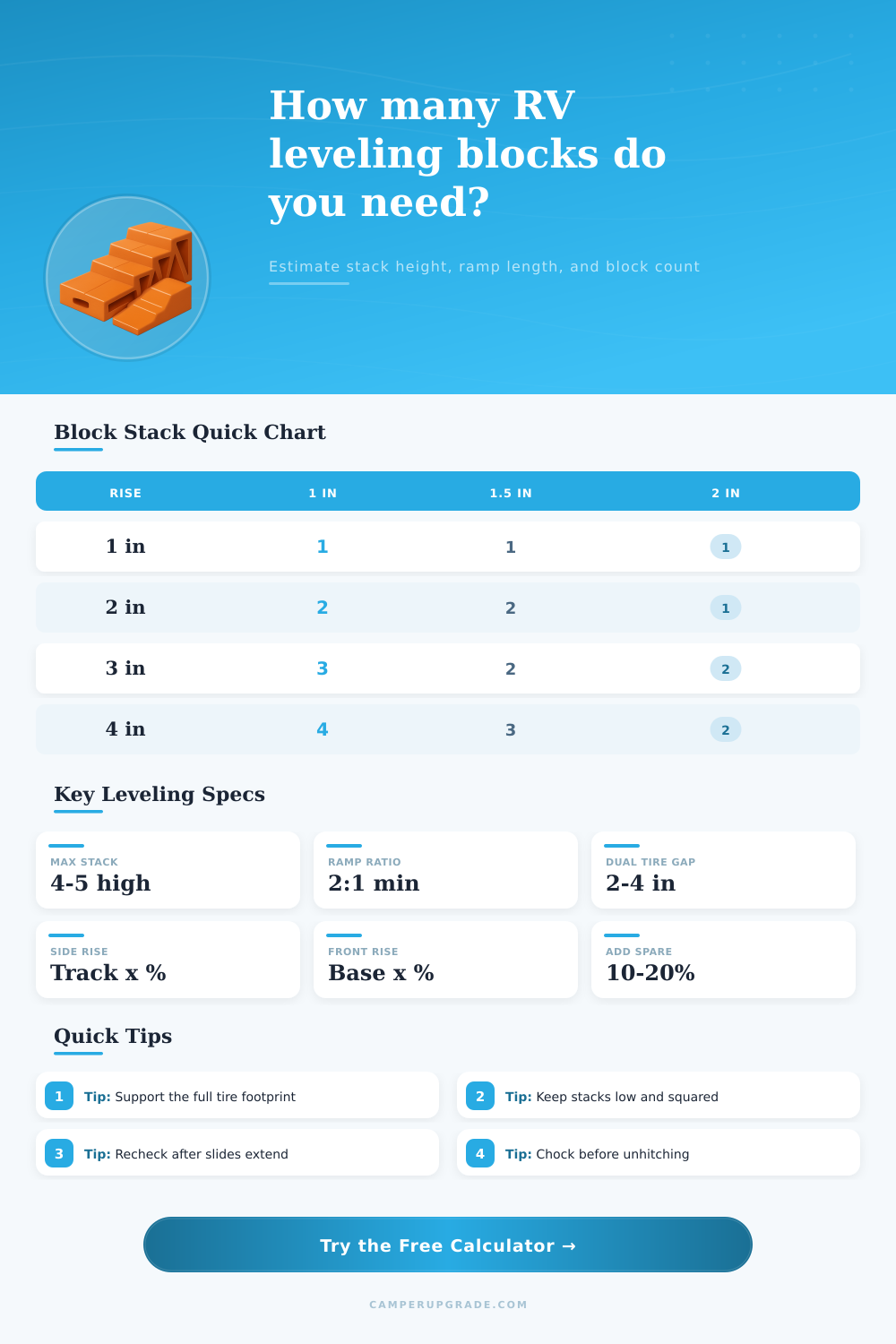
| Required rise | 1 in blocks | 1.5 in blocks | 2 in blocks |
|---|---|---|---|
| 1 in / 2.5 cm | 1 layer | 1 layer | 1 layer |
| 2 in / 5.1 cm | 2 layers | 2 layers | 1 layer |
| 3 in / 7.6 cm | 3 layers | 2 layers | 2 layers |
| 4 in / 10.2 cm | 4 layers | 3 layers | 2 layers |
| 5 in / 12.7 cm | 5 layers | 4 layers | 3 layers |
| 6 in / 15.2 cm | 6 layers | 4 layers | 3 layers |
| Side slope | 7 ft track | 7.5 ft track | 8 ft track |
|---|---|---|---|
| 1% | 0.8 in | 0.9 in | 1.0 in |
| 2% | 1.7 in | 1.8 in | 1.9 in |
| 3% | 2.5 in | 2.7 in | 2.9 in |
| 4% | 3.4 in | 3.6 in | 3.8 in |
| 5% | 4.2 in | 4.5 in | 4.8 in |
| 6% | 5.0 in | 5.4 in | 5.8 in |
| Lift | 2:1 ramp run | With 10 in tire patch | Use note |
|---|---|---|---|
| 1 in | 2 in | 12 in | One full tile often works |
| 2 in | 4 in | 14 in | Use a broad base layer |
| 3 in | 6 in | 16 in | Stagger ramp blocks |
| 4 in | 8 in | 18 in | Keep stack square |
| 5 in | 10 in | 20 in | Verify block rating |
| 6 in | 12 in | 22 in | Consider a different spot |
| RV setup | Typical tire span | Common lift | Starting pack |
|---|---|---|---|
| Camper van | 5.8-6.5 ft | 1-3 in | 10-14 blocks |
| Single axle trailer | 6.5-7.3 ft | 2-4 in | 14-18 blocks |
| Dual axle trailer | 7.0-7.8 ft | 2-5 in | 20-28 blocks |
| Class C motorhome | 7.3-8.0 ft | 2-5 in | 20-30 blocks |
| Fifth wheel | 7.5-8.5 ft | 2-6 in | 24-34 blocks |
| Class A motorhome | 8.0-8.8 ft | 2-6 in | 28-40 blocks |
When you park your vehicle at a campsite, the ground is typicaly not level. Uneven ground can cause your vehicle to tilt. A tilted vehicle cause problems such as making it hard to close the fridge doors, water pooling in one corner of the shower, and making it difficult to sleep because you may slide towards the foot of the bed during the night.
Leveling blocks are a tool to fix the tilt that your vehicle may develop when parked. To determine the number of leveling blocks to purchase and how high the leveling blocks should be stacked to even out the vehicle, some calculations must be performed. The amount of lift that is required for your vehicle to become even with the ground depends upon the slope of the ground.
How to Use a Leveling Block Calculator
For instance, a three percent slope from the left tire to the right tire will require a different amount of leveling blocks than if the three percent slope is from the front tire to the back tire. The distance between the tires from side to side is referred to as the width of the vehicle, and the distance from the front tire to the back tire is the length of the wheelbase. These two measurements, as well as the slope of the ground, can be measured to calculate the amount of lift that will be required to level the vehicle.
A calculator will help to make these calculations for you. Another consideration for the leveling blocks that you purchase is the thickness of the leveling blocks. One-inch leveling blocks will allow for fine control over vehicles that may have a gentle slope in the ground.
However, a large number of one-inch leveling blocks may be required to lift the heavy weight of the camper. If you decide to use thicker leveling blocks, fewer blocks will be required to lift the same amount of weight. However, with thicker leveling blocks, you will not be able to even the ground by a very small amount.
A calculator can be used to determine how each thickness of leveling blocks will change the total number of leveling blocks that will be required to level the camper. Ramps will help the tire of your camper to climb onto the leveling blocks. However, a short and steep ramp may not be the best ramp for your camper.
The short and steep ramp may cause the tire to scrape against the sidewall of the tire or it may cause the leveling blocks to slide. A gentle ramp is the best ramp because it will allow the tire to climb the ramp without resistance. A ramp calculator will take into account the ramp ratio that will be used to help determine if the ramp will fit in the gap between the tandem trailer axles.
Using such a calculator will allow you to avoid buying leveling blocks that cannot be stacked under the trailer tires. Another issue to consider is the material of the leveling blocks. Plastic interlocking leveling blocks are easy to stack and they do not readily split.
However, they may slide if placed on wet grass. Wood leveling blocks offer a larger area of contact with the ground and have better traction on soft ground. However, they are much heavier than plastic leveling blocks and they may crack under heavy use.
Rubber leveling blocks will provide friction between the trailer and the pavement. However, the rubber may compress when the campers weight is placed upon the leveling blocks. However, calculators will factor in each of these variables when calculating the number of leveling blocks to purchase.
If your camper trailer has dual axles, the distance between those two tires may limit your options for placing ramps. For instance, if the ramp that is calculated requires a wide platform to allow the tire of the camper to climb onto the leveling blocks, but the gap between the two tires is small, then the ramp will not fit. In this case, you may have to place two narrow stacks of leveling blocks under each tire instead of a wide ramp, or you may have to allow for one tire to be higher than the other.
A leveling block calculator will let you know of this physical limitation of your camper prior to unloading the leveling blocks. Since campsite ground may be unpredictable, you may have to deal with issues caused by tree roots, soft spots in the ground, or gravel pads. The camper and trailer may shift once the slides are extended or once the water tanks are filled with water.
To account for these unpredictable issues at the campsite, the calculator will allow for a small spare allowance of leveling blocks. It is recommended that you check the level of the camper trailer after the first night at the campsite. The level of the camper may have become unstable if the ground shifted during the night.
While the calculator will provide you with an accurate measurement of the number of leveling blocks required, these numbers are merely a suggestion and not a guarantee. The logic of the leveling process can be applied to several different types of campers. For instance, a camper van will have a short wheelbase and a narrow distance between the tires.
Therefore, it will require only a two-inch lift maximum. A fifth-wheel trailer may have a longer distance between the axles, known as the wheelbase, and it may be heavy with water in its tanks. In this instance, it may require six inches of lift or more.
By changing the number of the tires that are to be placed on the leveling blocks, the length of the wheelbase, and the slope of the ground, different types of campers can use the same set of leveling blocks. The purpose of utilizing leveling blocks is to make sure that the floor of the camper is level and that the doors of the camper will open and close properly. To determine how many leveling blocks you will need, you must measure the slope of the ground and utilize a leveling block calculator.
Whatever number of leveling blocks you calculate will be a suggestion, but you should always have some extra leveling blocks in your storage bin to account for any unforeseen issues.