Wheel Bolt Pattern Calculator
Enter lug count and center-to-center measurements to estimate bolt circle diameter, wheel pattern notation, stud fit, and measurement confidence.
Calculated Wheel Pattern
| Lugs | Imperial Pattern | Metric PCD | Common Use |
|---|---|---|---|
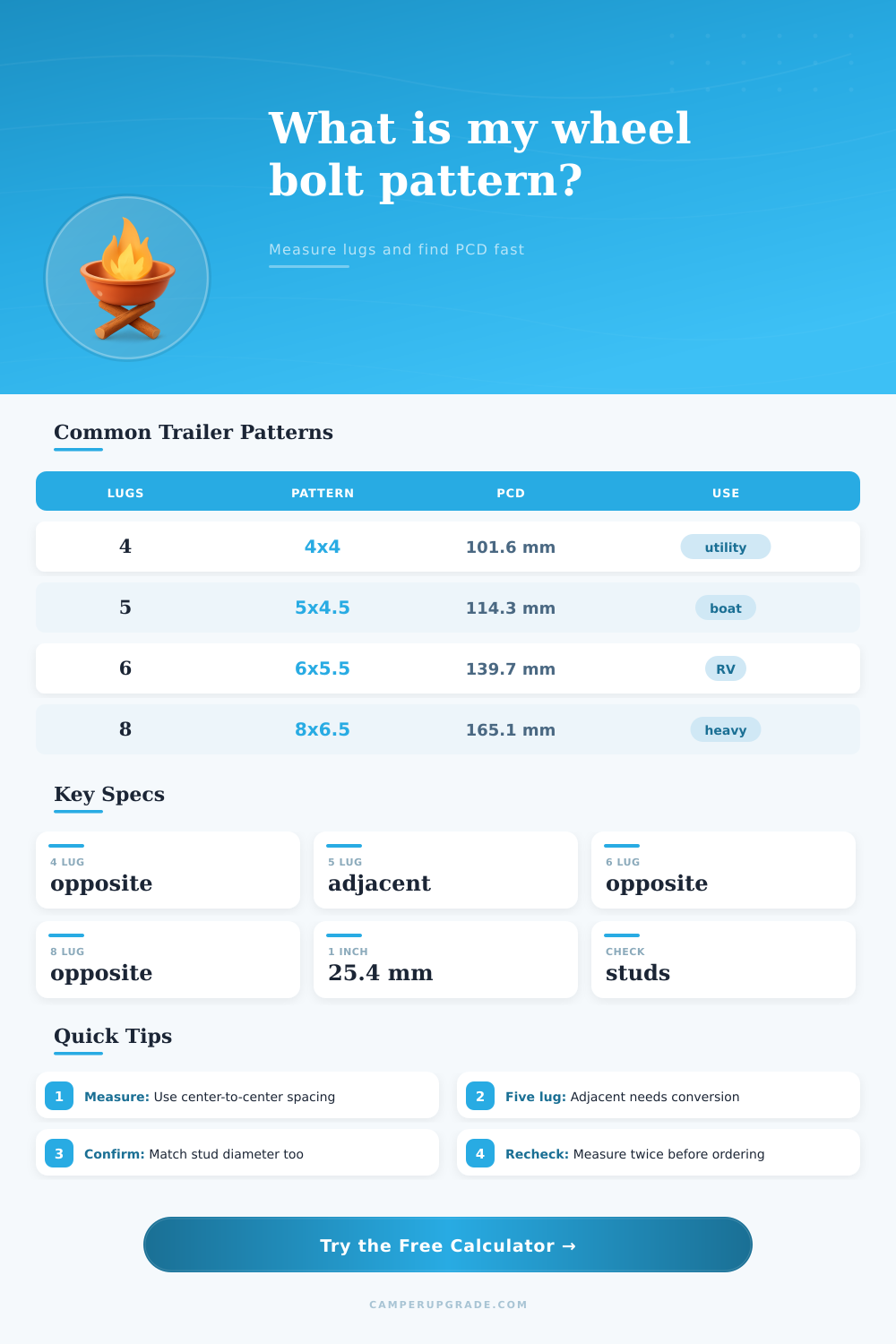
| 4 | 4x4.00 in | 4x101.6 mm | Small utility trailers and compact cargo wheels |
| 5 | 5x4.50 in | 5x114.3 mm | Boat trailers, pop-up campers, light travel trailers |
| 5 | 5x4.75 in | 5x120.7 mm | Some older camper and tow vehicle fitments |
| 5 | 5x5.00 in | 5x127.0 mm | Jeep-style tow vehicles and some off-road trailers |
| 6 | 6x5.50 in | 6x139.7 mm | Common travel trailer, truck, and off-road trailer pattern |
| 8 | 8x6.50 in | 8x165.1 mm | Heavy travel trailers, older HD trucks, equipment trailers |
| 8 | 8x170 mm | 8x6.69 in | Ford-style heavy duty tow vehicles |
| 8 | 8x200 mm | 8x7.87 in | Some dually truck and heavy camper applications |
| Lug Count | Best Measurement | PCD Formula | Example |
|---|---|---|---|
| 4 lugs | Opposite centers | PCD = opposite | 4.00 in becomes 4x4 |
| 5 lugs | Adjacent centers | PCD = adjacent / sin(36°) | 2.646 in becomes 5x4.5 |
| 6 lugs | Opposite centers | PCD = opposite | 5.50 in becomes 6x5.5 |
| 7 lugs | Adjacent centers | PCD = adjacent / sin(25.714°) | Uncommon; verify manually |
| 8 lugs | Opposite centers | PCD = opposite | 6.50 in becomes 8x6.5 |
| 10 lugs | Opposite centers | PCD = opposite | Heavy commercial hubs |
| Stud Size | Decimal Inches | Millimeters | Typical Wheel Use |
|---|---|---|---|
| 7/16 in | 0.4375 in | 11.11 mm | Older light trailers and small utility hubs |
| 1/2 in | 0.5000 in | 12.70 mm | Light and mid-size camper trailers |
| 9/16 in | 0.5625 in | 14.29 mm | Heavier travel trailers and tow vehicles |
| 5/8 in | 0.6250 in | 15.88 mm | Heavy equipment trailers and commercial hubs |
| M12 | 0.4724 in | 12.00 mm | Metric vans, SUVs, and tow vehicles |
| M14 | 0.5512 in | 14.00 mm | Modern trucks, vans, and larger trailers |
| Check | What to Measure | Why It Matters | Fitment Result |
|---|---|---|---|
| Bolt circle | PCD from lug centers | Holes must align with the hub studs | Pattern must match exactly |
| Stud diameter | Thread or shank outside diameter | Wheel holes and lug nuts must seat correctly | Match stud size and nut type |
| Center bore | Wheel pilot hole diameter | Too small will not seat on the hub | Equal or larger than hub pilot |
| Offset | Mounting face to wheel centerline | Affects clearance to springs, fenders, and brakes | Stay within hub and axle limits |
| Load rating | Stamped wheel capacity | RV and trailer wheels carry sustained loads | Rating must meet axle load |
A trailer and RV wheel bolt pattern describes an arrangement of the holes in the wheel hub. The bolt pattern will determine whether the trailer wheel will fit onto the wheel hub. Many trailer owners experiences problems with purchasing trailer wheels due to the bolt pattern not matching the hub.
If the bolt pattern of the trailer wheel does not match the trailer hub, the wheel will wobble on the hub or the lug nuts will become bound when attempting to fasten the wheel onto the hub. The provided calculator will help trailer owners avoid these problem by calculating the bolt pattern of the trailer wheels prior to purchase. To calculate the bolt circle diameter for the trailer wheel, you must provide the distance between the studs on the trailer hub.
How to Measure Trailer Wheel Bolt Patterns
If the trailer has an even number of studs on the hub, then the distance between two opposite studs can be used. If the trailer has an odd number of studs on the hub, then the distance between two adjacent studs on the hub must be provided. Trailers with five-lug and seven-lug wheels will only require the distance between two adjacent studs on the trailer hub because five-lug and seven-lug wheels do not have studs on the hub that are opposite another stud on the hub.
The distance between studs will be used to calculate the bolt circle diameter for the trailer wheels. This measurement will allow the trailer owner to determine whether the trailer wheels will fit onto the existing wheels on the trailer. Additionally, the calculator will show the nearest common wheel bolt pattern to the calculated bolt circle diameter so that the trailer owner can determine if the studs on the trailer hub are using a standard or custom bolt circle diameter.
Due to the heavy loads that trailers and RVs often carry over long distances, the measurements may need to be provided with a certain degree of tolerance. The trailer owner can adjust the tolerance settings for the calculator to meet the specifications of the trailer that is to receive the trailer wheels. For example, the tolerance for a light utility trailer can be set to a higher number than a heavy travel trailer because the heavy travel trailer needs to remain as close to the specifications that the trailer was manufactured with as possible.
Another measurement for trailer wheels that can be entered into the calculator is the stud diameter. The calculator will use the shank size of the stud to calculate the fractional and metric measurement of the diameter of the stud on the trailer hub. For example, most light trailers use half-inch studs on their wheels.
However, many of the trailers that can carry heavy loads use nine-sixteenths inch studs or M14 studs. Additionally, the nut seat angle for the trailer wheels should match the stud size. Using the wrong angle for the trailer wheels on a trailer with the wrong stud size will create stress points on the trailer hub that may lead to damaged hardware.
The bolt pattern calculator cannot calculate the center bore measurement on trailer wheels but is another specification for trailer wheels. The center bore on trailer wheels is the hole in the center of the wheel that must be placed over the center pilot on the trailer hub. Trailer wheels that are hub-centric require that the center bore of the wheel matches the size of the center pilot on the trailer hub.
If the center bore of the trailer wheel is smaller in diameter than the center pilot on the trailer hub, the trailer wheel will not mount to the trailer hub. If the center bore of the trailer wheel is much larger in diameter than the center pilot on the trailer hub, the trailer wheel may shift when the trailer is in motion. Thus, the center bore of the trailer wheel should be recorded so that it can be compared to the center bore of the replacement trailer wheels that are to be purchased.
The load ratings, offset, and backspacing of the trailer wheels are other specifications for trailer wheels but the calculator does not calculate them. The load rating is the number that is stamped on the trailer wheel that indicates the load that the trailer wheel can support. This number should be equal to or greater than the load capacity of the trailer axle.
The offset and backspacing of trailer wheels determine the distance between the trailer wheel and other components of the trailer such as the trailer brakes or fenders. These two measurements should also be checked for trailers with new trailer wheels even if the bolt pattern calculations are even the slightest bit off. Many people may believe that if the bolt pattern of the trailer wheels matches the bolt pattern of the existing trailer wheels on the trailer, then the replacement trailer wheels will work with those existing wheels.
However, this is not always the case. Trailer wheels and trailer hubs experience great amounts of heat, vibration, and stress from the corners of the trailer’s travel. These elements can cause small errors in the fitment of the trailer wheels to the trailer hubs to develop into cracked trailer wheels or stripped studs on the trailer.
Thus, it is critical to measure the bolt pattern, stud diameter, and center bore of the trailer prior to the replacement of the trailer’s wheels. The tables that are provided on the calculator page contain information regarding the common bolt patterns for the different types of trailers. Small utility trailers tend to use four-lug trailer wheels.
Boat campers tend to use five-lug trailer wheels. Many of the travel trailers use six-lug trailer wheels. Finally, the trailers that are used to transport the heaviest loads have eight-lug trailer wheels.
Each of these patterns has a metric equivalent that is also provided so that the trailer owners can compare the measurements of the trailer wheels in metric units to the specifications of the trailer hubs. Five-lug trailer wheels may be more difficult to calculate than other lug patterns for trailer wheels. When calculating trailer wheels with five-lug patterns, the distance between the two adjacent studs is used to calculate the sine of the angle.
When that angle is provided, the trailer wheels that are manufactured with a five-lug pattern can be calculated. Five-lug wheels have a bolt pattern that can be 5×4.5 or 5×114.3. Thus, the bolt pattern can be determined with these specifications, and the trailer owner can determine whether or not the trailer wheels will match the specifications for the existing trailer wheels on the trailer.
The bolt pattern can either match or it can not match the existing trailer wheels, and the use of a torque wrench will not fix a bolt pattern mismatch between the trailer wheels and the trailer hubs. In addition to measuring the bolt pattern between the existing trailer wheels, the bolt pattern of the tow vehicle can also be measured. For example, many towing vehicles have an eight-lug bolt pattern with a 8×170 or 8×200 bolt pattern.
However, trailer hubs often have an 8×6.5 bolt pattern. These two bolt patterns do not match, so the trailer wheels will not mount correctly to the tow vehicle. The calculator makes these types of problems obvious to the trailer owner so that they dont have to remove the old trailer wheels prior to knowing if the new trailer wheels will fit the trailer.
A few common mistakes can be made when using this calculator. For example, many trailer owners will choose between inch or millimeter units of measurement. Additionally, there are two modes for the studs on the trailer hub.
One mode will calculate the distance between studs that are opposite another stud on the wheel (opposite mode) while the other mode calculates the distance between studs that are adjacent to each other (adjacent mode). The opposite mode will be used for trailers with an even number of studs while the adjacent mode will be used for trailers with an odd number of studs. Thus, if these two settings are incorrectly set, the trailer wheels will not mount correctly to the trailer.
Finally, another mistake that trailer owners can make is not ensuring that each stud on the trailer hub is the same size. Some trailer hubs, especially those that are more than a few years old, may have studs of different sizes or angles on the same hub. Thus, the trailer owner must ensure that each stud on the trailer hub is the same size as the stud that is measured and entered into the calculator for the trailer wheels.
Any differences in stud sizes may cause the trailer wheels to not mount correctly to the hub.