Weight Distribution Hitch Calculator
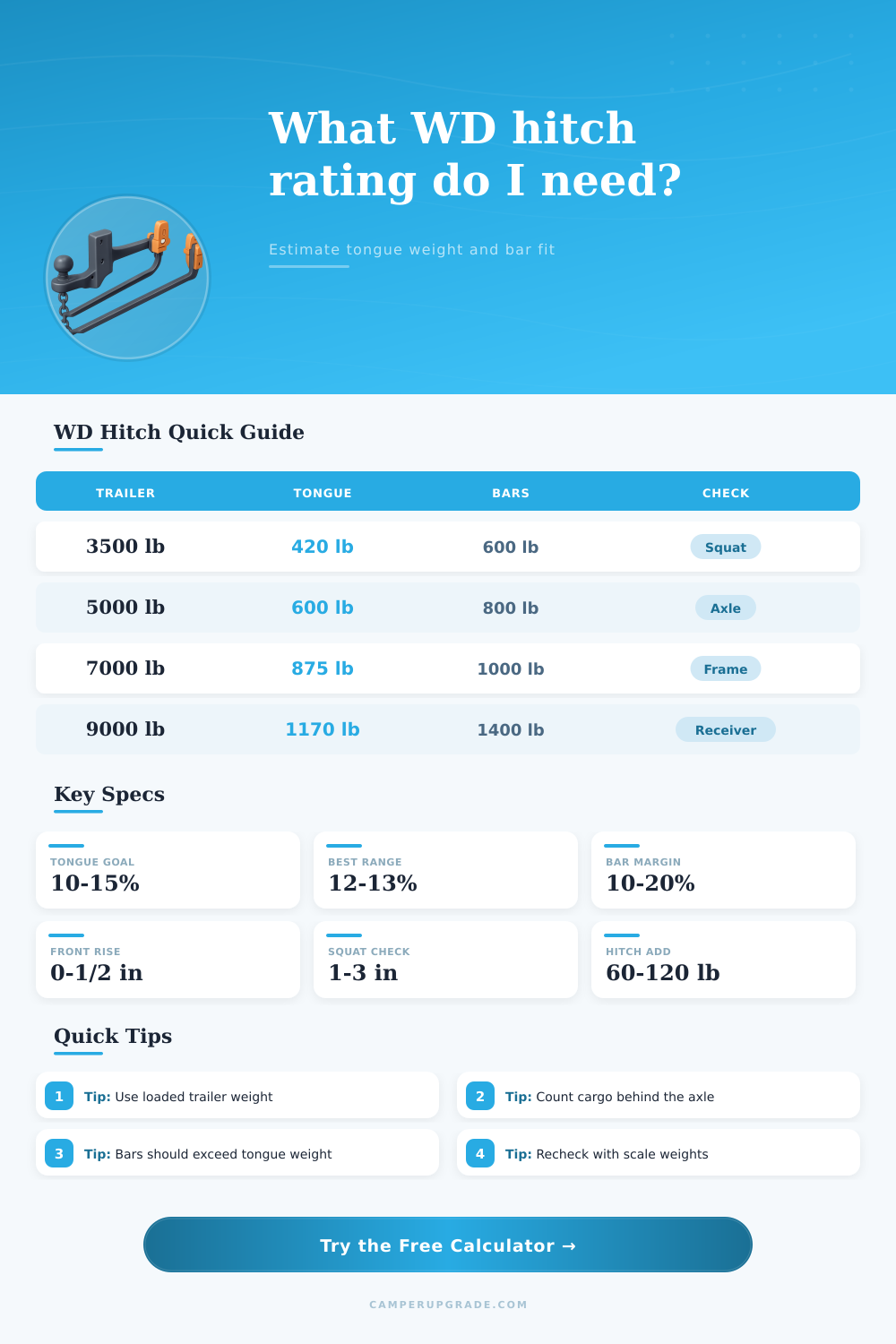
Estimate loaded tongue weight, spring bar rating, front axle restoration, receiver margin, and truck squat targets for a travel trailer setup.
| Loaded tongue weight | Common bar rating | Typical trailer weight | Setup note |
|---|---|---|---|
| 350-500 lb | 600 lb bars | 3000-4000 lb | Small camper, avoid overly stiff bars |
| 500-700 lb | 800 lb bars | 4000-5500 lb | Good fit for many midsize trailers |
| 700-900 lb | 1000 lb bars | 5500-7000 lb | Most half-ton travel trailer setups |
| 900-1100 lb | 1200 lb bars | 7000-8500 lb | Check receiver and frame brackets |
| 1100-1300 lb | 1400 lb bars | 8500-10000 lb | Often better behind heavier trucks |
| 1300-1500 lb | 1700 lb bars | 10000-12000 lb | Confirm all published ratings first |
| Trailer type | Usual tongue % | Watch point | Calculator use |
|---|---|---|---|
| Single axle camper | 10-12% | Can sway if rear-loaded | Start at 11% |
| Standard travel trailer | 12-13% | Most stable loaded range | Start at 12.5% |
| Bunkhouse trailer | 12-15% | Front pass-through adds load | Add cargo to tongue |
| Toy hauler travel trailer | 10-15% | Toys can reduce tongue load | Recalculate loaded |
| Long rear kitchen trailer | 11-14% | Rear cargo shifts balance | Use actual scale data |
| Measured change | What it suggests | WD adjustment target | Check before towing |
|---|---|---|---|
| Front unchanged | Axle nearly restored | Usually acceptable | Verify rear squat and steering feel |
| Front up 1/4 in | Mild unloading | Often within target | Confirm with owner's manual |
| Front up 1/2 in | More WD may be needed | Add washer tilt or chain tension | Stay within bar rating |
| Front up 3/4 in+ | Steering axle too light | Rework setup or load balance | Scale before highway travel |
| Rear squat over 3 in | High payload demand | Check payload and receiver | Do not mask overload with WD |
| Margin result | Meaning | Practical action | Best verification |
|---|---|---|---|
| 20%+ margin | Comfortable reserve | Setup by height and scale | CAT scale front and rear axles |
| 10-20% margin | Usable but close | Limit added cargo | Compare to door sticker and receiver |
| 0-10% margin | Very tight | Reduce tongue load or trailer weight | Weigh truck loaded for camping |
| Negative margin | Rating exceeded | Do not tow as entered | Choose lighter trailer or higher ratings |
This calculator estimates setup targets from common towing rules. Always follow the truck, receiver, trailer frame, and hitch manufacturer's instructions.
Towing a travel trailer changes the way that a truck sit on the road. When a trailer is hooked up to a truck without a weight distribution hitch, the rear of the truck will squat down and the front of the truck will becomes lighter. Each of these changes to the truck will change the way the truck steers, and will reduce the traction of the drive wheels of the truck.
Installing a weight distribution hitch will move some of the loads of the trailer from the rear of the truck to the front of the truck because the spring bars connects the trailer frame to the truck. Installing the hitch will restore balance to the truck, but it will not add any more capacity to the truck then the truck had prior to installing the trailer. You can use the calculator on this page to perform the arithmetic necessary to determine if your trailer and truck are within the limits of the truck model.
Balance Your Truck and Trailer When Towing
The loaded tongue weight of your trailer will be the starting point for all other calculations. The weights listed in the trailer brochures are dry weights. The dry weight isnt the same as the loaded weight of the trailer.
You will need to use the loaded weight of the trailer in your calculation, which is the weight of the trailer after you have added the water, propane, batteries and any other cargo that you typicaly carry in the trailer. The loaded tongue weight will drive every other number that you will calculate. If the tongue weight of your trailer is lighter than 10% of the loaded weight of the trailer, the back of the trailer may wander.
If the tongue weight of the trailer is more than 15% of the loaded weight of the trailer, the truck will feel vague when steering and the rear axle of the truck may be overloaded. Adding extra weight to the front storage compartment of the truck or the A-frame of the trailer will increase the tongue weight. This increased tongue weight will use some of the payload capacity of the truck.
The weight of the hitch hardware will be another important number to input into the calculator. The hitch head, shank, spring bars and chains add between 60 and 120 pounds to the truck. It is common for truck owners to ignore the weight of the hitch hardware in the payload of the truck.
The calculator will show you the percentage of the payload that the hitch hardware uses up so you can ensure you have enough payload for passengers and other items. If the hitch hardware is using 90% of the payload capacity of the truck, there is little remaining for additional passengers or cargo. The receiver rating and spring bar rating are separate from one another, but both appear on the trailer hitch.
The receiver has a weight-distributing tongue rating, which the trailer hitch calculator will compare to the loaded tongue weight of the trailer. The spring bars also have a rating, which the trailer hitch calculator will compare to the tongue weight to ensure that the spring bars are not too light for the trailer’s tongue weight. Using the tables on this page can show where your numbers falls relative to typical recommendations for trailer and truck configurations.
Front axle restoration is a step that most people will not think about until the truck begins to wander while traveling at highway speeds. As the trailer’s tongue presses down on the rear of the truck, the front of the truck will rise. The amount that the front of the truck rises is based off the length of the truck’s wheelbase and the length of the rear overhang of the truck.
The trailer hitch calculator will estimate how much weight is on the front of the truck so you can calculate to what height the front of the truck should rise. If the front of the truck rises more than 0.5 inches above it’s height when the trailer was not hooked up, it means the spring bars should be more tense or there should be a change in the load balance of the trailer. Rear squat is the measurement of the degree to which the truck will squat when towing the trailer.
This measurement should be taken while the hitch hardware is not engaged to the trailer. If the measurement of the rear squat of the truck is 3 inch or more, the payload of the trailer is high. There is no amount of weight distribution hitch equipment that will help a truck that has such high payload to remain within the limits of its payload capacity.
The trailer hitch calculator will measure and record the rear squat for comparison to the axle and tire ratings of the truck. Some of the mistakes that people make when performing these calculations include using the dry weight of the trailer in the first field; using the dry weight will result in a tongue load that is hundreds of pounds too low. People also often do not account for the weight of the hitch head when they calculate the payload of the truck.
Yet another mistake that people make is ignoring the spring bar rating. The spring bar rating should not be the same as the tongue weight of the trailer, but should be a range of weights that provides for comfort in the tongue weight of the trailer. While the trailer hitch calculator will not prevent these mistakes from being made, it will help to reveal these mistakes to the user when the numbers reveal unrealistic targets for the height of the front of the truck or if the margin for error is negative.
Some of the variables that exist in the real world that the trailer hitch calculator will not take into account include the length of the rear overhang of the truck. If the truck has a long overhang, it will cause the front of the truck to unload while the trailer is towing. The condition of the rear springs of the truck will affect the amount of squat the truck exhibits.
If the rear springs are soft, the truck will squat more than if the springs are stiffer. Other variables include the effect of wind, the grade of the road and other trucks that may be passed while towing the trailer. All of the height measurements made with the trailer hitch calculator are made on the assumption of a level ground and consistent tire pressures.
These measurements should be made again after the truck has sat overnight or after the trailer is loaded in a different way than it was measured. The goal of these calculations is to ensure that every load rating of the truck is within its published limit. If there are still comfortable margins within the receiver, payload and spring bar ratings, the truck is ready to hit the road.
If the required change in the height of the front of the truck is modest, you can take the truck and trailer to a CAT scale or one of the many truck stops that feature loading and unloading scales for trucks. This scale check will confirm the weights of the trailer and truck, and the confirmed weight will give the trucker a confidence when leaving the trailer behind.