Trailer Tire Load Capacity Calculator
Estimate the load carried by each trailer tire, compare it with sidewall capacity, and account for reserve, pressure, speed, heat, and side-to-side imbalance.
🚙 Trailer Tire Presets
📏 Tire Load Inputs
🛞 Tire Spec Grid
📋 Load Capacity Reference Tables
Common ST Tire Load Examples
| Tire Size | Load Range | Rated PSI | Typical Max Load |
|---|---|---|---|
| ST175/80R13 | C | 50 psi | 1,360 lb |
| ST205/75R14 | C | 50 psi | 1,760 lb |
| ST205/75R15 | D | 65 psi | 2,150 lb |
| ST225/75R15 | E | 80 psi | 2,830 lb |
| ST235/80R16 | E | 80 psi | 3,420 lb |
| ST235/85R16 | G | 110 psi | 4,400 lb |
Ratings vary by exact tire model. Always use the load and pressure printed on your tire sidewall or tire load chart.
Cold Pressure Capacity Adjustment
| Actual Cold PSI | Compared With Sidewall PSI | Calculator Factor | Use Case |
|---|---|---|---|
| 100% | At rating | 100% | Full listed load rating |
| 95% | Slightly low | 95% | Top off before travel |
| 90% | Low | 90% | Reserve shrinks quickly |
| 85% | Very low | 85% | Correct before towing |
| Under 80% | Unsafe range | 80% cap | Do not rely on margin |
Speed And Temperature Reserve Factors
| Condition | Input Range | Reserve Penalty | Why It Matters |
|---|---|---|---|
| Moderate cruise | Up to 65 mph | 0% | Typical ST tire baseline |
| Fast cruise | 66-75 mph | 5% | More heat buildup |
| Very fast tow | Over 75 mph | 10% | Reserve should be higher |
| Warm day | 90-99F | 3% | Hot pavement adds stress |
| Hot day | 100F+ | 6% | Heat raises failure risk |
Common Trailer Tire Setups At 15% Reserve
| Trailer Setup | Loaded Weight | Tires | Suggested Rating |
|---|---|---|---|
| Single axle cargo | 3,000 lb | 2 | 1,520+ lb each |
| Compact camper | 4,800 lb | 2 | 2,440+ lb each |
| Tandem travel trailer | 7,600 lb | 4 | 1,940+ lb each |
| Heavy bunkhouse | 9,800 lb | 4 | 2,500+ lb each |
| Toy hauler | 12,500 lb | 4 | 3,190+ lb each |
| Triple axle fifth wheel | 16,800 lb | 6 | 2,860+ lb each |
💡 Tire Capacity Tips
Towing a trailer place additional stress upon the trailer tires that many people do not necessarily appreciate. Additionally, trailer tires can fail even if they appear to be in good condition on the trailer tires. The reason for the failure of the trailer tires is due to the combination of the load, the heat, and the speed at which the trailer is traveling.
Often the problem with trailer tires is not due to the fact that they are being heavily overload, but instead due to the fact that the load of the trailer is too heavy for the trailer tires to handle under normal conditions. This load can change based off the tire pressure, the temperature of the trailer tires, and the way in which the trailer distributes its weight. Trailer tires is provided with a maximum load rating for the trailer.
How to Check Trailer Tire Load
This maximum load is based upon the tire’s cold tire pressure. When the trailer is towed, the trailer may be imbalanced in its load, the trailer tires may heat up while being towed, and the tire pressure may decrease while loading or while being towed. Because of these factors, it is recommended that a trailer tire calculator be use to determine the amount of load that can be placed upon each trailer tire while towed.
The calculator will consider the loaded weight of the trailer, the number of trailer tires, the cold tire pressure, and the speed that the trailer will travel. One of the first pieces of information that the trailer tire calculator will require is the total trailer weight. However, this load does not represent the load that is placed upon the trailer tires.
The tongue weight of the trailer is placed upon the tow vehicle, and thus the trailer tires do not have to bear this load. The tongue weight can be subtracted from the total trailer weight to determine the weight that is placed upon the trailer tires, and it is additionally possible to account for the side-to-side weight imbalance of the trailer. This will allow each trailer tire to be accounted for individually with the calculator.
The calculator determines the weight that will be placed upon each trailer tire while being towed. However, trailer tires has a load rating for the tire that is indicated on the sidewall of the tire. This load rating was determined for the trailer tire at the specified pressure.
Thus, if the trailer tire pressure is below the pressure at which the trailer was rated, the load capacity of those trailer tires will be less than the load that was indicated on the trailer tire. Additionally, trailer tires rated for speeds above 65 mph may have a reduced load capacity for those same speeds. Additionally, trailer tires may experience additional heat when exposed to high temperatures.
Such heat may reduce the load capacity of the trailer tires. These factors will be accounted for in the trailer tire calculator. One way of determining whether the trailer tires are able to handle the load that will be placed upon them is to calculate the reserve capacity of the trailer tires.
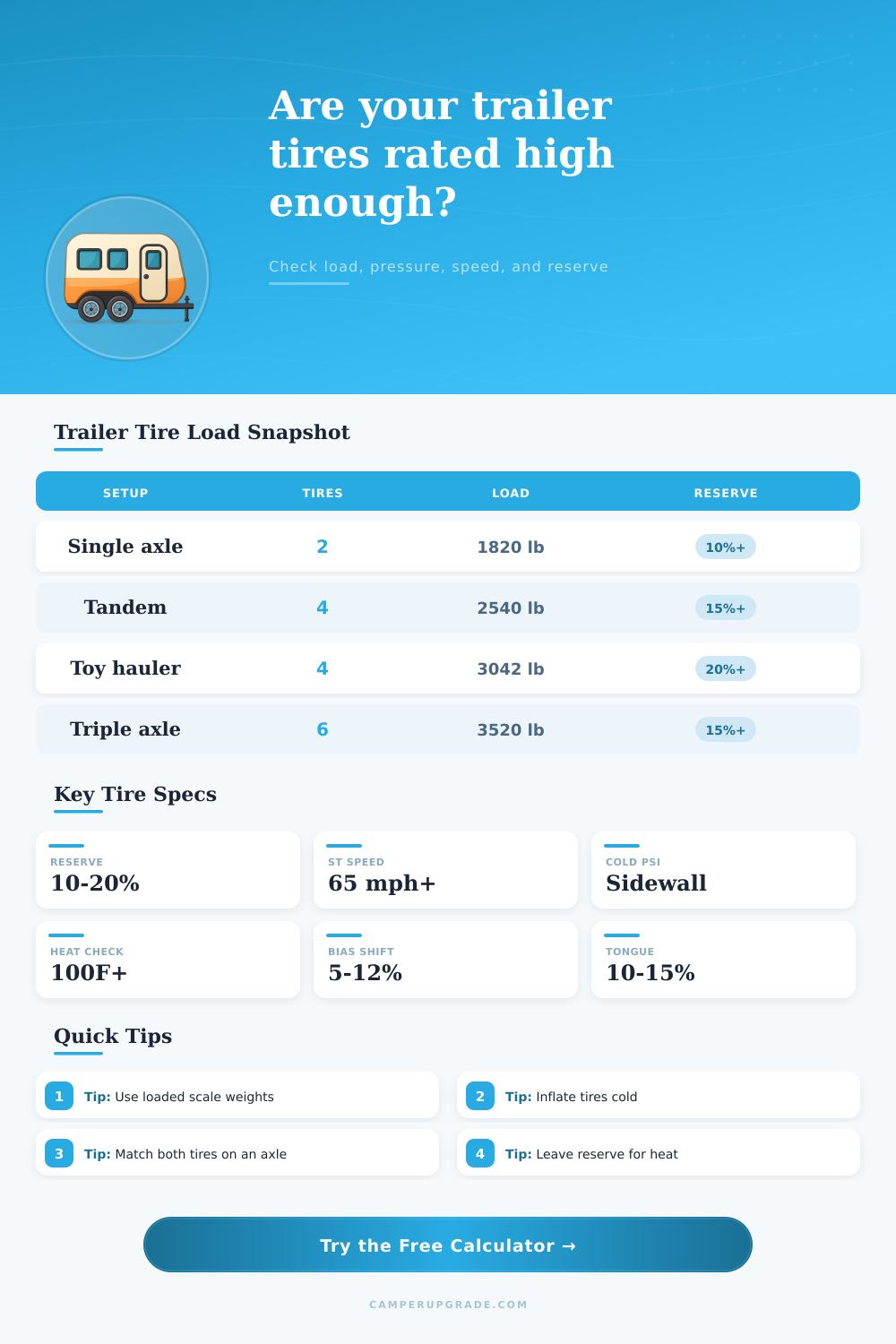
Many individuals that tow trailers aim for a trailer tire reserve capacity of between 10 and 15%. Such a reserve capacity allows for some additional weight to be added later to the trailer, for some of the load to be distributed into the trailer tires over time, and to allow for the heat of the trailer tires to build up along long trailer grades. The trailer tire calculator will indicate the reserve capacity of the trailer tires as a percentage.
In addition to the trailer tires, it is also important to consider the spare tire for the trailer. For instance, if the spare tire for the trailer is not a long-term tire for the trailer, or if the load and speed ratings for the spare tire are unknown, an additional reserve capacity should be provided for the trailer tires while they are in operation. The trailer tire calculator will include a field for the spares load rating to account for this potential additional tire.
Additionally, the trailer tire calculator will indicate the minimum load rating of trailer tires that would need to be purchased to ensure that the trailer will have an appropriate reserve capacity. Because the trailer owner can control trailer tire pressure, it is important to ensure that the trailer tires are at the proper tire pressure for the trailer. The proper tire pressure should be measured when the trailer tires are cold, and each tire on the trailer should have the same pressure.
A trailer tire with a pressure that is 5 or 6 pounds per square inch lower than the pressure of the other trailer tires will experience a reduction in the life of those trailer tires, especially if the trailer tires are exposed to high temperatures. This information can be displayed in the reference tables that are provided on the calculater’s website. The speed at which the trailer is driven also has an impact upon the load that can be placed upon the trailer tires.
Most trailer tires is rated for speeds that are above 65 mph. However, higher speeds can generate heat within the trailer tires, which can lead to the tires losing some of their load capacity. Thus, penalties will be applied to the trailer tires for speeds that are above 65 mph, as well as for increased temperatures of the trailer.
The load range of the trailer tires is one of the specifications that is provided for the trailer tires. Instead of the load range being the focus of any trailer tire calculations, the load that is specified for those tires at the rated pressure is the most important of the load ratings. While increasing the load range of the trailer tires will increase the load capacity at higher pressures, that increased load capacity will only be beneficial to the trailer if the trailer is actually using those higher pressures.
Thus, the load range for the trailer tires will be accounted for in the trailer tire calculator to help determine the load that will be placed upon each tire. The most common mistake made by trailer tire owners is to believe that the number that is specified on the sidewall of each trailer tire will never change. When exposed to different levels of load, pressure, speed, and temperature, the load that each trailer tire can handle will change.
The trailer tire calculator makes it possible for the trailer tire owner to see the change in load and the capacity of those trailer tires prior to departure of the trailer for the day. Once the trailer owner becomes familiar with these numbers, it becomes possible to make a decision regarding whether the trailers tires are adequate for the tasks that they will be performing. Additionally, such a calculation will provide the trailer tire owner with information that will be of benefit when shopping for new trailer tires.