Trailer Axle Weight Calculator
Estimate axle group load, per-axle load, tongue weight percentage, and rating margin after moving gear or adding cargo.
| Load Case | Total Trailer | Tongue Load | Axle Group | Per Axle |
|---|---|---|---|---|
| Current input | 6200 lb | 760 lb | 5440 lb | 2720 lb |
| With cargo changes | 6550 lb | 917 lb | 5633 lb | 2817 lb |
| Rating buffer target | 6550 lb | 917 lb | 6300 lb max | 3150 lb max |
| Remaining margin | 350 lb added | 157 lb added | 667 lb | 333 lb |
| Trailer Type | Typical Tongue or Pin | What Low Usually Means | What High Usually Means |
|---|---|---|---|
| Utility trailer | 10% to 15% | Gear too far rearward | Front cargo too heavy |
| Travel trailer | 10% to 15% | Sway risk increases | Tow vehicle payload strain |
| Boat trailer | 5% to 10% | Winch post or load aft | Bow gear may be forward |
| Toy hauler | 12% to 15% | Toy load too far back | Garage plus front tanks loaded |
| Fifth wheel | 15% to 25% | Rear cargo dominates | Pin load may exceed payload |
| Axle Setup | Example GAWR Per Axle | Combined Axle Rating | 10% Buffer Target |
|---|---|---|---|
| Single light axle | 2,000 lb | 2,000 lb | 1,800 lb |
| Single utility axle | 3,500 lb | 3,500 lb | 3,150 lb |
| Tandem camper axles | 3,500 lb | 7,000 lb | 6,300 lb |
| Tandem heavy axles | 5,200 lb | 10,400 lb | 9,360 lb |
| Triple RV axles | 7,000 lb | 21,000 lb | 18,900 lb |
| Cargo Location | Tongue Effect | Axle Effect | Best Use |
|---|---|---|---|
| Forward storage | Raises tongue load | May reduce axle share | Light bulky gear |
| Just ahead of axles | Slightly raises tongue | Most weight stays on axles | Dense camping gear |
| Over axle group | Minimal tongue change | Adds mostly axle load | Tools, water jugs, batteries |
| Behind axle group | Lowers tongue load | Can increase sway risk | Only when tongue is high |
| Rear bumper carrier | Can sharply lower tongue | Raises rear leverage | Small rated accessories |
| Margin Result | Interpretation | Common Action | Recheck |
|---|---|---|---|
| 20% or more | Comfortable axle cushion | Verify tire pressure | Before long trips |
| 10% to 20% | Normal working margin | Keep dense gear centered | After cargo changes |
| 0% to 10% | Tight axle margin | Reduce or redistribute load | At a certified scale |
| Below 0% | Axle rating exceeded | Remove load before towing | Immediately |
This calculator estimates fore-aft loading. It does not replace certified scale weights, left-right wheel position weights, tire ratings, hitch ratings, or the trailer manufacturer label.
The distribution of weight on a trailer is a critical factor in determining the safety of the trailer, the tow vehicle, and the driver. The distribution of weight on a trailer affect the handling of the tow vehicle while it is on the road. For instance, if heavy items are place in the back of a trailer, the front of the tow vehicle will feel light compared to the trailer.
Because of this difference in weight, the trailer may begin to wander or sway when other vehicles pass the tow vehicle. This wandering or swaying of the trailer happen due to the tongue weight and axle loads being outside of the designed range of the trailer. To avoid these issues, the tongue weight and axle loads must remain within the correct limits of the trailer for a safe drive.
How to Balance Trailer Weight for Safe Towing
The calculator above allow for the performance of mathematical calculations once the user enters the dimensions of the trailer and the weight of the trailers contents. The weight of the trailer, the tongue weight of the trailer, the distance between the trailer coupler and the axle group of the trailer, and the weight of any items to be added to the trailer must be entered into the calculator. Based on these measurements, the calculator will provide the new load on each axle group of the trailer, the load of each axle of the trailer, the percentage of the tongue weight of the trailer, and the remaining margin of the trailer in relation to the axle load rating of the trailer.
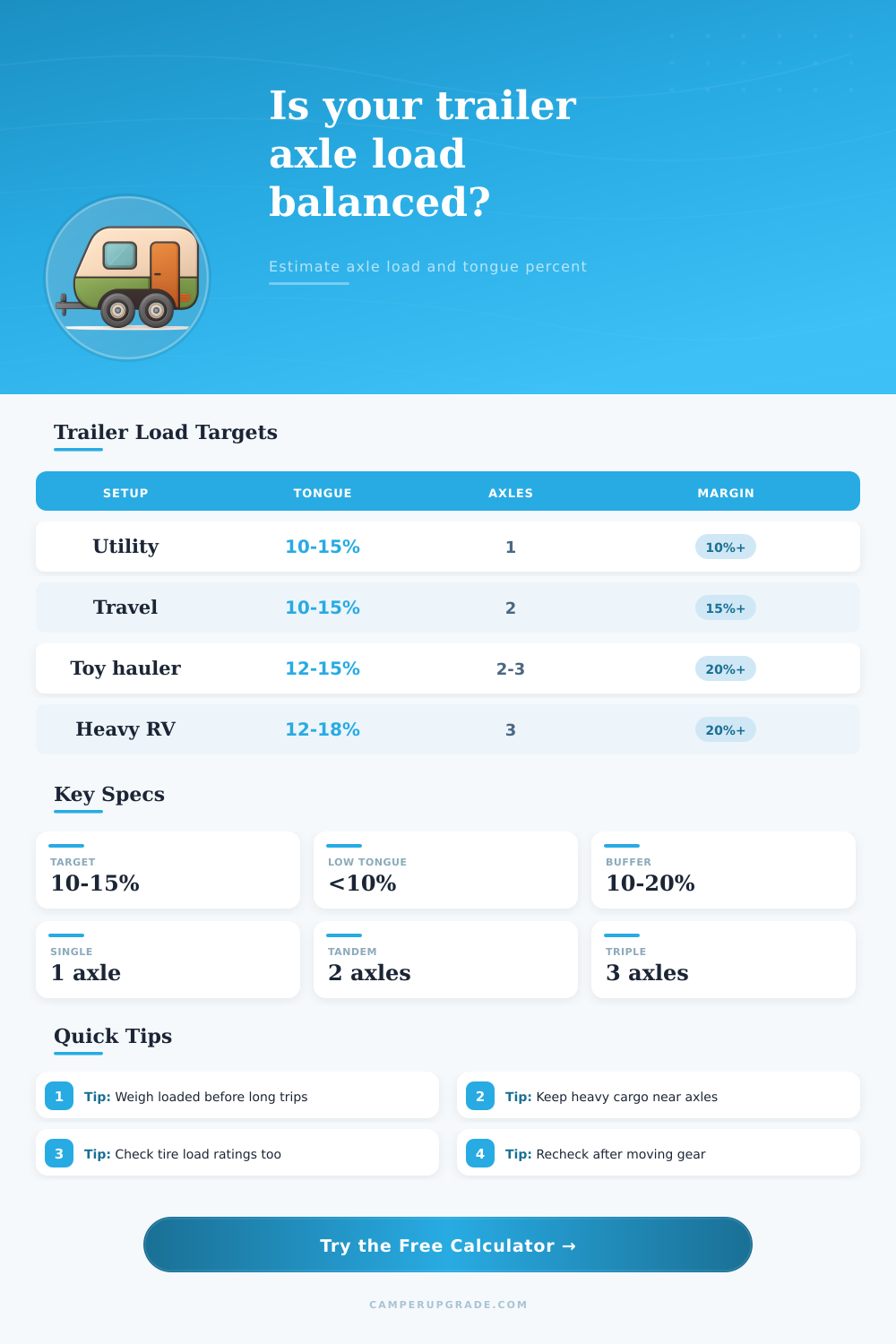
The position of the items within the trailer can significantly impact these measurements. For instance, merely moving a few hundred pounds of cargo a few feet can lead to changes in the tongue percentage of the trailer. The tongue weight of the trailer has a percentage between ten and fifteen percent.
This percentage relates to the downward force create by the tongue weight of the trailer on the trailer hitch. If the tongue weight is too low, the trailer will tend to sway. This occurs due to not having enough downward force of the trailer hitch to keep the trailer moving behind the tow vehicle.
In contrast, if there is too much tongue weight, the tongue will overload the rear axle and the suspension system of the tow vehicle. Overloading these components can create issues with the steer of the tow vehicle and the ability of the tow vehicle to be able to brake appropriately. These tradeoffs can be seen through the weight calculator to allow the trailer operator to decide how to best move the cargo on the trailer.
Each trailer has axle groups that have a Gross Axle Weight Rating (GAWR). The trailer manufacturer stamps the GAWR. This rating is different than the Gross Vehicle Weight (GVWR) of the trailer.
The GVWR includes the tongue weight and the total weight of the trailer. However, the GVWR is not always a rating that is applied to the trailers axles. The weight calculator can be used to enter the GAWR for each axle of the trailer.
Additionally, a percentage buffer for the GAWR can be selected. This buffer accounts for error in the actual weighing of the trailer. Ten percent is a common buffer for most people.
However, people who tow trailers more often may use a fifteen or twenty percent buffer for safety. The tables provided as references to trailers has typical ratings for those trailer types. For instance, the load ratings for a utility trailer and a travel trailer are different from one another due to the different types of cargo on each of these trailers.
However, each of these trailers aim to have a similar percentage of tongue weight. A toy hauler trailer may have a significant drop in the percentage of tongue weight if an individual places motorcycles or an ATV into the rear of the trailer. Additionally, the load ratings for trailers that tow boats may be different due to the fact that the motor and fuel tanks for the trailer boats are located at the rear of the trailers.
These reference tables allow individuals to compare the specifications of their trailers to the examples provided. Although the trailer weight calculator allows for an individual to have an idea of the tongue weight, axle load, and tongue percentage, there are some variables in the trailer and tow vehicle that the weight calculator does not have the ability to account for. The tandem axles of the trailer may not be perfectly centered.
Additionally, tongue jacks may not be in the same position as the trailer coupler. Furthermore, the water tanks on the trailer can weigh significantly different when filled with water than when the tanks are empty. Because of these variables, the trailer should be weighed on the actual trailer and tow vehicle.
The trailer weight calculator is a planning tool only. One of the most common mistake with trailers is to continually load the trailer until the axle group reaches its load rating. This can cause numerous issues for the axles of the trailer.
The load ratings for the axles will wear out faster and over time can lead to breakages in the axles. The buffer percentage that is selected with the trailer weight calculator is used to provide some of this safety for the axles of the trailer. Additionally, the weight ratings of the trailers tires may be less than that of the axle group that they are attached to.
Thus, if the axle group is near its maximum loading, the tires will also be under heavy stress. Furthermore, trailer operators may ignore the total weight of the trailer in some cases. The total weight is important, but it does not provide information about the even distribution of the trailers load.
For instance, placing all of the trailers load towards the rear of the trailer will create issues related to the tongue weight of the trailer. The tongue weight will be too light for the trailer to remain in balance and may also overload one of the trailers axles. The trailer weight calculator will allow an individual to avoid placing the trailer into this dangerous situation.
By noting the tongue percentage of the trailer and the load of each axle, the trailer can be loaded in a way that ensures that the load is appropriately distributed. An individual should use a trailer weight calculator prior to each trip that they take with the trailer. The current weight of the trailer can be noted.
Additionally, the weight of the cargo to be added to the trailer can be entered into the calculator. The tongue percentage and the load on each axle can be noted with the trailer. If the tongue percentage is outside of the recommended range or if the margin for each axle is close to the rating for each axle, the cargo must be moved on the trailer prior to traveling with the trailer.
This will help to avoid the wandering of the trailer that may develop on the highway. Additionally, dense items like batteries or water containers will have a larger impact on the trailers tongue percentage than will items like folding chairs. Thus, an understanding of how the different types of items can impact the tongue percentage will help the trailer to be loaded in the most efficient way possible.