Windsurf Fin Size Calculator
Estimate windsurf fin length, fin area, rake style, and grip-control balance from sail size, board width, rider weight, wind strength, discipline, and water state.
🏄Windsurf Setup Presets
⚙Sail, Board Width, Rider, Wind, and Discipline Inputs
This calculator estimates a practical starting fin. Exact choice still depends on fin stiffness, foil section, footstrap position, mast track, sail draft, and how powered you sail.
🧮Fin Sizing Method Cards
Sail Power
sail x 6.1The sail drives the base fin length. Bigger sails load the rail and need more lateral resistance.
Tail Width
width trimWide tails and outboard straps can hold longer fins, while narrow wave tails need shorter fins.
Rider Load
weight biasHeavier riders, low wind, and early-planing goals add length; high wind and chop subtract length.
Fin Outline
area checkWeed, wave, freestyle, slalom, and formula outlines carry different area for the same printed depth.
📏Fin and Board Spec Grid
📊Windsurf Fin Sizing Tables
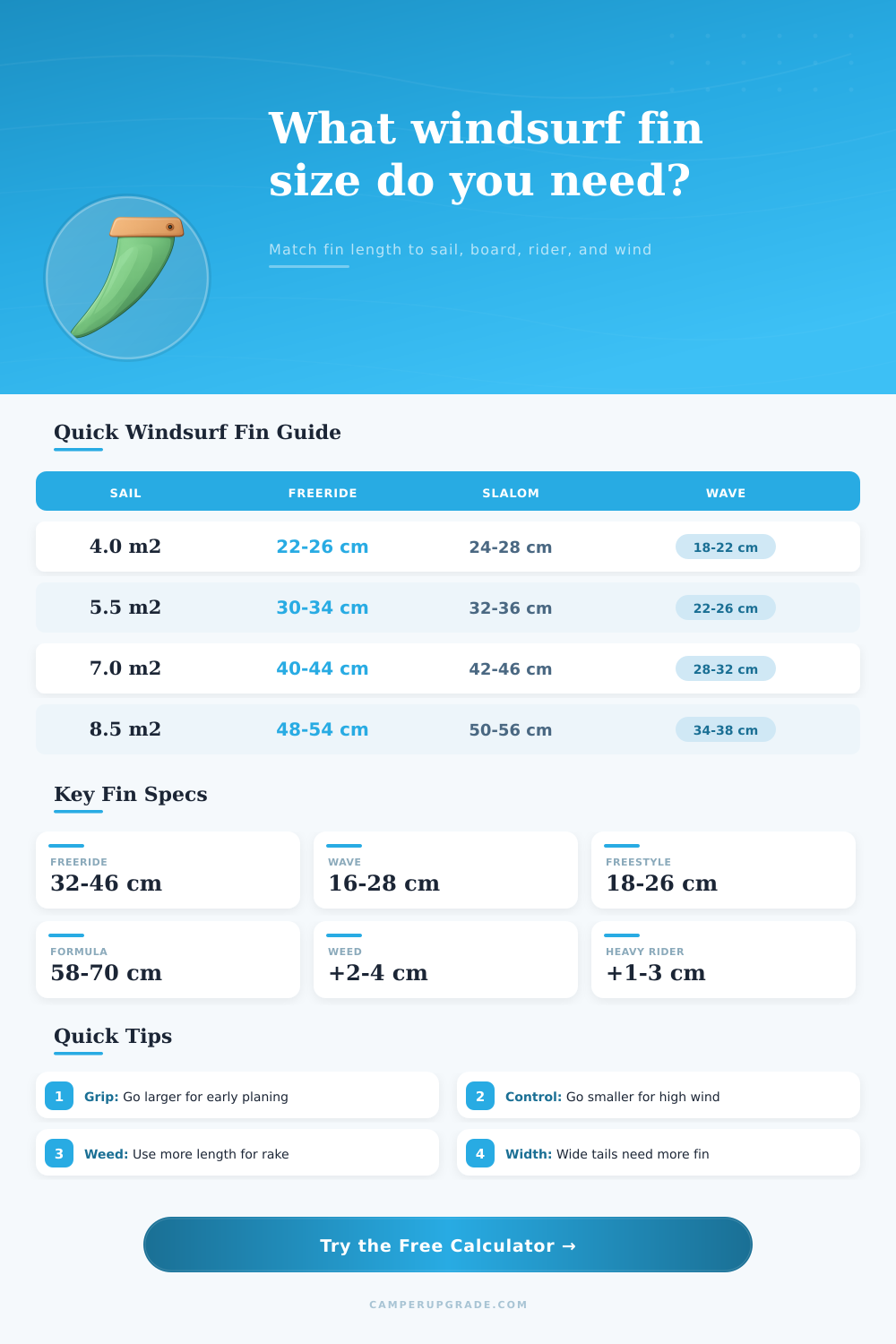
| Sail Size | Freeride | Freerace | Slalom |
|---|---|---|---|
| 4.0 to 4.7 m² | 22-28 cm | 24-30 cm | 26-32 cm |
| 5.0 to 5.8 m² | 30-36 cm | 32-38 cm | 34-40 cm |
| 6.0 to 6.8 m² | 36-42 cm | 38-44 cm | 40-46 cm |
| 7.0 to 7.8 m² | 42-48 cm | 44-50 cm | 46-52 cm |
| 8.0 to 9.5 m² | 48-56 cm | 50-58 cm | 52-60 cm |
| Discipline | Typical Fin | Length Bias | Best Feel |
|---|---|---|---|
| Freeride | Pointer | Baseline | Easy grip |
| Freerace | Fast pointer | +1 to +3 cm | Locked rail |
| Slalom | Race pointer | +2 to +5 cm | Upwind drive |
| Wave | Wave or multi | -8 to -14 cm | Loose turns |
| Freestyle | Short chord | -10 to -16 cm | Slide control |
| Board Tail | Common Sail | Fin Range | Notes |
|---|---|---|---|
| 50-58 cm | 4.0-5.4 m² | 18-30 cm | Wave, freewave |
| 59-66 cm | 5.0-6.5 m² | 28-38 cm | Freeride small |
| 67-74 cm | 6.0-7.8 m² | 36-48 cm | Freeride core |
| 75-85 cm | 7.5-9.0 m² | 46-58 cm | Freerace wide |
| 86 cm+ | 9.0-12 m² | 58-70 cm | Formula |
| Condition | Adjustment | Why | Watch For |
|---|---|---|---|
| Light wind | +2 to +5 cm | Earlier lift | Tail walking |
| Flat speed | 0 to +3 cm | Locked trim | Too much lift |
| Normal chop | -1 to -2 cm | Control | Spinout |
| Heavy chop | -3 to -6 cm | Settles board | Upwind loss |
| Weed water | +2 to +4 cm | Rake loss | Box leverage |
💡Fin Tuning Tips
To determine the correct fin for an windsurf board, a person must consider several factor. The size of the fin will determine how the windsurf board behave in the water. Too small of a fin will cause the windsurf board to slide on the water when the rider pull on the sails.
Too large of a fin will cause the tail of the windsurf board to lift when encountering high wind, or create drag for the rider when riding on choppy water. A person must consider sail size, board shape, rider weight, sailing discipline, and water condition to determine the correct fin for there windsurf board. Sail size is one of the primary factors to consider when choosing a fin for a windsurf board.
How to Choose the Right Fin for Your Windsurf Board
The size of the sail will determine the amount of lateral resistance that the fin must provide. Large sails will require a large fin to counterbalance the forces of the sail. Small sails, however, will require a smaller fin to prevent the windsurf board from sliding on the water.
The consistency of the wind is another factor in the selection of the correct fin. Winds that is steady allow for a longer fin. Gusty winds, however, will require a shorter fin to allow the fin to release some of that lateral pressure on the windsurf board when the gusts of wind arrives.
The shape of the windsurf board is another factor in the determination of the correct fin. A wide tail on the board allow for the rider to use a longer fin. The wider tail provides more leverage for the fin.
A narrow tail, or wave tail, requires a shorter fin. The volume of the windsurf board also has an effect on the length of the fin that should be use with that windsurf board. A high volume windsurf board will allow for the use of a shorter fin.
A lower volume windsurf board will require a longer fin to provide enough lift for the tail to remain in contact with the water. The weight of the rider is one more factor to consider. A heavy rider will require a fin that provides more grip on the watersurface than a lighter rider.
The additional weight of the rider will force the tail of the board down into the water. A light rider, however, will not force the tail of the windsurf board down into the water as much, eliminating the need for a fin that provides as much grip as one that are used with a heavy rider. The numbers for both rider weight and sail size can be entered into a calculator to determine the length of the correct fin.
The type of sailing discipline that a rider intends to use will affect the type of fin that is chosen for the windsurf board. A rider that intends to freeride will require a fin that can handle gusts of wind and enable the rider to plane on flat water. A slalom sailor will require a fin that provides maximum drive force with the board so that the rider is locked into their position on the board.
A wave rider will use a shorter fin that can be released when turning on the watersurface. A freestyle rider will also use a short fin that allows their tail to slide on the watersurface. Other factors that may affect the choice of fin for a windsurf board are the conditions of the water that will be sailed on and the presence of weeds in the water.
Flat water allow for the use of a larger fin. Choppy water will require a smaller fin so as to prevent the windsurf board from feeling unsettled on the water. If there are weeds in the watersurfing area, the raked weeds will require a longer fin than the upright fin to ensure that the fin of the windsurf board does not get snagged on the weeds.
The results of the calculator will provide a length for the fin and the range in which that length may be used. A rider who desires early planing and upwind grip will select a longer fin. A rider who would like to make jibes on the windsurf board will select a shorter fin to accomplish this task.
The trim feel score will allow a rider to determine if a fin will feel locked into the position on the watersurfing board or if it will feel loose. Based on the trim feel score, a rider can decide if the suggested fin will be appropriate for the goal that they have for their sailing session. Although the calculator can indicate the length of the best fin for the rider, the rider can only finalize the decision by actualy testing the fins.
Stiff fins will hold their shape when the rider is performing movements on the windsurf board, thus the stiff fins will feel more locked into the board than soft fins of the same length. When a rider moves their footstraps forward on the board, the leverage that the fin has on the board change. Moving the footstraps forward can make a long fin feel more like a short fin.
Many riders use two different fin for the same windsurf board. One of the fins will be used under more common conditions, while another can be used for specific conditions that may arise while windsurfing. Through using different fins for the windsurf board under different conditions, a rider will be able to recognize the patterns that develops.
A rider will be able to note that a specific combination of sails, board, and other factors require a specific length of fin for a range of wind speed. A rider will also recognize that increasing the volume in the windsurf board allow the rider to use a shorter fin. Eventually, these types of recognitions will enable a rider to prepare a shortlist of the types of fins that can be used for their windsurfing needs, thus eliminating the guesswork when standing in front of a rack of fins.
Thus, the choice of fins is an ongoing process in windsurfing.