Parachute Size Calculator
Estimate parachute canopy area, round diameter, square side, descent speed, drag load, and air-density margin for non-human recovery payloads such as rockets, drones, camera rigs, test packages, and camp gear drops.
| Canopy style | Typical Cd | Stability | Sizing note |
|---|---|---|---|
| Flat circular sheet | 0.75 to 0.90 | Low to fair | Simple, but usually needs more area than shaped canopies. |
| Hemispherical round | 1.30 to 1.60 | Good | Common recovery choice with a vent or spill hole. |
| Cross parachute | 0.85 to 1.15 | Good | Reduced oscillation and easy panel construction. |
| Annular or toroidal | 1.45 to 1.75 | Very good | Efficient, stable, and often smaller for a target rate. |
| Ram-air parafoil | 0.55 to 0.90 | Directional | Glides instead of dropping vertically, so test carefully. |
| Descent rate | Use case | Landing feel | Area impact |
|---|---|---|---|
| 6 to 8 ft/s | Very fragile payloads | Soft | Very large canopy and more drift. |
| 9 to 12 ft/s | Sensors, cameras, rockets | Gentle | Large canopy with manageable impact. |
| 13 to 18 ft/s | Rugged electronics | Moderate | Common recovery compromise. |
| 19 to 25 ft/s | Durable field package | Firm | Smaller canopy with less drift. |
| Over 25 ft/s | Rugged tests only | Hard | Landing energy rises quickly. |
| Air condition | Density kg/m³ | Size change | Planning note |
|---|---|---|---|
| Sea level, 15°C | 1.225 | Baseline | Standard atmosphere reference. |
| Warm lowland day | 1.15 | +3% | Small increase from thinner air. |
| 5000 ft elevation | 1.06 | +8% | Useful default for mountain launches. |
| 10000 ft elevation | 0.90 | +17% | High-altitude recovery needs more area. |
| Cold dense air | 1.30 | -3% | Lower calculated area, but keep margin. |
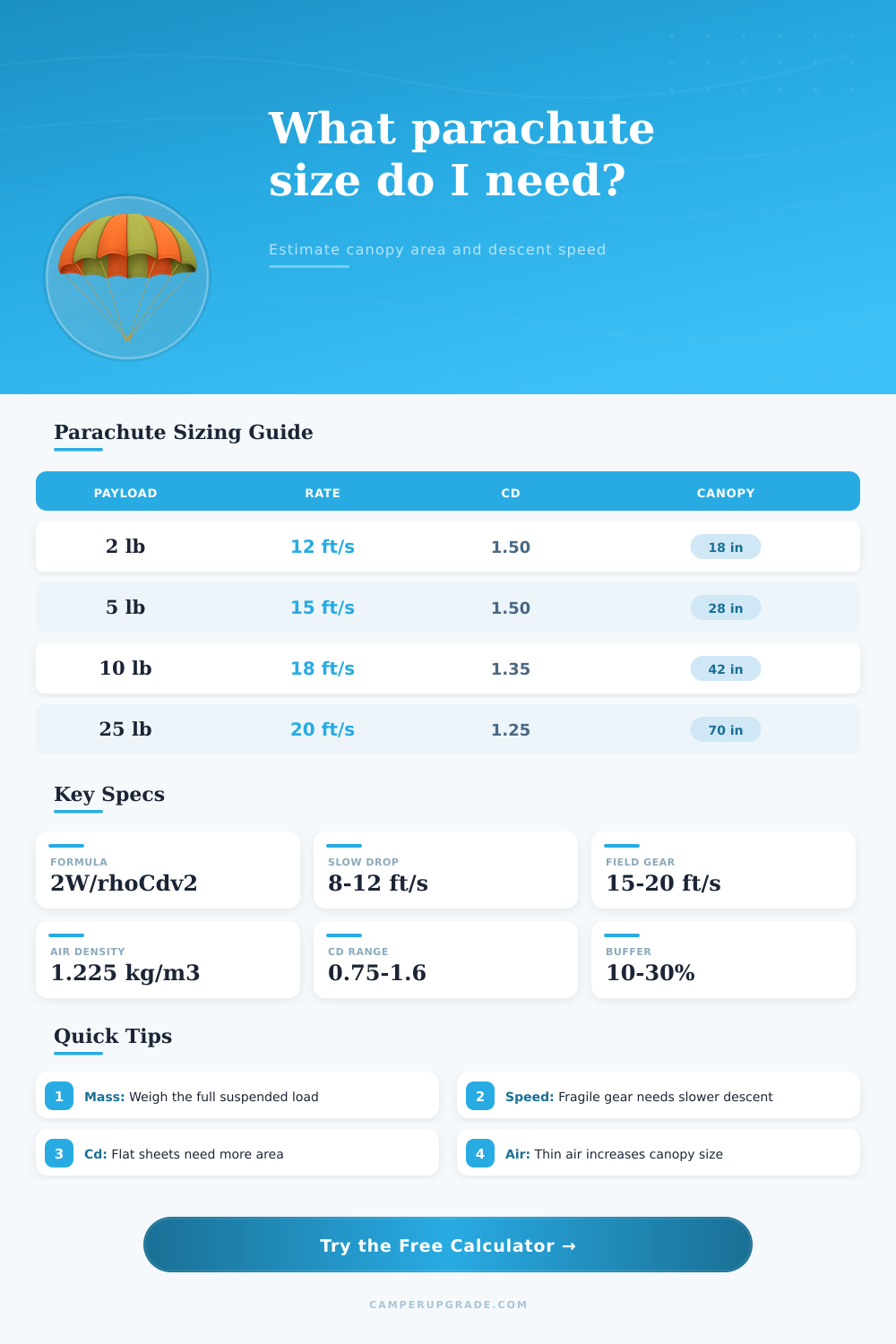
| Payload | Target rate | Cd used | Approx round size |
|---|---|---|---|
| 1 lb rocket | 12 ft/s | 1.50 | 13 in with 20% buffer. |
| 5 lb drone | 15 ft/s | 1.50 | 29 in with 20% buffer. |
| 10 lb camera rig | 14 ft/s | 1.45 | 45 in with 20% buffer. |
| 25 lb canister | 20 ft/s | 1.25 | 72 in with 20% buffer. |
| 60 lb test load | 22 ft/s | 1.35 | 103 in with 20% buffer. |
Choosing a parachute requires you to calculates the target descent rate for your payload. The target descent rate is the rate at which your payloads will descend towards the ground. You must choose a descent rate based off the type of payload that you are using.
For example, if your payload contain delicate electronics that you dont want to destroy upon landing, then your descent rate should be slow. Conversely, if your payload is rugged enough to withstand the impact of a fast descent rate, then you can use a faster descent rate. Using a parachute that is too small for your payload will result in a faster descent rate for the payload, which could lead to the destruction of your payload.
Choose the Right Parachute and Descent Rate
Using a parachute that is too large for your payload will make it difficult for you to pack the parachute. The total suspended load is the total weight that you will have to use in your calculations for the parachute. The total suspended load is the weight of the payload, as well as the weight of the rigging, the harness, and the parachute fabric.
Each of these components add to the total load of the payload and parachute system. If you do not include the weight of the rigging and harness in your total suspended load calculation, your total suspended load will be too low. If the total suspended load is too low, the parachute will not be able to slow the fall of your payload enough.
The descent rate is the speed of the payload during the fall from the payload. You should choose the descent rate for a payload according to the durability of the payload. If the payload is fragile, it is important that the descent rate is slow enough to allow the payload to land safely.
A rugged payload can withstand high descent rates. The calculator will provide a descent rate based upon the variable that you input into the calculator. This calculation will help you to avoid the calculation error that could result from performing these calculations by hand.
The calculator will calculate the descent rate for your payload under steady-state conditions. The steady state descent rate is the descent rate of the payload after the parachute has fully inflated. You must also consider the shock load of the payload, which is the load that the payload experiences during inflation of the parachute.
The shock load is often higher then the descent rate. To manage this load, you may have to use reefing or a deployment bag for your parachute. Another variable to consider is the drag coefficient.
The drag coefficient is a number that represents the amount of air resistance created by the area of the parachute canopy. The higher the drag coefficient, the higher the load that the air resistance of the parachute exerts on the payload. A higher drag coefficient mean that the payload will experience a slower descent rate.
This value is factored into the calculations that the parachute calculator makes. For instance, if you pick the style of the canopy in the calculator, the calculator will automatically input the drag coefficient into the calculations. The third variable that affects the descent rate is air density.
Air density is the number of air molecule within a given volume of the air. Air density decreases at higher altitudes. Because of this, the rate at which the payload descends will be faster at higher altitudes.
This is due to the fact that less air molecules will create a drag force on the parachute. Therefore, you may need to adjust the size of the parachute according to the altitude from which the payload will fall. The calculator allows you to input the air density of the area from which you are deploying the payload.
This will allow you to calculate the size of the parachute necessary for that altitude. A safety margin must be included in your calculations for the payload. A safety margin accounts for the fact that your calculations may not be perfect and that the payload may not be packed in the perfect manner when deploying the parachute.
A common safety margin is 20% for the area of the parachute. For payloads that is fragile, however, some payload designers will incorporate a 30% safety margin. Adding a safety margin to the parachute will decrease the descent rate of the payload.
Although the safety margin for the parachute will increase the total weight of the payload and parachute system, such extra fabric can provide a safety margin in case of error in the deployment of the parachute. The parachute calculator will provide three specific outputs for you. The first output will be the canopy area, which will allow you to calculate the area of the parachute that you need for your payload.
The second output will be the equivalent round diameter or the equivalent square side length of the parachute. This will allow you to compare the size of your parachute to commercial parachutes. The third output will be the drag load, which will allow you to calculate the drag force on the suspension lines for the parachute.
In addition to the parachute calculator, you should also consider the packing volume of the payload and parachute system. The packing volume is the amount of space that your parachute will take up when packed within the payload. If the parachute that you are using has a large area, it will require a large volume in order to pack the parachute.
This large volume of the parachute may not be able to fit within the airframe of the payload. Therefore, you will have to ensure that the parachute will fit within the payload airframe. Use the pack-diameter check in the parachute calculator to ensure that the parachute will fit within the recovery compartment of the payload.
Another factor to consider is the line length and the number of lines that will attach to the payload. Shorter lines may help to reduce oscillations in the movement of the parachute, but may also make the parachute less stable when inflating the parachute. More lines may help to distribute the load of the payload across the lines, but will add to the total weight of the payload and increase the packing volume of the payload.
The target line length can be calculated according to the diameter of the parachute canopy. This suggested length of the lines can be used in the development of your payload. Finally, you should use the reference tables within the calculator.
These tables will display typical descent rates for the different types of payloads. The reference tables will also display information about the different types of canopies and how each type of canopy will impact the descent of the payload. These tables can help you to ensure that the calculations that you have created are within normal limits.
Use the reference tables in conjunction with your parachute calculator to ensure that you have created a reliable system for the descent of your payload. You should of used these tables to avoid error.