Binocular Magnification Calculator
Compare binocular power, objective size, field of view, exit pupil, relative brightness, twilight factor, apparent field, eye relief, and handheld stability for camping, hiking, birding, boating, and sky watching.
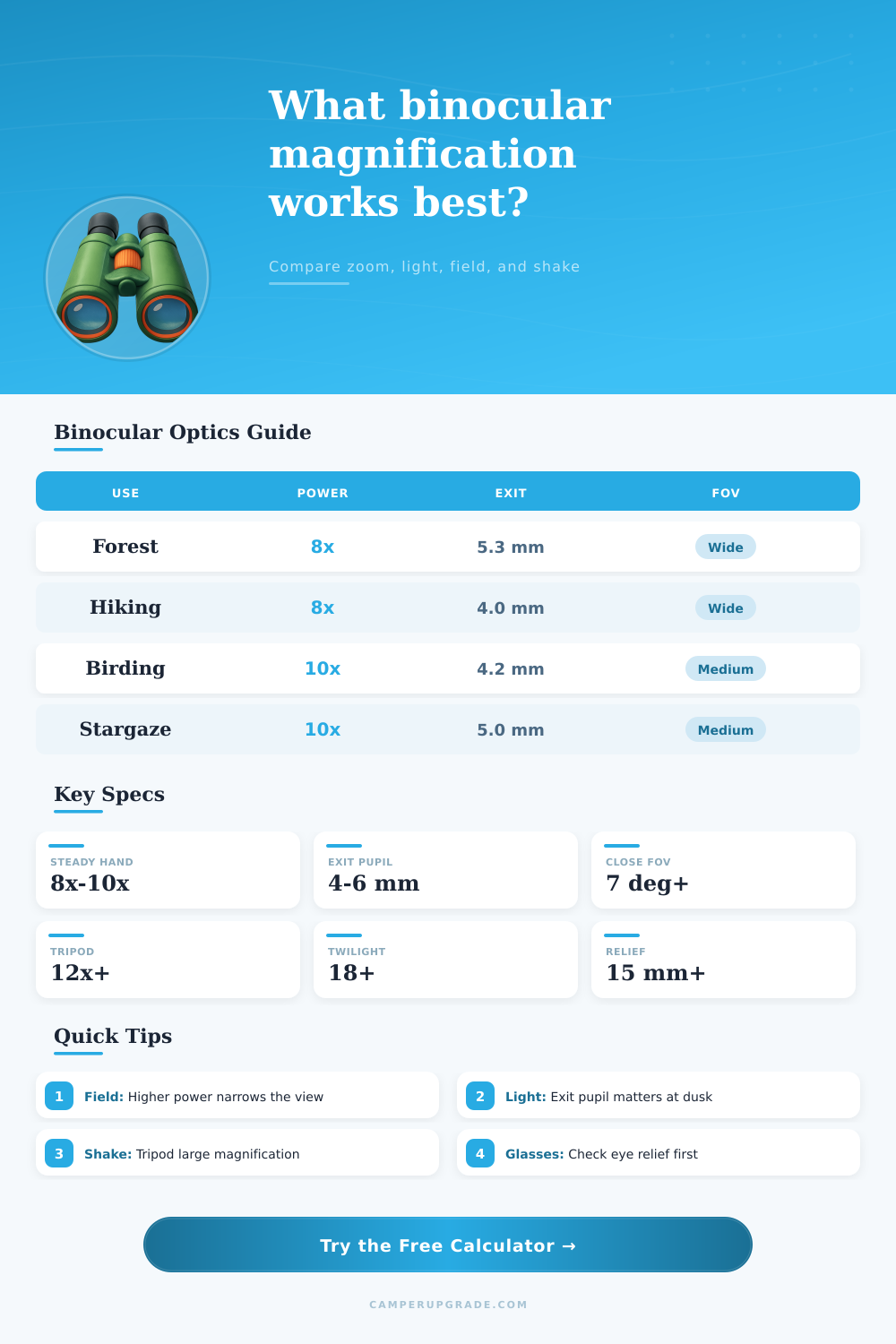
| Format | Exit pupil | Best use | Handheld note |
|---|---|---|---|
| 8x25 | 3.1 mm | Events, travel, light day hiking. | Easy to hold, but dimmer in shade. |
| 8x32 | 4.0 mm | Trail, backpacking, compact birding. | Very steady for most users. |
| 8x42 | 5.3 mm | Forest, wildlife, all-around camping. | Bright and forgiving eye placement. |
| 10x42 | 4.2 mm | Open country, shorelines, distant wildlife. | More detail, slightly more shake. |
| 10x50 | 5.0 mm | Dusk glassing and casual stars. | Manageable, but benefits from bracing. |
| Magnification | Field feel | Shake risk | Typical choice |
|---|---|---|---|
| 6x to 7x | Very wide | Low | Marine, kids, moving platforms. |
| 8x | Wide | Low | Hiking, forest birding, general use. |
| 10x | Medium | Moderate | Open terrain and more distant detail. |
| 12x | Narrower | High | Best braced or tripod mounted. |
| 15x plus | Narrow | Very high | Tripod viewing and astronomy detail. |
| Exit pupil | Brightness feel | Light condition | Planning note |
|---|---|---|---|
| 2.5 to 3.2 mm | Compact | Bright daylight | Small and light, less forgiving at dusk. |
| 3.3 to 4.2 mm | Balanced | Day and mixed shade | Good travel and hiking compromise. |
| 4.3 to 5.5 mm | Bright | Dawn, dusk, forest | Comfortable eye placement and useful dim-light view. |
| 5.6 to 7.1 mm | Very bright | Marine and night sky | Only fully used if your pupil opens that wide. |
| Over 7.1 mm | Oversized | Special use | Extra light may be wasted by the eye pupil. |
| Spec | Strong target | Watch point | Why it matters |
|---|---|---|---|
| Apparent field | 60° plus | Under 50° | Wide apparent fields feel easier for tracking. |
| Eye relief | 15 mm plus | Under 13 mm | Glasses users may lose the field edge. |
| Close focus | 6 to 8 ft | Over 15 ft | Short focus helps nearby wildlife and camp details. |
| Weight | 18 to 30 oz | Over 36 oz | Heavy binoculars fatigue hands and neck faster. |
| Tripod need | 12x plus | 10x tired hands | Support reveals detail that shake hides. |
When you purchase binoculars, you must make a decision about the level of magnification you need. The magnification of binoculars is the first number in the binocular description. Magnification makes an object appear more closer to you.
So, if the binoculars has an 8x magnification, the object will appear eight times closer to you. However, if the binoculars have a 16x magnification, the object will appear twice as close than an object viewed with 8x magnification. Higher magnification allow for closer viewing of an object but make it more difficult to view the object due to the effect of hand shake on the viewing.
How to Choose the Right Binoculars
The higher the magnification of the binoculars, the more shake will affect the viewing. People who purchase binoculars often choose 8x or 10x magnifications because these is considered to provide the best view of an object while minimizing the negative effect of shake on the viewing experience. The second number in the description of binoculars is the objective lens diameter.
The objective lens diameter is the lens that determine how much light the binoculars will gather. The larger the lens diameter, the more light the binoculars will gather. A 50 mm lens will gather more light than a 32 mm lens.
However, the larger the objective lens, the more the binoculars will weigh. Therefore, while a large lens diameter will allow for better viewing in the dawn or in the forest canopy, where there is less light, the extra weight of the binoculars may prevent someone who plan on having to carry the binoculars for long distance from purchasing them. The field of view for binoculars is the width of the viewing experience through the binoculars.
For a binocular with higher magnification, the field of view will be narrower. High magnifications will allow viewers to examine the distance between objects. However, a narrow field of view makes it more difficult to follow a moving subject.
Conversely, a wide field of view will make it easier for the viewer to find a moving subject within their viewing range and to find the subject again after they have looked away from the binoculars. Exit pupil is the circle of light that will exit the binocular and enter the viewer’s eye. The viewer calculates the exit pupil by dividing the objective lens diameter by the magnification.
For the viewer’s eyes, the exit pupil should be the same size as the pupil of the viewer’s eye. In bright light, the pupils of the viewer’s eyes will be small so a large exit pupil is not necessary. However, the pupils of the eyes become larger in dim light so that more light enter the eye.
In this case, the larger the exit pupil, the more useful the binoculars will be in dim light. Therefore, if the exit pupil of the binoculars does not match with the size of the viewers pupils for the different light levels, the binoculars will not be as bright as they should appear to the viewer. Eye relief is the distance between the eyepiece of the binoculars and the viewer’s eyes.
This distance is especially important for individuals who wear glasses. Individuals who wear glasses must have a certain distance between the viewer’s eyes and the eyepiece in order to view the full field of view of the binoculars. If this distance is too short for individuals who wear glasses, those individuals will have to either press the binoculars against their face or remove their glasses in order to view through the binoculars.
Many people want at least a 15 mm eye relief for comfort in wearing the binoculars. A 15 mm eye relief will allow viewers who wear glasses to view through the binoculars comfortabley. Handheld stability depends on the weight of the binoculars and the viewing platform.
High magnification binoculars require more stability when viewing an object. This is because it is more difficult for an individual to hold the binoculars steady while viewing due to the higher magnification. If the viewer’s platform is moving, such as if they are viewing from a moving boat, the binoculars will be harder to hold steady than if they are viewing from a stable platform.
However, stability in viewing will allow the viewer to focus on the object being viewed and prevent the shaking of the image that is being viewed. Close focus distance is the distance at which the binoculars will clearly focus the object. Some binoculars allow viewers to focus on objects that are close to the viewer’s eyes.
Other binoculars will require viewers to stand or sit at a further distance from the object they want to view. Shorter close focus distances are more versatile with the viewer’s viewing experience. Shorter close focus distances will allow viewers to focus on nearby objects.
The weight of the binoculars is one factor to consider when purchasing binoculars. The heavier the binoculars, the less often the viewer will have to carry them. If an individual chooses heavy binoculars, they may avoid having to transport the binoculars to certain locations so as to avoid discomfort in their arms.
Conversely, if the binoculars are lighter in weight, the individual will be more likely to transport and see them throughout the day. Therefore, the weight of the binoculars should of been considered along with the type of activity that the viewer would like to perform when using the binoculars. You’ll find that magnifications is very important based off of how you use them.
Its a moddern way to look at it. Actually, choosing the right one is alot more easy than it seems.